Circumcision
Acts of the ApostlesCircumcision in Acts is not treated as a single, universally applied test of religious belonging. The controversy over requiring it of Gentiles becomes a decisive question for the expanding community of the Realm, and the resolution distinguishes Gentile entry from Jewish observance: Gentiles need not convert fully to Judaism, while Jewish believers remain free to honor Torah. Paul’s later decision to circumcise Timothy makes that distinction concrete in missionary practice.
The Controversy over Gentile Inclusion
Some believers from Judea arrive in Antioch asserting that Gentiles must be circumcised to be saved. In their view, without circumcision Gentiles cannot belong to the community in the present or be included in the Realm after the apocalypse. The dispute therefore concerns more than a bodily practice: it asks whether Gentiles must first be fully initiated into Judaism in order to participate in the community.
Paul and Barnabas debate the visitors, but the church in Antioch does not leave the question to the two missionaries to settle by themselves. It appoints a delegation to consult the apostles and elders in Jerusalem. The book presents this referral as a consequential exercise of communal discernment and apostolic authority, appropriate to a decision affecting the future of the Gentile mission.
The Council’s Deliberation and Decision
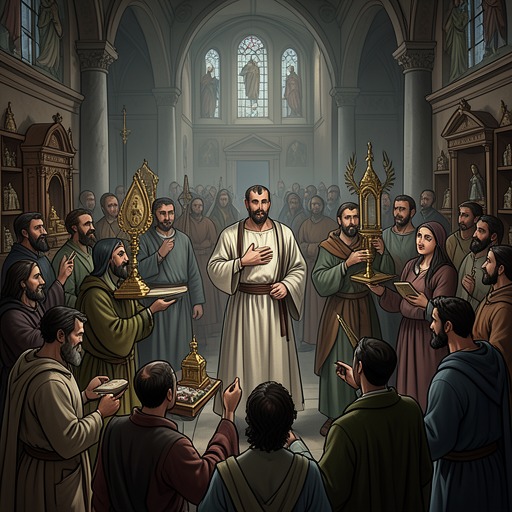
The Jerusalem congregation welcomes the delegation. After Paul and Barnabas report on the work among Gentiles, some Christian Pharisees restate the position that Gentiles must be circumcised and follow Torah. Their presence matters: the disagreement occurs within the movement, among people committed to the faith, rather than simply between the church and outsiders. The account also leaves Jewish practice intact; it gives no indication that Jewish believers in Antioch have stopped honoring Torah.
The council engages in much debate, described as direct conversation among believers. The issue is how to interpret Torah faithfully in relation to Gentiles in light of the perceived nearness of the apocalypse. The resulting decision does not require Gentiles to undergo circumcision as a condition of joining the community. The Pharisees who had argued for circumcision appear satisfied with the council’s eventual outcome. Circumcision thus marks a distinction in the decision: the inclusion of Gentiles does not depend on their full conversion to Judaism, and the decision does not abolish Jewish observance.
Timothy and the Practice of Mission
After the council, Paul adds Timothy to the mission team. Timothy has a Jewish mother and a Greek father, and Paul circumcises him so that he will not cause offense among Jewish people. This action does not reverse the council’s ruling or establish circumcision as a requirement for Gentile believers. Instead, it shows Paul making a particular choice about a member of a mission team in a context where Jewish customs remain valid and deserve respect.
The contrast between the council’s decision and Timothy’s circumcision is central to the rule’s treatment in Acts. The council answers whether Gentiles must be circumcised to belong; Timothy’s case concerns how a missionary team can avoid making Jewish practice an unnecessary point of offense. The book accordingly presents Gentile freedom from the requirement alongside respect for those who practice circumcision. The policy on Gentile inclusion is not a declaration that Jewish customs have lost their standing.
Significance for the Community
Circumcision becomes a test of whether the community can extend belonging without demanding that Gentiles become Jews, while also refusing to treat Jewish practice with contempt. The decision is reached through debate, reports from mission, and consultation with leaders in Jerusalem, rather than by Paul and Barnabas acting alone. Its process reflects the importance of shared judgment when a dispute bears on the movement’s future.
The later account of Timothy shows that the decision is not a simple rule against circumcision. Its scope is specific: circumcision is not imposed on Gentiles as a condition of salvation and communal inclusion, but Jewish customs continue to be treated as legitimate. Acts holds these points together, presenting a growing mission that welcomes Gentiles without requiring them to adopt every Jewish practice, and that expects Gentiles and missionaries to respect Jewish ways.