Common sharing and the ideal community
Acts of the ApostlesCommon sharing and the ideal community describe an economic practice and a vision of belonging in Luke-Acts: people loosen their grip on wealth and rely on a community shaped by trust in God, mutual provision, and inclusion in the Realm. The ideal is tested not by knowledge or respectability alone, but by whether people release old-age attachments and put resources at the service of others.
The Ideal and Its Contrast
In Luke 18, a wealthy Jewish ruler asks what he must do to inherit eternal life, a phrase the commentary reads as a cipher for the Realm. He is faithful in many respects and knowledgeable about Torah, so the reader may expect him to accept Jesus’ demand to sell what he owns, distribute the proceeds to the poor, and live from the community’s shared bounty. Instead, his attachment to wealth holds him within the old age. The contrast makes common sharing more than a charitable gesture: it is a concrete break with the values and securities that keep a person from entering the Realm’s communal life.
Acts 10:44–48 supplies the foil. Gentiles receive the Holy Spirit and baptism, gaining assurance that they too belong to the Realm and have eternal life. Rather than going away sorrowful, they speak in tongues and extol God. The commentary sets their response against the ruler’s refusal: they relinquish attachment to the old age and receive the community he sought but would not join. Their inclusion also makes the pattern a question of relations between Jewish and Gentile believers, not simply of individual generosity. The Gentile experience is the same in its reception of the Spirit, while the Jewish experience remains originative; Gentiles are consequently called to live respectfully with Jewish people in the community.
Sharing Across Communities
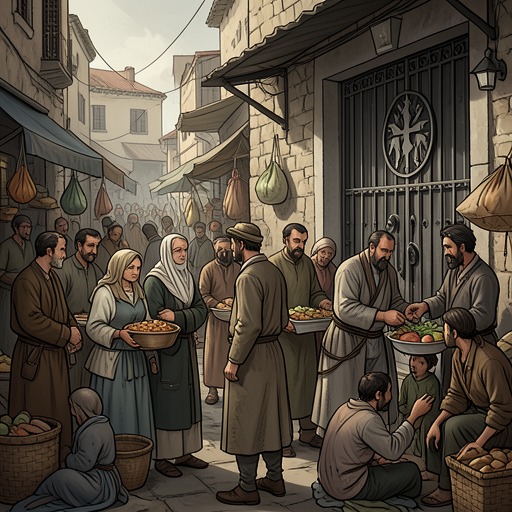
The ideal becomes material in the response of the Gentile disciples in Antioch to Agabus’s report of a severe famine during the reign of Claudius. They send relief to believers in Jerusalem. Their offering enacts the shared provision associated with the ideal community: resources move across the boundary between Gentile donors and the Jerusalem church, and God uses the Gentiles to provide for the church there. The gift therefore signifies the reunion of Jewish and Gentile peoples as well as meeting need.
The offering also points beyond immediate relief. The commentary reads it as a present moment anticipating Isaiah’s vision of an eschatological world in which Gentiles place their resources in the service of the God of Israel. On this account, common sharing joins practical action to expectation: aid answers a concrete crisis while prefiguring a world ordered by mutual support and provision. Contemporary relief offerings can be understood in the same terms—not only as charity, but as practical solidarity and anticipation of that future.
Trust, Anxiety, and Providence
A related contrast appears in the reading of Luke 12:13–34 alongside Acts 16:35–40. Jesus warns against trusting the old age’s values, represented by a barn builder who relies on riches. The alternative is trust that God will sustain the community on its way to the Realm, as God provides for ravens, lilies, and grass. Common life thus depends not only on distributing wealth but also on refusing to make accumulation the foundation of security.
Paul and Silas embody that trust under pressure. When magistrates propose releasing them secretly, the two invoke their Roman citizenship and insist on a public release. The commentary treats this legal status as an unexpected instrument of divine providence: trust in God does not mean that practical protections cannot serve the community’s witness. The parallel also brings anxiety into view. Witness to the Realm can raise fears about what may happen, while the story of Paul and Silas presents provision arriving through a means that might not have been expected.
A Measure of Discipleship
Together, these contrasts make the ideal community a measure of response rather than a description of a flawless institution. The wealthy ruler’s scriptural knowledge and responsible conduct do not prevent his discipleship from stopping short when it comes to wealth. The Gentiles’ reception of the Spirit, their praise, and the Antioch offering show belonging taking visible form in worship, solidarity, and the transfer of resources to Jerusalem.
The commentary invites congregations to examine where they stand between these responses: whether they resemble people who know the tradition but remain attached to the securities of the old age, or a Spirit-led community ready to share. Relief giving becomes one contemporary test of that question. Its significance lies not only in what it supplies, but in the relationships it enacts and the future it anticipates.