Community That Rejects Social Hierarchy
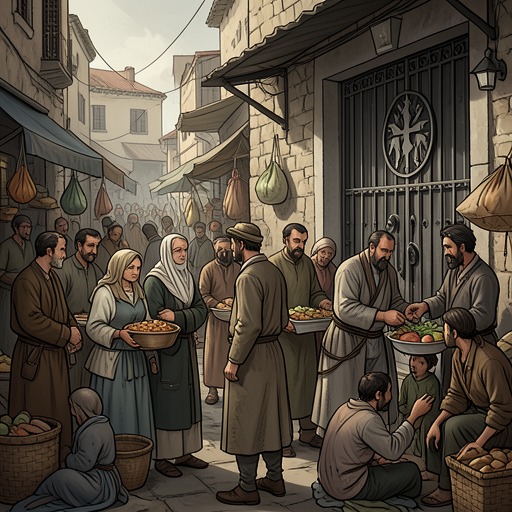
Acts of the ApostlesCommunity That Rejects Social Hierarchy is Luke’s vision of a community in which social rank does not decide who may receive the Realm or take part in its life. Its challenge to hierarchy appears in scenes of welcome and shared belonging, but also in conflicts over the standing of gentiles and in the unequal power structures the narrative does not entirely erase.
A communal identity
In Acts, identity is more communal than individualistic: participants in the movement toward the Realm belong together in identity, mutual support, and mission. The individual is not complete apart from active involvement in the whole, while each person represents the community. This account contests the idea that personal achievement, even at others’ expense, is the proper measure of a life.
The vision nevertheless remains incomplete. Luke includes both men and women in the community, and the passage points toward restored mutuality between them, but the apostles are all men and retain the principal leadership roles. Inclusion is a real feature of the community, not proof that its social relations have become fully egalitarian.
Welcome across social boundaries
Jesus’ welcome of children offers a model for receiving those treated as insignificant. In the ancient Mediterranean social hierarchy, children stood near the bottom; in the episode they represent people without the power to bring about the Realm, who can only receive it as a gift. Luke carries this pattern into the gentile mission: as God, through the Holy Spirit, welcomes gentile believers, the community is called to welcome them too.
That welcome crosses a boundary between related communities, not a simple divide between strangers. Samaritans shared beliefs and practices with Jewish people while developing their own culture; their worship centered on their version of the Pentateuch and Mount Gerizim, and they maintained their own priesthood and observances. Luke places Samaria between the predominantly Jewish settings of Jerusalem and Judea and the “ends of the earth.” The disciples’ entry into Samaritan territory therefore extends the witness outward without reducing Samaritan identity to a mere obstacle.
Rank, access, and conflict
The social pyramid is especially visible at the banquet. In the conventional arrangement, guests were seated according to rank, with the best places reserved for the highest standing. Luke’s image of the eschatological banquet overturns that ordering: the community seeks those who would ordinarily be left out, represented by people who are poor or cannot walk or see. Gentiles likewise occupy the position of people initially unwelcome at the banquet; extending the invitation to them becomes a test of faithfulness to the Realm.
This expansion produces conflict inside the community. When Peter returns to Jerusalem, some Jewish members criticize him for eating with gentiles. The meal is the immediate complaint, but the deeper dispute concerns whether gentiles must fully enter Judaism to belong. The disagreement is not adequately described as a contest between oppressive Judaism and liberating Christianity: Luke presents the church as growing from Israel’s story, and the mission to gentiles as part of God’s intention to bless all peoples. At the same time, Luke’s account can caricature Jewish people who reject that mission, a tension that requires care rather than a simple contrast between Judaism and the church.
Status challenged, not erased
Luke’s scenes also show how strongly public standing shapes access to power. In the arrest of Peter and John, the council’s social and political prestige contrasts with the apostles’ lower status. Their hearing follows Jewish legal protocol: they are held until the next day, when they can be examined in daylight. The contrast exposes a hierarchy of authority even as the apostles’ witness places that authority under scrutiny.
Lydia’s story presents a different crossing of status and gender. In Philippi, the witnesses meet her at a place of prayer by the river on the sabbath. She is a gentile seller of purple cloth, an expensive commodity associated with wealth, and the head of her household. Through baptism, she and the household she leads join the community. Her independent household leadership makes visible a place for women who act without reference to a man, while her means show that wealth need not bar wholehearted participation. The account thus widens belonging without suggesting that social rank has ceased to matter: the community’s task is to redirect status and resources toward shared life and mission.