Corinth
Acts of the ApostlesCorinth, about fifty miles west of Athens, becomes a decisive setting in the account of Paul’s second missionary journey. Its episodes bring together Jewish refugees, a gentile host, a synagogue official, and a Roman proconsul, while testing whether Paul should persist amid hostility or turn elsewhere. The city’s story is not a simple progression from rejection to a gentile mission: Jewish people join the movement, and the Roman official’s intervention protects Paul by treating the dispute as an internal Jewish matter.
Setting and Arrival
The journey through this part of Acts moves among sharply different experiences: uproar in Thessalonica, welcome in Beroea, philosophical dialogue in Athens, disputes over legal jurisdiction in Corinth, and finally a return to Antioch. Corinth is the western destination after Athens, approximately fifty miles away. The city’s place in this sequence makes it one more setting where the travelers’ witness meets local conditions rather than unfolding in a uniform way.
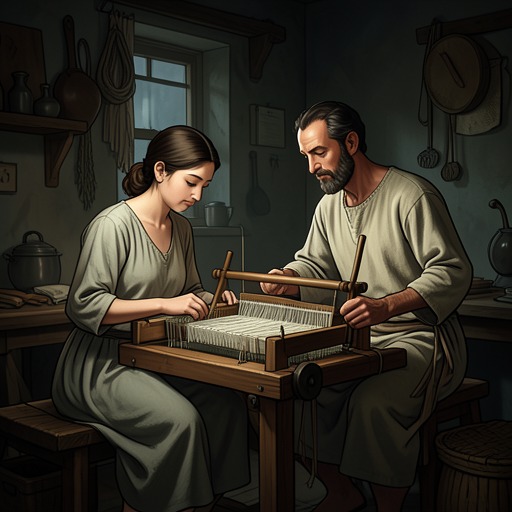
Paul arrives with Priscilla and Aquila, Jewish refugees who had left Rome after Emperor Claudius evicted the Jewish population, probably in 49 CE. Their presence gives Corinth’s story a political background beyond the immediate preaching disputes. The expulsion makes the Jewish people visible as a community subject to Roman prejudice and persecution; it also lends the narrative’s later movement toward Rome an added note of anxiety. Paul’s companions therefore connect the local work in Corinth to a wider history of displacement and imperial power.
Paul’s stay also unfolds in company with Silas and Timothy. As in several earlier cities on the second journey, he begins his witness in the synagogue. The narrative presents Corinth not as an isolated mission outpost but as one station in a route whose gains and setbacks are cumulative, with companions and local residents shaping what can happen there.
Conflict, Welcome, and a Change of Venue
Some Jewish hearers revile Paul’s preaching. In protest, he shakes the dust from his clothes and declares them responsible for the consequences of rejecting the message. The gesture marks a rupture in the encounter, and Paul turns toward gentiles. The account treats this as a charged decision: resources are limited, opposition is intense, and the anticipated end gives urgency to the work. It also leaves a tension in view, because Paul’s declaration that he is turning to gentiles does not prove to be the last word on his engagement with Jewish people.
After leaving the synagogue, Paul goes next door to the house of Titius Justus, a gentile who worships God but has not converted to Judaism. The move changes the immediate setting of the witness without removing the synagogue from the story. Crispus, the synagogue official, believes and is baptized with his household; many additional Corinthians also come forward. His response directly complicates any account of the episode as a clean break between Jewish rejection and gentile welcome: synagogue leadership itself is among those joining the movement.
The house next door becomes a concrete sign of the story’s changing pattern. Paul’s public break with opponents does not close the possibility of Jewish participation, and the gentile host’s house provides a nearby place where a mixed response can gather. Corinth thus holds conflict and welcome in close physical and narrative proximity.
The Vision and Paul’s Extended Stay
Jesus appears to Paul in a vision and directs him not to be afraid but to continue speaking. The assurance is not merely that Paul has spiritual support: Jesus tells him that many people in Corinth belong to him. The promise answers the danger and uncertainty of the local mission with a reason to stay, rather than an instruction to withdraw.
Paul remains in Corinth for eighteen months, a duration the account presents as evidence of his confidence in that assurance. His long stay gives the vision practical consequence: it sustains continued witness in a setting where opposition has already surfaced. The episode also makes endurance a matter of discernment. The narrative offers a clear promise to Paul, while leaving later readers to consider how a community might know when persistence is warranted and when circumstances call for moving on.
Jurisdiction and the End of the Journey
Some Jewish people bring a charge against Paul before Gallio, the proconsul of Achaia, the region around Corinth. They claim that Paul is persuading Jewish people to worship in ways unauthorized by Torah. Before Paul can answer, Gallio rules that the dispute does not concern matters of interest to Rome. He treats it as an internal Jewish question for the Jewish people to settle among themselves.
Gallio’s ruling makes Roman authority an unexpected protection for Paul. The official does not decide the religious dispute on its merits; instead, he draws a boundary around the state’s jurisdiction. That response gives the episode its legal force and its ambiguity: an agent of imperial government helps preserve the space in which Paul can continue his witness, even though the charge itself arises within a Jewish communal setting.
The second missionary journey concludes with Paul returning to Antioch. As he leaves, he cuts his hair in connection with a Nazirite vow, a special consecration to God. The vow indicates that Paul continues to practice Judaism and rededicates himself to the mission. The detail resists the idea that the journey’s conflicts have simply carried him away from his Jewish commitments; Corinth’s story of departure and dispute ends within an ongoing practice of religious dedication.
Narrative Significance
Corinth gathers the journey’s contrasts into one sustained episode: hostility and welcome, a turn toward gentiles and the baptism of a synagogue official, danger and an eighteen-month stay, religious accusation and a Roman official’s decision to limit the state’s role. The location matters because these developments occur side by side, without resolving into a simple opposition between Judaism and the gentile mission.
The city also shows how the mission is shaped by more than Paul’s preaching alone. Refugees accompany him, Titius Justus provides a nearby household setting, Crispus and his household join, and Gallio’s jurisdictional decision changes the immediate consequences of the accusation. In the account of the journey, Corinth is therefore a place where relationships, hospitality, religious belonging, and public authority all affect the possibility of continued witness.