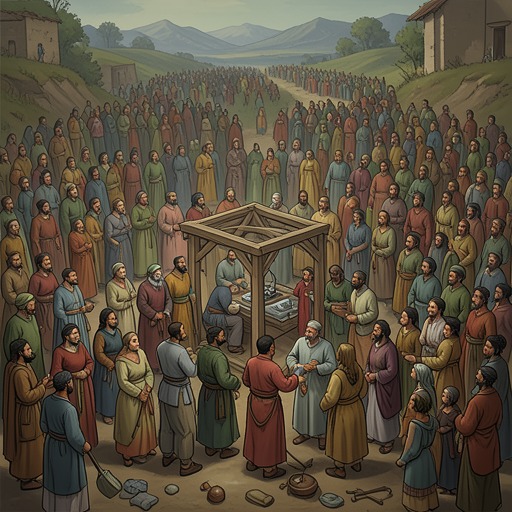
Cornelius
Acts of the ApostlesCornelius is a Gentile Roman centurion whose welcome into the community of the Realm marks a decisive opening in Acts: the Gentile mission is shown not as a departure from Israel’s story but as a movement God is leading. Through paired visions, Cornelius and Peter are brought together; Peter visits Cornelius, and the episode makes the first embrace in a wider reunion among God, Gentiles, and the Jewish community.
Identity and Place in Acts
Cornelius is the first Gentile in Acts to enter the community through conversion. He is a centurion, an officer in charge of one hundred Roman soldiers, and a God-fearer: a Gentile attracted to the God of Israel who has not fully converted to Judaism. He prays and gives alms. These details locate him at a boundary without making him a stranger to Jewish religious life. He is neither presented as an idol-worshipping adversary nor as already Jewish; his story concerns the opening of the community to someone who stands between those categories.
His position also gives the encounter public and institutional weight. Peter is a leader among the apostles, while Cornelius’s military office places him within the Roman order. Luke’s account does not treat his rank as the reason he is welcomed: Cornelius’s importance lies in what his inclusion reveals about the scope and divine direction of the mission. The narrative uses Peter’s apostolic standing to assure its readers that the new development is not an unauthorized private initiative.
The Double Vision and Peter’s Visit
The encounter is structured by a double vision: Cornelius and Peter each receive an individual vision, and the two experiences draw them toward a common purpose. The paired visions do more than bring the men into the same scene. They function as narrative confirmation that God is present and leading the events, so that Cornelius’s reception cannot be reduced to Peter’s personal preference or an accidental meeting.
In Cornelius’s vision, an angel tells him to send for Peter, also called Simon, from Joppa. Peter’s vision takes a different form: he sees a gathering of animals, including some classed as unclean, and hears an instruction to kill and eat. He protests that he has never eaten anything profane or unclean. The voice repeats the instruction three times, a pattern ancient writers could use to signal that a matter is important and reliable. The vision’s imagery makes the boundary between clean and unclean central to the encounter, but the account’s significance is not that Jewish practice was simply a repressive legalism. Such distinctions had helped sustain a distinct witnessing community; the story instead places them in the context of a new end-time movement.
The Spirit then directs Peter toward the messengers sent by Cornelius. Peter follows them to Cornelius’s house, where he joins a group gathered there. In explaining his presence, Peter says that it is unlawful for a Jewish person to associate with Gentiles. The book’s commentary cautions that this is an overstatement: Jewish and Gentile people associated in everyday life, although shared meals could present complications. The dramatic phrasing intensifies the perceived boundary so the narrative can stress the importance of crossing it. Cornelius asks Peter to interpret what has happened, making the visitor’s understanding of the encounter a central part of the scene.
Authority, Interpretation, and Inclusion
Luke uses Peter’s role to establish the mission’s authorization. Full apostolic sanction for the Gentile mission does not arrive until the Jerusalem council, but here Peter supplies an earlier form of apostolic authority: he is the leader through whom Cornelius is led toward the Realm, the participant who presides over the coming of the eschatological Spirit among Gentiles, and the interpreter who later explains the mission to the congregation in Jerusalem. The account therefore joins a new development to the existing apostolic community rather than casting it as a rival undertaking.
Peter’s interpretation begins with the principle that God shows no partiality. The passage also retains its qualification: in every nation, anyone who fears God and does what is right is acceptable to God. The account does not present inclusion as indifference to conduct or as a simple erasure of difference. Cornelius is welcomed within a story that remains rooted in the God of Israel, and the good news reaching Gentile members of the community is shown to have Jewish origins. At the same time, Jewish members are reminded that the Gentile mission comes from God.
Cornelius’s entry has consequences beyond his own household. Luke presents it as assurance that God is drawing the present age to its close and gathering Gentiles and the Jewish community into a great reunion. Gentiles must repent and be baptized; the boundary markers that had sustained Judaism in the old age are no longer required in their full form for this end-time community. The later council’s instructions for faithful Gentile life draw on the same categories. Cornelius’s story thus marks a change in the conditions of belonging without depicting that change as a rejection of Israel’s tradition.
Narrative Significance and Legacy
Cornelius’s encounter is more than a story about an individual’s reception. It is Luke’s narrative assurance that the expansion of the community is God-led, with Peter’s participation connecting the Gentile mission to apostolic authority. The paired visions establish direction before the two men meet; Peter’s visit makes the boundary crossing visible; Cornelius’s request for interpretation gives that crossing a theological question to answer. The sequence turns a private religious experience into a matter for the whole community.
The account also resists a tidy opposition between Jewish and Gentile cultures. Jews and Gentiles often lived alongside one another, and the book warns against portraying them as wholly separate or assuming that Jews simply hated Gentiles. Luke does associate idolatry with disorder, injustice, exploitation, violence, and death, yet Cornelius is described as a God-fearer who prays and gives alms. His story therefore does not equate Gentile identity with those evils. It depicts a Gentile already drawn toward the God of Israel and shows the community being called to recognize what God is doing.
For the book’s Gentile readers, the episode becomes a spiritual autobiography: their place in the community is traced to the God of Israel and to a mission opened through this encounter. The church’s continuing mission to Gentiles follows the pattern associated with Peter’s visit to Cornelius: discerning how the renewing word of the Realm may meet settings shaped by practices and systems that produce injustice, exploitation, violence, and death. Cornelius’s arrival is consequently both a first inclusion and a model for understanding an ongoing mission.