Deaths of Ananias and Sapphira
Acts of the ApostlesThe deaths of Ananias and Sapphira form the dark counterpoint to the early community’s sharing of possessions: the couple sells property, gives only part of the proceeds to the common treasury, and dies after separately lying about what they contributed. In the interpretation offered here, the episode is not merely a punishment story about two individuals. It exposes the moral and communal stakes of economic solidarity: resources are meant to sustain a community in which no one is anxious about survival, while deception and hoarding corrode the trust that makes such a community possible.
The Community and Its Economy
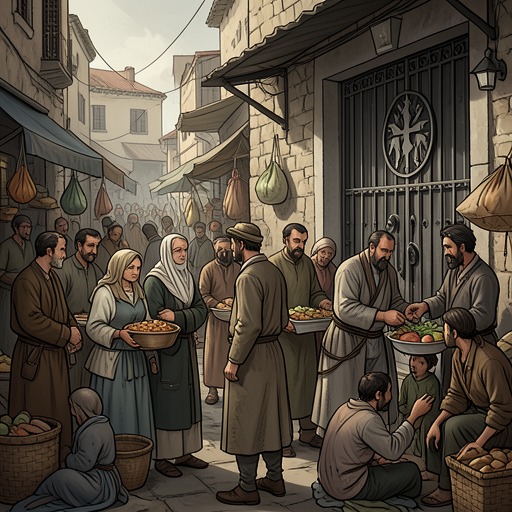
Luke places the deaths against an idealized account of the believers as being of one heart and soul. They regard their possessions as common resources, and the community’s material life is directed toward ensuring that no one is in need. The description may imply that members sold possessions and placed the proceeds in a common treasury, though some scholars understand it as a practice of retaining private ownership while selling goods as needs arose. In either reading, the decisive point is that possessions serve the community rather than private advantage.
This sharing is presented as more than individual charity. It is economic solidarity: a practical form of mutual support that anticipates the material abundance associated with the Realm of God. Luke’s account treats material provision as both concrete and symbolic. Shared resources relieve anxiety about survival, and willingness to share signals a person’s response to the values of the Realm. The episode of Ananias and Sapphira therefore stands within a larger contrast between an old-age mentality, in which goods are used for self-serving purposes, and a community oriented toward the new age, in which material resources sustain others.
That contrast also explains why the story carries consequences beyond the couple’s private decision. A community built on shared provision depends on confidence that members will deal honestly with one another. The couple’s act strikes at both the distribution of resources and the relationships that make common life possible.
The Sale and the Deception
Ananias and Sapphira sell a piece of property. They put some of the proceeds into the common treasury but keep a bundle for private use, while acting as if they have committed the full sale price to the community. The evidence describes this not as an openly stated decision to reserve part of the money, but as a deception: they give the appearance of complete sharing while withholding some of what they have received.
The account makes their dishonesty central to the meaning of the act. Luke says that Satan has filled their hearts, marking their behavior as aligned with the values of the old age rather than with the community’s trust in God’s provision. The interpretation offered here connects that failure of trust to the couple’s refusal to place all their resources at the community’s service. Their action is thus both financial withholding and a false representation of their relationship to the common life.
The episode gains force from its place beside examples of faithful giving. Joseph, a Levite from Cyprus whom the apostles name Barnabas, sells a field and puts the proceeds into the treasury; his contribution embodies encouragement through economic solidarity. Luke’s wider account also recalls the widow who gives her last financial resource to the Temple, trusting that provision for the poor will sustain her. Against these examples, Ananias and Sapphira represent a different use of possessions: they retain part for themselves while presenting their conduct as full participation.
Peter’s Confrontation and the Deaths
Peter first confronts Ananias with a direct indictment. Ananias immediately falls dead. Peter then gives Sapphira an opportunity to tell the truth. She does not know that her spouse has died; she also lies, and is immediately struck. The sequence makes the couple’s deaths follow their separate encounters with Peter and their repeated deception.
The severity of the outcome creates a difficult theological question for readers and preachers: does God straightforwardly put people to death for lying, misusing funds, or violating the common good? The evidence does not resolve that question by supplying a different mechanism or a mitigating explanation. Instead, it identifies the story as a cautionary tale and directs attention to its warning about the consequences of dishonest economic relations.
The deaths are the episode’s stark reversal: what appears to be an act of contribution is exposed as a performance concealing withheld resources, and the couple’s claim to stand within the shared life ends in death. Luke’s contrast with the faithful widow is especially sharp. She gives sacrificially in trust that God will provide through the community’s care for the poor; Ananias and Sapphira retain part of their proceeds and misrepresent what they have given. The contrast asks readers to consider which model of the use of material resources they would choose to follow.
Consequences and Continuing Significance
The episode’s warning extends from the couple to the conditions required for communal life. Dishonesty creates distrustful relationships; failure to share undermines genuine community. In the interpretation presented here, the couple cannot survive in a setting whose common life depends on honesty and mutual provision. Possessions are therefore not treated as a morally neutral private matter: how they are used can affect whether people are able to live together in trust and security.
The same logic is extended to groups and nations. When communities engage in deceit and hoard resources, they foster climates of suspicion and hostility that can contribute to their downfall. The story’s concern is thus not exhausted by the deaths of two people or by an individual test of generosity. It makes the use of possessions a matter of collective life and death, connecting financial conduct to the durability of relationships and institutions.
For contemporary interpretation, the passage presses beyond a charity model in which individuals occasionally contribute to the needs of the poor. Its challenge is to enter economic solidarity and to confront structures that reinforce poverty and widen the gap between wealthy and poor. Luke’s pattern is to present a vivid picture of a community anticipating the Realm and then give that vision a particular human example. Read in that frame, the deaths of Ananias and Sapphira expose the opposite pattern: a community’s ideal of shared provision cannot be sustained by appearances alone. Its material practices, and the trust those practices create or destroy, are integral to its common life.