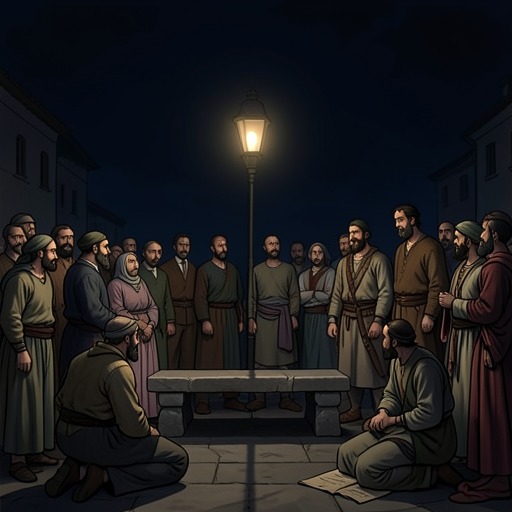
Healing at the Beautiful Gate
Acts of the ApostlesThe Healing at the Beautiful Gate is both a bodily restoration and a public sign of the Realm: on their way to prayer, Peter and John encounter a person unable to walk, and Peter heals him in the name of Jesus. In the account’s interpretation, the scene moves beyond alms as a means of surviving the old age and gives Peter an occasion to explain how the healing points to God’s work of restoration. The event thus joins an unplanned encounter, a miracle, and public witness in one sequence.
Setting and Encounter
Peter and John pass through the Beautiful Gate on their way to pray at the customary hour of 3:00 p.m. The gate is identified as probably the bronze Nicanor Gate in the Jerusalem Temple. The episode begins not with a planned healing mission but with two people following an ordinary religious routine and meeting someone in need along the way.
The commentary cautions against defining the person solely as a “crippled beggar.” He is a person unable to walk who makes his income by asking for alms; those circumstances describe his situation and means of support, not the whole of his identity. This distinction matters to the account’s framing: the encounter is with a person, not merely a condition or a narrative device.
Peter and John have not set out to heal anyone. They meet the person on their way, and the commentary draws attention to that contingency: the opportunity for healing arises on an everyday path rather than through a prearranged undertaking. The scene’s movement begins with an ordinary journey and a request for help, then opens into an act neither apostle had planned.
From Alms to Restoration
The person asks for alms. Such assistance can help him survive, but the commentary describes alms as a survival tactic in the old age: they enable endurance without changing the circumstances that make survival precarious. Peter’s response goes beyond the request for money. He heals the person, and the contrast between alms and healing gives the action its particular significance in the account.
The healing is not treated simply as an isolated display of power. In Luke-Acts, miracles make visible, on a small scale, the restoration associated with the Realm. Here, the person’s changed bodily circumstances embody that larger claim. The event presents the Realm not as an abstraction alone but as God’s work becoming perceptible in an encounter at the temple gate.
The commentary places the episode within the parallel between the ministry of Jesus and that of the church. In the power of the Spirit, Jesus announced the coming of the Realm, taught its implications, revealed its presence through miracles, and confronted the rulers of the old age. In Acts, the church carries out a similar ministry. Peter and John therefore do not appear as independent sources of healing: they serve as instruments through whom God heals, and the event presents the church’s work as continuous with Jesus’ Spirit-empowered ministry.
Peter’s Interpretation and Public Witness
The healing does not end with the change in the person’s circumstances. Acts 3:11–26 presents Peter interpreting its meaning. The occurrence gathers the attention of people nearby, and Peter addresses them in the setting of Solomon’s Portico, the large porch on the east side of the temple where people discussed religious matters. The commentary compares the sudden public attention to a newspaper headline or breaking news report: an event that draws a crowd becomes an opening for interpretation.
Peter’s explanation connects the healing with the ministry of Jesus and with the identity of the church. The sermon is described as showing that a favorable response to Jesus and the church’s ministry is faithful to Jewish tradition. That claim serves two audiences within Luke’s community: it affirms the Jewish identity of its Jewish members and urges its gentile members to respect them. The miracle’s public meaning therefore includes not only what happened to the person at the gate, but also how the assembled community is invited to understand the church’s place within Jewish life.
Meaning and Interpretive Tensions
In the account’s wider interpretation, the miracle confirms that Jesus and the church represent God and the presence and character of the Realm. Yet the commentary emphasizes that a miracle can also become the occasion for conflict, because the dialogue prompted by an event may matter as much as the event itself. The healing initiates a public exchange in which Peter interprets its significance; the episode is thus at once an act of restoration and the beginning of contested witness.
The commentary also distinguishes the question of whether such healings can be expected today from the deeper theological claim it finds in the story. It notes that some congregants may struggle over belief in past miracles or over whether they should pray for miraculous healing in the present. Its central interpretive emphasis is not a guarantee that every request for healing will be answered, but the claim that God is at work making the world more like the Realm. That framing keeps the scene’s focus on restoration while acknowledging the difficulty raised by unmet expectations.
As a narrative event, the healing turns a request for material assistance into a visible sign that calls for explanation. Its significance rests in that double movement: Peter responds to a person encountered on an ordinary route, and the resulting change becomes public testimony about God’s work. The person’s need is not the endpoint of the story; the account uses the healing to show both what the Realm’s restoration looks like in miniature and how the church bears witness to it.