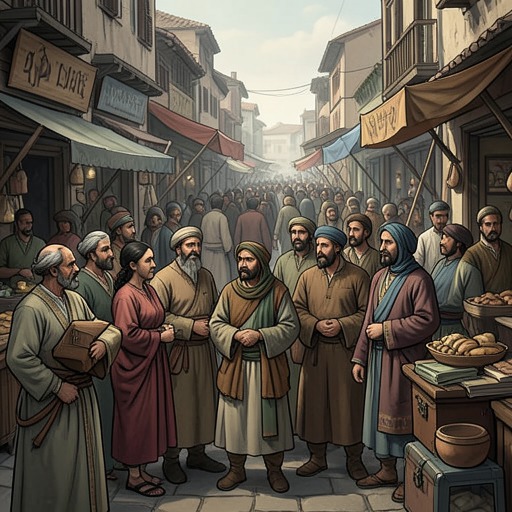
Iconium
Acts of the ApostlesIconium is a setting where the expanding witness to the Realm encounters a divided public response. Paul and Barnabas speak in a synagogue, where Jewish and Greek hearers welcome their message, but opposition follows; the city divides, and a Jewish-gentile group drives the witnesses onward. The episode complicates any simple contrast between receptive gentiles and hostile Jews, while advancing the journey from Iconium toward Lystra and Derbe.
Setting within the Journey
In Acts, Iconium is one point in a wider geographical movement that carries the witness from Jerusalem and Judea through Samaria toward the ends of the earth. The book treats this route not merely as travel but as a theological pattern: the Realm’s witness reaches beyond its starting communities and becomes increasingly inclusive. Iconium belongs to the outward-moving mission, but the response there makes clear that geographical expansion does not guarantee acceptance.
The account of Iconium follows a dispute in Antioch of Pisidia and precedes the mission’s arrival in Lystra and Derbe. Paul and Barnabas continue their work in a synagogue, speaking to Jewish and Greek hearers; the Greeks are likely God-fearers. Their presence in the same setting makes the episode a scene of overlapping religious and social affiliations, rather than a straightforward encounter between a single, uniform community and outsiders.
Welcome and Opposition
Some hearers in Iconium welcome the news of the Realm. Others, described in Acts as unbelieving Jews, oppose the witnesses and influence gentiles against them. The narrative thus places welcome and resistance side by side: the message is received by people from more than one background, while opposition also crosses communal boundaries.
Paul and Barnabas persist in speaking, even as the city divides. Some residents side with the unhappy Jewish group; others support the witnesses. The account does not reduce the city to a single response or make opposition the position of an entire people. Its conflict is local and contested, with Jewish and gentile residents both participating in the struggle over the mission.
Flight and Consequences
The confrontation escalates when a group of Jewish and gentile residents joins in an attempt to stone Paul and Barnabas. The witnesses flee Iconium and go to Lystra and Derbe, carrying the mission onward rather than ending it. Their departure is both a consequence of the danger and part of the larger pattern of movement through which Acts narrates the spread of the witness.
The flight also sharpens the account’s contrast between persistence and vulnerability. Paul and Barnabas continue to bear witness, but their mission does not make them immune to opposition. At Iconium, that opposition is not exclusively Jewish: gentiles join Jewish residents in acting against the witnesses. The episode therefore resists an easy assumption that being gentile itself confers theological insight or sympathy for the Realm.
Significance of the City Episode
Iconium matters as a qualification to any account of the mission that assigns resistance to one community alone. Acts supports the gentile mission, yet it also shows gentiles antagonistic toward its representatives. The city’s divided response makes the spread of the Realm more complex than a clean passage from Jewish rejection to gentile welcome; both reception and resistance can arise among different groups in the same place.
The episode also points to the importance of how the message is heard. The book raises the possibility that gentile resistance may reflect bad information about the Realm and invites consideration of what forms of witness might open minds and hearts to it. Iconium thus serves not only as a stage on the route to Lystra and Derbe, but as a test of interpretation: the mission must continue amid misunderstanding, division, and opposition without treating any ethnic identity as a guarantee of either insight or hostility.