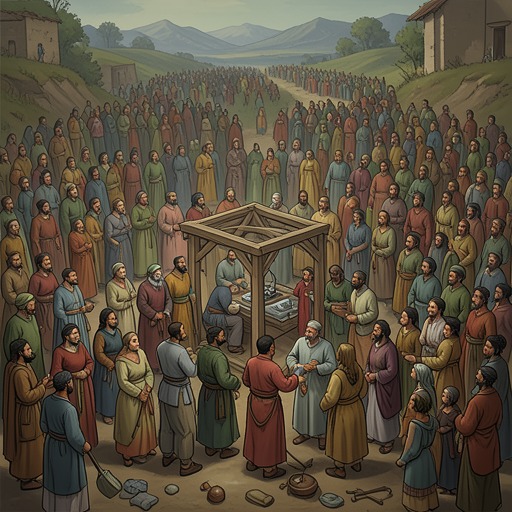
John (the apostle)
Acts of the ApostlesJohn (the apostle) is one of the Twelve and, in the episodes discussed here, a partner of Peter in the church’s public witness. The book presents him less through an independent personal biography than through this shared ministry: at the Beautiful Gate, before the authorities, and in the apostolic endorsement of Philip’s mission in Samaria. His significance lies in the way those scenes make apostolic leadership serve the continuing mission of Israel and the widening community of the Realm.
Identity and Apostolic Role
Luke reserves the title “apostles” for the twelve close followers gathered by Jesus. Their number recalls the twelve tribes of Israel and the ideal of a complete community whose covenantal life is meant to be a light to other peoples. In Acts, the apostles are an authoritative body, and their presence can authenticate consequential developments in the church’s witness. John’s place among them therefore connects his appearances to the community’s representative and authorizing role, rather than presenting him merely as an individual companion of Peter.
That representative function is particularly visible as the movement reaches beyond its original setting. The book describes the church’s mission outward from Jerusalem toward Judea and Samaria, and the apostles’ participation helps show that outreach is not simply a local initiative detached from the wider community. John is one of the figures through whom the narrative makes that connection visible.
Witness with Peter in Jerusalem
At the Beautiful Gate, Peter and John are the instruments through whom God heals a person who could not walk. The healing enacts, in miniature, the restoration associated with the Realm. Peter then interprets the event, joining the visible change in the person’s condition to the proclamation of God’s purposes. The episode belongs to a broader pattern in which the church’s ministry follows Jesus’ Spirit-powered model: announcing the Realm, interpreting its implications, and demonstrating its presence through acts of healing.
The healing also brings Peter and John into conflict with temple authorities. The authorities are disturbed by the apostles’ proclamation that resurrection is found in Jesus and take them into custody overnight, arranging an examination in daylight according to Jewish legal protocol. The contrast is pointed: a council of high social and political standing examines apostles of comparatively low status. The officials ask by whose name the healing was done, because in the ancient setting a name could invoke the power associated with it. Peter answers that the apostles acted in the name of Jesus, whom God raised from the dead. John is present in this joint witness, in which the healing and the resurrection proclamation reinforce one another.
The account also reverses the apparent direction of judgment. The authorities put the apostles on trial, but the reader is invited to see the authorities themselves as under judgment. The people have already responded positively to the healing, while the resurrection claim challenges the leaders’ theology and the social and economic power intertwined with temple authority. For Luke’s later readers, the destruction of the Temple in 70 CE further sharpens that dramatic irony. John’s role in the scene is collective rather than separately elaborated: he stands with Peter as the apostolic witness before an institution that assumes it alone can judge.
Apostolic Support for the Samaritan Mission
The mission in Samaria extends the story’s geography and its account of community. Samaritans worship the God of Israel, but have their own religious tradition, priesthood, observances, and version of the Pentateuch, which locates proper worship on Mount Gerizim. Their relationship with Jewish communities has included tension, but the evidence cautions against depicting it as perpetual hostility; periods of tolerance and cooperation also occurred. In this setting, Philip, one of the seven appointed in the Jerusalem community, carries the witness and proclaims the news of the Realm. His work among Samaritans is thereby associated with the church’s mission rather than treated as an isolated venture.
Peter and John come from the apostolic circle to join Philip and the converts. Their arrival underscores the connection between the expanding mission and the church’s recognized leadership. Samaritans welcome the Realm, respond to Philip’s preaching, and are baptized; the circle of disciples, previously altogether Jewish, now includes Samaritans. John’s presence thus belongs to a consequential widening of the community, across a boundary between closely related but distinct religious groups.
The narrative also distinguishes water baptism from the reception of the Spirit in this episode. Peter and John lay hands on the newly baptized converts, and the account treats the Spirit’s manifestation as a further part of their full incorporation and empowerment. Acts does not make the timing of baptism and the Spirit uniform in every episode; here they occur separately. The scene’s emphasis is not on a fixed sequence applicable to every account, but on the inclusion of the Samaritan converts in a Spirit-empowered community, with apostolic participation marking the event’s connection to the wider church.
Relationships and Narrative Significance
John’s most clearly evidenced relationship in these episodes is his partnership with Peter. At the Beautiful Gate, the two appear together as agents of healing; before the authorities, they share the consequences of public proclamation; in Samaria, they travel from the apostolic circle to join Philip and the converts. The repeated pairing gives John a steady narrative function: he accompanies Peter in witness and participates in the church’s discernment and authorization as its mission crosses boundaries.
The broader account places this ministry within a community whose leadership is meant to serve the Realm’s care for all. The appointment of seven in Acts 6 responds to an internal failure of mutual support toward widows; the book frames such leaders as mission team leaders rather than simply as fixed institutional officers. This context helps clarify the kind of authority associated with John’s apostolic role: authority matters insofar as it supports the church’s mission and its life together, not merely as a structure that preserves its own domains of power.
Across these scenes, John is not given a separate speech, private motive, or detailed personal transformation. Instead, the narrative makes his significance legible through accompaniment and presence. Beside Peter, he stands within an apostolic body that bears witness to resurrection, interprets a healing as a sign of the Realm, and recognizes the extension of the community to Samaritans. His portrayal consequently emphasizes shared authority and public service over individual distinction.