Joppa
Acts of the ApostlesJoppa is a coastal hinge in Luke-Acts, where the movement from Jerusalem toward the ends of the earth becomes concrete. Peter’s passage through the city advances the geography of the mission, and the raising of Dorcas there joins the Realm’s power to a local practice of care for vulnerable widows. Set in the city from which Jonah embarked toward Gentile Nineveh, Dorcas’s story also prepares for Peter’s departure from Joppa to meet Cornelius: a journey Luke presents as part of the widening embrace of the God of Israel.
Setting and Place in the Journey
Joppa lies beyond Lydda on Peter’s route north from Jerusalem. The healing and raising narratives of Acts 9:32–43 move Peter first to Lydda, about twenty-five miles northwest of Jerusalem, then to Joppa, about eight miles farther on, and finally toward Caesarea, about thirty-five miles north of Joppa. These distances give a physical shape to the geographical movement forecast in Acts 1:8: witness begins in Jerusalem and Judea, passes through Samaria, and goes toward the ends of the earth.
The route is also a narrative transition. After the threats against Paul in Damascus and Jerusalem, Peter comes back to the foreground. His work in Lydda and Joppa shows the Realm still active beyond Jerusalem and anticipates the conversion of Cornelius. The apostolic circle, rather than Paul alone, remains central to the emerging Gentile mission.
Dorcas and the Community’s Care
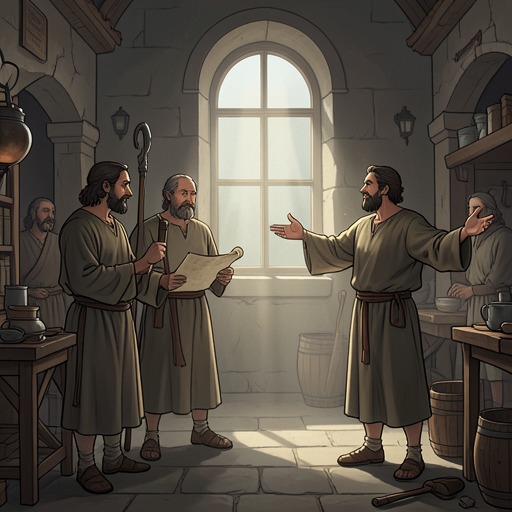
In Joppa, Dorcas—also called Tabitha—embodies discipleship through practical generosity. Dorcas is her Greek name, Tabitha her Aramaic one; both mean “a gazelle.” Luke calls her a woman disciple, using a feminine form found nowhere else in the Gospels and Letters. Her good works and acts of charity take a concrete form: she makes clothing, including tunics, for widows in the city.
That work matters in a society without public social security, where widows were especially vulnerable. Dorcas is not merely an individual benefactor. The account presents her as someone through whom the community provides for women who might otherwise be neglected. Some scholars have proposed that she belonged to an order of widows committed to mutual care, though the narrative does not establish that such an order existed. Even without that possibility, her example makes communal responsibility visible: care for widows is a way the community enacts God’s concern for them.
The Raising and Its Consequences
Dorcas dies, and her body is washed, following a common practice of the time. Peter’s raising of her therefore confirms that she was genuinely dead, and that the Realm’s power is not confined to healing. Through the Spirit, Peter performs an act comparable to Jesus’ raising of the dead; the pattern will appear again in a Gentile setting when Paul raises Eutychus.
Her return to life also affirms the continuing importance of her work. The story’s force is not only that a death is reversed, but that the care she provided is to continue. Read alongside Luke’s repeated pairing of women and men, the episode anticipates relationships restored to mutuality and offers a woman disciple’s ministry as a model for the community. Its placement gives the raising both personal and public consequence: Dorcas’s service to widows is bound to the witness of the Realm.
Jonah, Cornelius, and the Expanding Mission
Joppa carries a further scriptural association: it is the port from which Jonah set out on his mission to call the Gentile sinners of Nineveh to repentance. Immediately after Dorcas’s raising, Peter leaves Joppa on the journey that leads to Cornelius and the first Gentile conversion. The location thus connects an earlier story of reluctant movement toward Gentiles with Luke’s account of a mission newly opening to them.
The sequence suggests that the Gentile mission is itself a kind of raising into life: Gentiles are being brought into the promises and purposes of the God of Israel. That reading does not make Dorcas a mere symbol. Her particular ministry to widows remains central, while the city’s place in the narrative makes her restoration resonate with the wider welcome to come. Joppa is where care for people at risk and movement across communal boundaries meet.
Geographic and Theological Significance
Across Luke-Acts, the journey from Galilee to Jerusalem and onward through Judea and Samaria to the ends of the earth gives the narrative its larger shape. Joppa participates in that movement as a threshold between Peter’s work among Jewish communities and the approaching encounter with a Gentile household. The city’s significance lies not simply in its position along a route, but in the events that make movement meaningful: Peter restores Dorcas, and then travels from the same city toward Cornelius.
Luke describes the church as the Way, a name that evokes a people on a journey. Joppa brings that image into focus: a community leaves the security of its center, attends to people whose needs might be overlooked, and moves toward a wider fellowship. The city’s place in the narrative binds geographical expansion to restored life and practical solidarity.