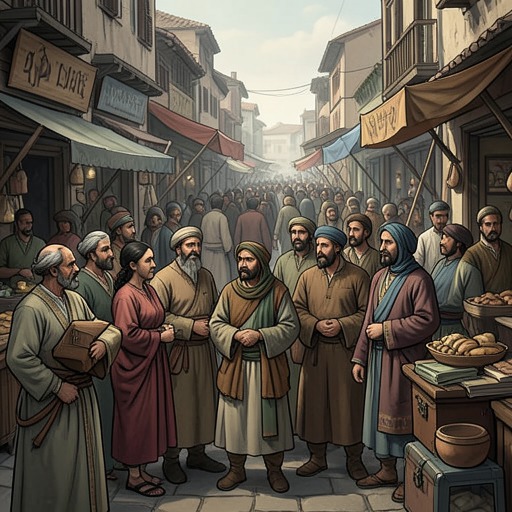
Lystra
Acts of the ApostlesLystra is a city in the first missionary journey where a healing prompts a crowd to mistake human witnesses for gods, and where that brief acclaim gives way to lethal violence. The episodes make the city a testing ground for the mission: Paul and Barnabas reject idolatrous honor, Paul survives being stoned and dragged outside the city, and the missionaries later return to strengthen the congregations formed amid such resistance.
Setting and Place in the Journey
Paul and Barnabas arrive in Lystra after the opposition encountered in Iconium. The city lies about twenty-five miles southeast of Iconium, placing the episode within a journey that moves from one community to another and repeatedly tests the witnesses’ reception. In Lystra, a person who has never walked is healed; the event becomes the occasion for an abrupt public misreading of who the missionaries are and what their power means.
The book’s discussion treats the account as part of the first missionary journey, not as an isolated marvel. The healing opens a public encounter, but it does not settle the community’s response. The city’s narrative movement runs from a crowd’s attempted sacrifice, through the missionaries’ appeal to the living God, to violence against Paul and a subsequent return to the churches established on the journey.
Healing and Misrecognition
The person healed in Lystra has never walked and is described as having faith. Paul sees that the person has faith to be healed and calls for them to stand upright; they leap up and walk. The account thus begins with a visible change in a person’s bodily condition, but the crowd interprets the event not as a sign pointing beyond the human witnesses, but as evidence that the witnesses themselves are divine.
The crowd identifies Barnabas as Zeus and Paul as Hermes, associating Paul with a god regarded as the sponsor of eloquence. The distinction between the two assignments matters: the crowd reads the event through its own religious categories, making Barnabas Zeus and Paul Hermes rather than recognizing the missionaries as mortals bearing witness to God. The narrative presents this response as an instance of gentile idolatry, not as proof that gentile identity guarantees theological insight.
The local priest of Zeus brings oxen and garlands and prepares to make a sacrifice. Those concrete preparations turn the crowd’s mistaken interpretation into a public ritual about to happen. Paul and Barnabas respond by tearing their clothes and rushing into the crowd, insisting that they are mortals. Instead of accepting the honors or treating the crowd’s enthusiasm as a successful outcome, they redirect attention to the living God, who made heaven and earth.
The Missionaries’ Appeal
Paul and Barnabas’ response is described as impassioned and deeply Jewish. Their appeal does not present God as a stranger to the nations: even when gentiles did not acknowledge God, God had not been without witness. The witnesses point to rain, fruitful seasons, food, and joy as signs of divine provision. The argument therefore answers the crowd’s attempted worship by locating divine activity in the sustaining gifts already experienced among the nations, rather than in the missionaries as incarnations of gods.
This address combines a call to turn from idols with an account of a God already supporting human life. Its emphasis is not simply on condemning the crowd’s mistake, but on redirecting its attention toward the source of the gifts it receives. In the book’s interpretation, the episode also complicates any simple contrast in which Jews alone resist the mission: gentiles, too, can oppose or misconstrue the Realm, and their response may reflect bad information as well as idolatrous assumptions.
Reversal and Persecution
The first missionary journey’s account of Lystra sets its attempted celebration against a violent reversal. In the broader sequence, some residents of Iconium stone Paul and Barnabas; in Lystra, people stone Paul, drag his body out of the city, and suppose him dead. The contrast is stark: a crowd that had prepared an offering to the witnesses is followed by people who treat Paul as one to be killed. The material supplies no further account of the healed person’s life, and the episode’s focus moves from the healing to the volatility of public response.
Paul and Barnabas later declare to the disciples that entry into God’s Realm comes through many persecutions. Their experience in and around Lystra gives that teaching its narrative weight: resistance is not an incidental interruption that invalidates the mission, but a danger the witnesses and communities must be prepared to face. The book draws a parallel with Jesus’ teaching that those joining the movement should count the cost, as someone building a tower or a ruler preparing for war must assess what the undertaking demands.
Return and Narrative Significance
The missionaries do not leave the newly established churches as though the work ended with preaching or with the dramatic events in the city. They return to the churches they have founded, remind them to be prepared for resistance, and appoint elders as local shepherds with prayer and fasting. The return makes the mission communal: its continuance depends not only on traveling witnesses but also on communities equipped to endure and to be cared for locally.
Paul and Barnabas eventually return to Antioch and report what God had done with them, emphasizing that God had opened a door of faith for the gentiles. Lystra’s significance lies in the unresolved tension between that opening and the hostility that accompanies it. Healing can be misread as divine status for human agents; an attempted sacrifice can give way to stoning; and a mission exposed to violence can still return to strengthen its communities. The city thus joins the journey’s scenes of witness, misunderstanding, suffering, and renewed communal life.