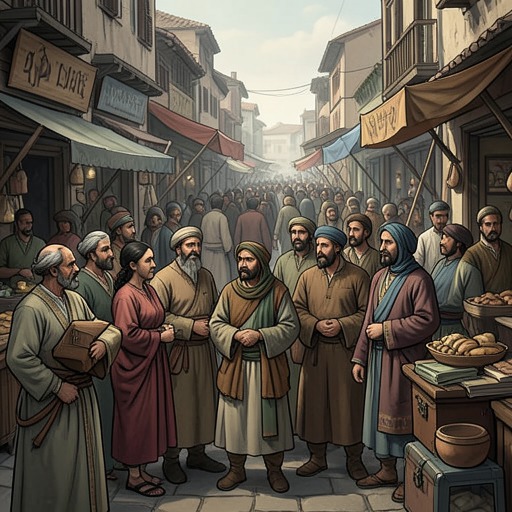
Paul and Barnabas's first missionary journey
Acts of the ApostlesPaul and Barnabas's first missionary journey, described in Acts 13:1–14:28, gives geographic form to the expanding witness of the community of the Realm. Commissioned by the Holy Spirit and the congregation at Antioch of Syria, the missionaries cross cultural and regional boundaries, encounter welcome as well as resistance, and establish communities whose life must continue after the travelers leave. The journey’s return is as important as its outward movement: Paul and Barnabas revisit congregations, appoint local elders, and report that God has opened faith to Gentiles.
Commissioning and Purpose
Acts presents the journey as the first of three trips Paul and his companions make to establish congregations, though the book itself does not call them missionary journeys. In the account’s interpretation, these journeys answer the difficulty of waiting for the apocalypse: the church is not to wait passively, but to live through the delay by engaging in mission. Mission is therefore not simply one task the church undertakes. Reaching out, as Paul does on the journeys, expresses what it means to belong to the community of the Realm.
Antioch as a Sending Community
The first journey begins with the Holy Spirit and the congregation at Antioch of Syria authorizing the effort by Paul and Barnabas. That authorization locates the mission within a community rather than treating it as the achievement of two independent travelers. Antioch already matters as a center of Gentile expansion and as a base for Paul’s journeys; its sending role connects local communal discernment with movement beyond the city.
The book also frames the Antioch community as a sign of the wider fellowship the journey is meant to extend. When Gentile mission takes root there, the church in Jerusalem sends Barnabas, who recognizes God’s work and brings Saul from Jerusalem. Their presence matters beyond the immediate growth of the Antioch church: Luke presents Barnabas and Saul as witnesses whose testimony can be trusted in the later apostolic council. The network linking a local congregation, its emissaries, and Jerusalem thus helps carry both people and authorization across communities.
Crossings, Encounters, and Opposition
The journey carries the narrative beyond familiar centers through a series of encounters in different cities. At Antioch of Pisidia, Paul and Barnabas enter a synagogue, where the customary invitation to learned visitors to speak gives Paul an occasion to interpret Israel’s history and invite listeners into the movement toward the Realm. The account describes interest among many hearers, followed by controversy and opposition; Paul and Barnabas then turn toward Gentile listeners. The episode makes the widening of the mission visible, while also requiring care in interpreting Luke’s negative treatment of Jewish people: repeating his polemical explanation without criticism risks perpetuating anti-Judaism.
In Iconium, the response is divided rather than uniform. Paul and Barnabas speak in a synagogue, and both Jewish and Greek listeners welcome their message. Opposition follows, and the city divides over the missionaries. The resistance is not confined to one ethnic group: Gentiles join Jewish residents in acting against the witnesses, a reminder in the account that Gentile identity by itself does not ensure theological insight. Paul and Barnabas leave for Lystra and Derbe, carrying their witness onward under pressure.
The journey’s hardships show what persistence costs. At Lystra, Paul is stoned and dragged outside the city, with those responsible supposing him dead. The account links this experience and the earlier hostility in Iconium to the missionaries’ warning that entry into God’s Realm involves persecution. Resistance is not a detour from the story’s mission; it becomes part of the conditions under which the witness continues.
Local Communities and Shared Responsibility
The outward route does not leave the new congregations behind. Paul and Barnabas return to the churches they have established, making the communal character of the Realm explicit. They encourage the believers to be prepared for resistance and, with prayer and fasting, appoint elders to shepherd the local congregations. The journey therefore includes not only public proclamation and new beginnings but the practical work of supporting communities that must endure after their founders move on.
This emphasis on shared responsibility is consistent with other descriptions of the movement’s growth. At an earlier stage, Joseph, a Levite from Cyprus, sells a field and places the proceeds in the community treasury; the apostles give him the name Barnabas, interpreted as “child of encouragement.” The episode gives economic solidarity a human face and shows how material resources could serve the movement. Later, in Philippi, the witnesses meet Lydia, a Gentile seller of purple who worships God. She and the household she heads become part of the community through baptism. Her story broadens the picture of who can participate: she is both a woman making decisions as head of her household and a person of means whose resources can support the community’s life and mission.
Return and Significance
After revisiting the congregations and appointing elders, Paul and Barnabas return to Antioch and report what God has done with them. The journey’s defining result, as the account summarizes it, is that God has opened a door of faith for the Gentiles. The report does not present the mission as the travelers’ possession: its achievement belongs to God, and its continuing life depends on the communities formed along the way.
The journey also belongs to Acts’ larger geographical design. The narrative moves from Jerusalem and Judea through Samaria toward the ends of the earth, while Luke-Acts as a whole carries the story from its beginnings in Jewish settings toward Rome, a symbol of the Gentile world and the old age’s power. The first journey is one part of that widening movement, joining place-to-place travel to the growing inclusion of peoples beyond the initial Jewish community.
Read in this way, the journey is not only an account of successful expansion. It holds together Spirit-led commissioning, local participation, cross-cultural connection, opposition, pastoral care, and the delegation of leadership. Its return to Antioch closes the travel sequence but leaves the mission in the hands of the communities it has connected: a network of congregations, witnesses, and supporters continuing the movement toward the Realm.