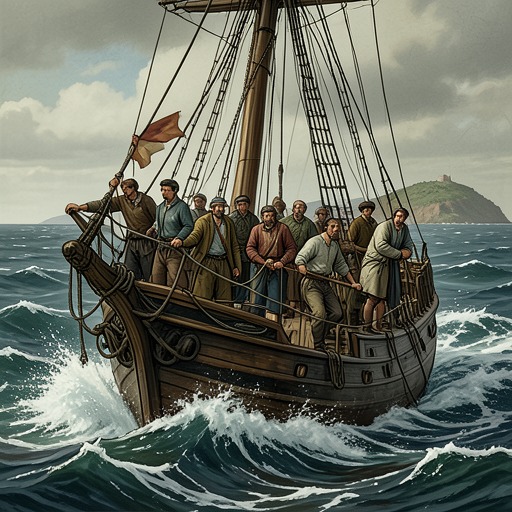
Paul’s ship to Rome
Acts of the ApostlesPaul’s ship to Rome is the vessel on which the imprisoned Paul travels under guard toward Rome. The ship’s deterioration turns the voyage into a sustained test of judgment and survival: Paul warns of danger, the people directing the voyage disregard him, a storm strips away cargo and equipment, and the vessel ultimately breaks apart near land. Its passengers reach safety, but only through a landing far rougher than expected. In Luke’s account, the shipwreck makes the sea a figure for chaos and shows that the mission can survive even when its planned course does not.
The voyage and its warning signs
Paul sails as a prisoner in the custody of Julius, a centurion of the Augustan Cohort. The early passage is uneventful, but the ship encounters increasingly difficult conditions as it travels from Myra toward Fair Havens against the wind. By then the season has turned: the Fast, the Day of Atonement in September or October, has passed, and the worsening weather makes delay consequential.
Paul warns that continuing will bring difficulty, the loss of cargo, and danger to life. The centurion, the pilot, and the ship’s owner do not follow his assessment. When the harbor proves unsuitable for wintering, they put out to sea, hoping to reach Phoenix. The warning establishes Paul as a perceptive interpreter of the situation, although his status as a prisoner makes him an unlikely authority. The narrative’s contrast is pointed: the people with conventional command of the voyage decide among themselves, while the captive recognizes the danger ahead.
The storm and the ship’s failing defenses
Soon after leaving port, a violent wind makes the ship unmanageable. The crew lowers a sea anchor to keep the vessel from running onto Syrtis, but the measures taken cannot restore control. The next day, they throw cargo overboard; when that is not enough, they jettison the ship’s tackle as well. The storm obscures the sun and stars, removing the familiar means of navigation. The account describes the crew’s despair starkly: “All hope of our being saved was abandoned”.
The ship’s successive losses give physical form to the crisis. Cargo and tackle, ordinarily part of the vessel’s capacity to travel, become weight to be discarded in an effort to stay afloat. The sequence moves from difficulty to helplessness, and from efforts at control to the abandonment of hope. Luke does not present the storm as a simple allegory for the congregation’s circumstances; rather, the ship’s peril offers an experience with which Luke’s audience, and later congregations, can identify.
Assurance and the contested route to safety
In the midst of the storm, Paul encourages those aboard and reports an angelic assurance: he will stand before the emperor, and everyone on the ship will reach safety. The promise does not mean that the vessel will make a calm or undamaged passage. Safety will come by running aground on an island, so the mission’s destination remains certain while its route is not.
The narrative links assurance to Paul’s coming appearance before the emperor and to his role in carrying the witness to the Gentiles toward its goal. It also holds together two realities that might seem opposed: the voyage is genuinely dangerous, and God remains present within the danger. The sign that the mission will continue is not the preservation of the ship as a functioning vessel, but the survival of those aboard and the possibility of reaching land.
Shipwreck and survival
At daybreak the travelers find land they do not recognize. They attempt to bring the ship ashore on Paul’s advice, but it strikes a reef and becomes stuck, while the stern begins to break apart. Safety is now close enough to see, yet the prisoners face another threat: some soldiers want to kill them to prevent any escape. If prisoners fled, the soldiers could be held accountable and severely punished.
Julius intervenes and abandons the soldiers’ plan. He orders everyone to leave the ship; the passengers reach land by swimming or by holding on to pieces of the wreck. The outcome fulfills Paul’s assurance that those aboard would survive, but not the prospect of an orderly landing. The ship, which had carried the travelers toward Rome, cannot complete the journey intact. Its destruction does not end the witness: the broken vessel becomes the means by which the survivors reach shore.
Narrative significance
Luke places the ship within the larger journey of Acts, which moves from Jerusalem through Judea and Samaria toward the ends of the earth, with Rome as the destination of the story. The voyage intensifies that journey through a repeated pattern of conflict and confidence, suffering and support. The sea represents chaos, but the narrative uses the ship’s continued passage toward its destination to affirm that danger does not cancel the mission.
The shipwreck also sharpens the question of whose judgment deserves attention. Paul is the prisoner, yet he reads the conditions accurately; Julius, a Roman officer, eventually acts to preserve Paul and the others from a threat posed by his own soldiers. The narrative therefore makes the ship more than transport: its successive crises expose the limits of conventional authority, test confidence in Paul’s witness, and show the Realm’s possibilities persisting even when the vessel and the expected landing fail.