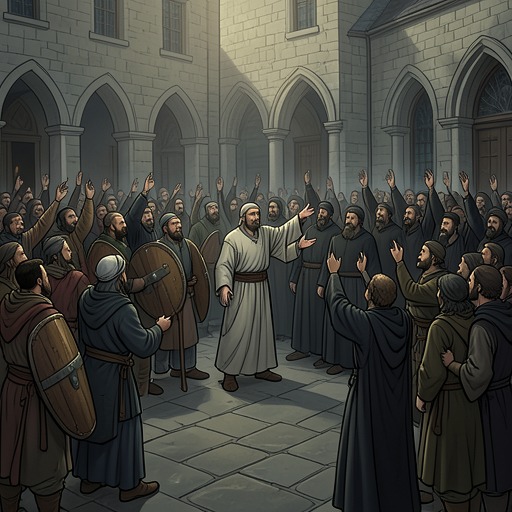
Peter and John's first arrest and hearing
Acts of the ApostlesPeter and John's first arrest and hearing turns a public healing into a contest over resurrection, authority, and speech. After Peter and John proclaim that the dead are raised in Jesus, temple authorities have them arrested and bring them before the council. Asked by what power the healing occurred, Peter names Jesus, whom God raised from the dead. The council cannot deny the evidence, but attempts to silence the apostles; they refuse, and the episode makes the authorities’ effort to control testimony part of the conflict itself.
Causes and Background
The arrest follows the healing at the Beautiful Gate and Peter’s public interpretation of it. The authorities are disturbed not simply by an isolated act of healing but by the apostles’ proclamation that resurrection is present in Jesus. The Sadducees did not believe in the resurrection of the dead, and the priests who controlled the temple bank were often intertwined with this wealthy social group. In the commentary’s reading of Luke, resurrection challenges both their theology and their social and economic standing.
The arrest therefore brings a theological dispute into a setting marked by unequal status. Peter and John, whose social standing is lower than that of the council members, are held overnight and examined the next day, following the described Jewish legal protocol of a daytime hearing. The council’s prestige sharpens the contrast between institutional authority and the apostles’ claim that God has acted through the risen Jesus.
The Hearing and Peter’s Answer
The council asks by what name the apostles healed the man who had been unable to walk. In the ancient context described by the commentary, invoking a name could be understood as invoking the force associated with it; mighty deeds could be attributed to the devil as well. The question is thus more than a request for identification: if the council could attach the deed to a power it could discredit, its own social authority would remain secure.
Peter answers that the apostles acted in the name of Jesus, whom God raised from the dead. The answer links the healing to resurrection and to the presence of the Realm. It also turns the council’s inquiry against its assumptions: the restored man is standing before the examiners as evidence of the power they are attempting to contain. Luke’s use of the language of being saved carries a double sense, referring both to healing and to inclusion in the Realm.
The hearing also reverses the apparent direction of judgment. The authorities have put the apostles on trial, but the narrative invites its readers to see the authorities themselves as under judgment. The people have already responded favorably to the apostles’ witness, while Luke’s audience, writing after the destruction of the temple in 70 CE, could see that later catastrophe as a further sign of judgment on the leaders.
Efforts to Silence the Witness
The council cannot deny the evidence of the healed person standing before it. The power that healed at the Beautiful Gate, the commentary observes, also points to the power to raise the dead and bring the Realm. The authorities nevertheless try to limit the consequences of that revelation. Concerned about their own power and the possibility of a popular uprising, they do not actively punish the apostles; instead, they attempt to stop them from speaking.
Peter and John answer that they cannot keep from speaking about what they have seen and heard. Their reply makes testimony the event’s decisive action: the authorities can question, detain, and issue prohibitions, but they cannot make the apostles deny what they have witnessed. The conflict is not resolved by a change of mind among the council. It shifts to whether the apostles will submit to enforced silence, and they do not.
Release and Continuing Significance
The council’s inability to deny the healing, combined with its concern about public reaction, limits its response. The apostles are released rather than actively punished, but release does not mean their message has been accepted. The attempted prohibition leaves the central disagreement intact: the authorities seek to protect their standing by curbing speech, while the apostles continue to bear witness to resurrection and the Realm.
The episode belongs to the larger literary and theological sequence of Acts 3:1–4:31, which joins the healing, its public interpretation, the hearing, and the continuing response of the authorities. Acts 4:5–12 is appointed for the Fourth Sunday of Easter in Year B, but the commentary stresses that this shorter reading needs the surrounding story to make its stakes clear. Read in that wider sequence, the first arrest and hearing depicts witness provoking confrontation and identifies enforced silence as one way authorities try to preserve power. It also warns against treating Jewish leaders as a single, uncomplicated group: the account concerns particular authorities and their actions, not a warrant for hostility toward Jews.