Peter–Cornelius relationship
Acts of the ApostlesThe Peter–Cornelius relationship is the pivotal encounter through which Acts depicts the Gentile mission as an act of God rather than a human departure from Jewish tradition. Peter, a leading apostle, is brought to Cornelius, a Gentile Roman centurion drawn to the God of Israel; their meeting leads to the Spirit’s coming upon Gentiles, their baptism, and the Jerusalem community’s recognition that God has opened the way to life for them. The relationship therefore changes not only the standing of Cornelius’s household but the terms on which the community understands its expanding mission.
Different Positions, a Shared Direction
Cornelius is a centurion, an officer responsible for one hundred Roman soldiers, and a God-fearer: he is attracted to Israel’s God but has not fully converted to Judaism. He prays and gives alms. Peter, by contrast, is a leader among the apostles. Luke’s presentation brings these distinct social and religious positions together while making Peter the instrument through whom Cornelius is led into the community of the Realm. The encounter gives apostolic standing to the Gentile mission before the fuller authorization of the apostolic council.
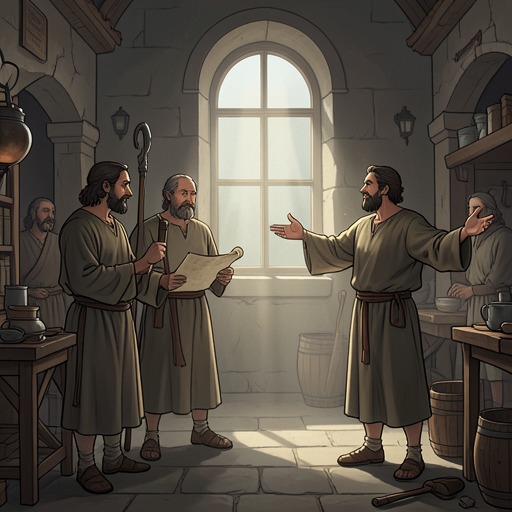
Their meeting is framed by a double vision: each man receives an individual vision, and the two experiences direct them toward a common purpose. An angel instructs Cornelius to send for Peter, who is in Joppa. Peter, meanwhile, sees a spread of animals that includes those regarded as unclean and hears an instruction, repeated three times, to kill and eat. He protests that he has never eaten anything profane or unclean. The paired visions make the encounter more than a private exchange: they present God as guiding both participants toward a meeting whose significance neither man establishes alone.
Crossing a Boundary
The visions address the meaning of Jewish food practices as well as the immediate question of Peter’s visit. In the account’s interpretation, clean and unclean distinctions had helped sustain Jewish identity and its vocation of bearing witness among the nations. Luke’s end-time theology presents the old boundaries as no longer necessary in their former form as God draws the age toward its close. The narrative does not simply portray Peter as abandoning Jewish identity; it shows him being led to recognize that the Gentile mission belongs to God’s purpose.
When messengers from Cornelius arrive, the Spirit directs Peter to meet them at the gate. Peter goes to Cornelius’s house, where a group has assembled, and says that association between Jews and Gentiles is unlawful. The commentary cautions that this is a dramatic overstatement: Jewish and Gentile people interacted in everyday life, although eating together could present complications. The emphatic statement heightens the importance of Peter’s arrival and the boundary the story is negotiating. Cornelius asks Peter to interpret what has taken place, making Peter’s response central to how the encounter will be understood.
The Spirit and a Shared Initiation
Peter explains the significance of events to Cornelius and those gathered with him, interpreting the coming of the Realm for Gentiles. The account’s case for Gentile inclusion rests on more than Peter’s authority: it draws together the encounter, the story of Jesus, prophetic tradition, and apostolic testimony. The decisive confirmation comes while Peter is speaking. The Holy Spirit falls on the Gentile listeners, who speak in tongues and extol God; they turn from Gentile deities toward the God of Israel. Their reception of the Spirit echoes the experience of the Jewish community at Pentecost.
Jewish believers are present to witness what happens; the account also specifies that six Jewish believers accompanied Peter. Their presence makes the event publicly attestable within the community rather than a claim resting only on Peter’s report. Peter asks whether anyone can withhold baptism from those who have received the Spirit just as Jewish believers have. The Gentiles are baptized, and their reception of the Spirit and baptism mark them as full participants in the community moving toward the Realm. The parallel with Pentecost is consequential: the Jewish believers’ experience remains the originating pattern, while the Gentiles’ experience confirms that they belong within it.
Jerusalem: Evidence and Recognition
The relationship continues beyond Cornelius’s house when Peter returns to Jerusalem. Some circumcised Jewish members criticize him for eating with uncircumcised Gentiles. The dispute over a meal is, in the commentary’s reading, the visible symptom of a larger question: whether Gentiles who have not fully converted to Judaism have a place in the church. The conflict is not fully resolved until the apostolic council, but this episode brings the community to an informal recognition of the mission.
Peter retells the events, emphasizing the threefold vision, the Spirit’s direction, the six witnesses, and the Gentiles’ reception of the same gift as the Jewish community at Pentecost. Rather than merely demanding assent, he leaves his hearers to weigh the evidence and asks, “Who was I that I could hinder God?” The group falls silent; its objection loses force. The members praise God and acknowledge that God has given even the Gentiles the repentance that leads to life. Peter’s account thus turns his personal encounter with Cornelius into a matter the Jerusalem community must recognize and interpret.
Significance Beyond the Encounter
Luke presents the episode as a great reunion underway among God, Gentiles, and the Jewish community. Its narrative function is to assure Jewish members that the Gentile mission originates with God, while reminding Gentile members that the good news reaching them comes from Jewish origins. Inclusion does not erase that history: the Gentile experience is the same in its essential signs as the Jewish experience, and the Jewish community’s experience is originative. The account therefore couples welcome with a call for Gentiles to live respectfully with Jewish people.
The relationship also makes experience part of theological discernment. Peter’s testimony, the witnesses, the visions, and the Spirit’s observable presence together shape the community’s judgment about God’s purposes. The book treats the encounter not as the end of disagreement but as a decisive precedent for the continuing Gentile mission, with the question of Gentile belonging returning at the apostolic council. In this structure, Peter and Cornelius stand at the point where a personal meeting becomes a communal change: Peter’s role as apostolic witness and Cornelius’s reception of the Spirit together establish a path by which Gentiles enter the community without severing its connection to Israel.