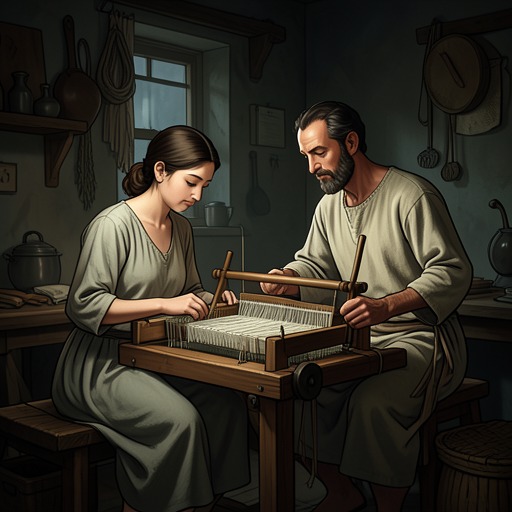
Priscilla and Aquila instruct Apollos
Acts of the ApostlesPriscilla and Aquila instruct Apollos in an episode that makes teaching a shared ministry rather than the preserve of a single, male authority. The couple, already associated with Paul’s work in Corinth, help a learned and eloquent teacher recognize that his formation is incomplete: he has received only John’s baptism. Apollos accepts their advice, and the community in Achaia welcomes him. The episode thus joins mutual leadership to a movement of growth, in which learning remains possible even for an established teacher.
Setting and Background
Luke introduces Priscilla and Aquila when Paul leaves Athens for Corinth, about fifty miles to the west. They are Jewish refugees who had come to Corinth after Emperor Claudius expelled the Jewish population from Rome, probably in 49 CE. Their circumstances place the couple’s work within a history of displacement and Roman prejudice; their presence also complicates any picture of the early Christian mission as detached from the hardships facing Jewish people.
In Corinth, Priscilla, Aquila, and Paul are all tentmakers. Tents were commonly made of leather or heavy cloth, so tentmaking involved work as leatherworkers or weavers. The trade put them in the marketplace, where people also came to discuss philosophy. For Paul, this work provided financial support for his mission and a setting in which to witness. The occupation helps situate the couple’s ministry in ordinary economic and public life rather than in a separate institutional sphere.
The account also has a larger narrative setting. Acts moves through successive missionary journeys, and the third begins in Antioch before eventually turning toward Jerusalem. Its opening section brings Priscilla and Aquila back into view, now not simply as Paul’s coworkers but as teachers in their own right. Their instruction of Apollos extends the story’s attention from travel and public proclamation to the formation of leaders within the community.
Shared Teaching and Leadership
Priscilla and Aquila teach Apollos together. Luke presents this shared responsibility as significant: the couple are not merely present alongside a male teacher, but participate in teaching someone who is himself an eloquent and scripturally learned speaker. The account gives their partnership practical weight in the community’s transmission and development of its message.
Their joint work also carries a wider implication about relationships between women and men. The analysis of Luke’s narrative connects the scene to a vision in which the Realm restores women and men to mutual partnership. Luke’s account of Mary learning from Jesus had already represented a woman as a full-fledged disciple; Priscilla’s recognized role as a teacher takes that impulse further. The episode models shared leadership rather than treating women’s participation as incidental.
This model is not a warrant for assigning the couple a later, formal church title. The evidence supports a more concrete claim: they share responsibility for teaching in the community of the Realm. Their authority is shown through the work they do, and the result is another person’s fuller participation in the community’s mission.
Apollos and the Need for Growth
Apollos is presented as both gifted and incomplete. Luke describes him as eloquent and well versed in scripture, and he is already a teacher. Yet he has received only the baptism of John. In the account’s theological framework, entry into the community involves repentance, baptism in the name of Jesus, and reception of the Holy Spirit; Apollos’s existing learning and leadership therefore do not make further formation unnecessary.
Priscilla and Aquila advise him about the need to receive the baptism of Jesus. Their teaching is not framed as a public humiliation or a rejection of his gifts. Instead, the decisive feature of Apollos’s response is his willingness to accept their counsel. The account contrasts his readiness with figures in Luke’s earlier narrative who turn away from invitations to join the movement of the Realm: Apollos does not cling to what is familiar when he is shown what remains incomplete.
The result is a portrait of discipleship as responsive growth. Apollos’s learning is real, but it is not the last word about his formation. Nor does his position as a teacher exempt him from being taught. The episode places humility and receptiveness alongside eloquence and scriptural knowledge as qualities needed for service.
Reception and Narrative Significance
After accepting the teaching, Apollos is welcomed by the community in Achaia. His acceptance links instruction to an outcome beyond the private exchange: the community receives someone whose discipleship has been brought into fuller accord with its account of life in the Realm. The episode thus shows how teaching can enable participation and strengthen the movement across communities.
The narrative also draws attention to the relationship between gift and response. Participation in the Realm is presented as a gift, but Apollos’s story shows that receiving the gift entails openness to further instruction and change. His response distinguishes him from those who turn away from the journey: he accepts what the couple teach, and the community receives him.
Taken together, the couple’s action and Apollos’s response make the episode a compact account of how a community develops its leadership. Teaching is shared by a woman and a man; a prominent teacher remains teachable; and the result is welcome rather than exclusion. The scene’s significance lies not only in Apollos’s progress, but in the kind of community the instruction makes visible: one in which leadership serves formation, partnership crosses gendered expectations, and growth remains possible at every level of responsibility.