Publius
Acts of the ApostlesPublius is the leading resident of Malta in the account of Paul’s stay on the island. His importance to the episode is relational: his father’s severe illness brings Paul to the household, and the healing that follows connects Publius’s family with the wider account of healing and hospitality among the islanders. Malta is not merely a pause on the journey to Rome; it becomes a place where the Realm is revealed through care for sick people and welcome for a traveling witness.
Identity and Setting
Publius is identified as Malta’s leading resident. The evidence does not provide further biographical details about him, describe his office, or explain how he came to hold his position. His role in the episode is established instead through his household and through the island community’s response to Paul.
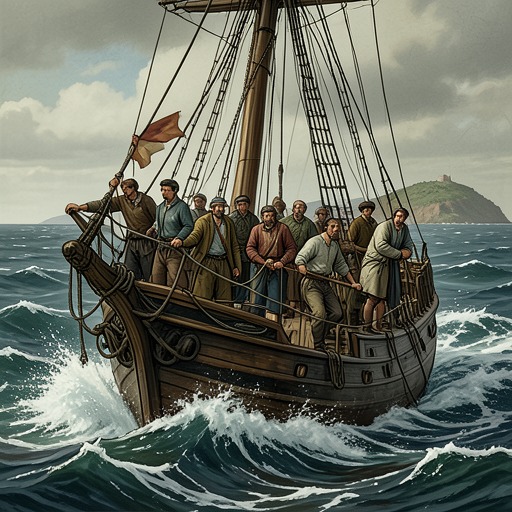
The account places Publius within Malta, where Paul and the other travelers have arrived after the dangers of the voyage. For the book’s interpretation, the island is more than a temporary stop before Rome: it is a location where the Realm becomes visible. Publius’s household is the episode’s particular point of contact, as the condition of his father leads to a healing that is followed by reports of healings among other islanders.
His Father’s Illness and Paul’s Visit
Publius’s father is sick in bed with fever and dysentery. The source explains that dysentery could be life-threatening, describing it as a severe inflammation of the colon that could cause diarrhea, dehydration, fever, and abdominal pain. The account thereby presents the illness as a serious circumstance, not a passing discomfort, while offering no further personal details about the father or his prior health.
Paul visits the sick man, lays hands on him, and prays. Publius is not described as performing these actions or directing Paul; the evidence identifies him through his connection to the father and the household where the encounter occurs. The narrative’s attention rests on Paul’s visit and prayer and on the resulting healing.
The account says that Publius’s father is healed. It then widens the scene beyond the household: other people on Malta also come and are cured. The sequence links an individual family’s crisis with a broader island episode, in which the healing associated with Paul’s ministry reaches beyond Publius’s immediate circle.
Malta’s Welcome and the Journey to Rome
The Maltese response to Paul is marked by honor and practical assistance. The islanders provide the provisions he needs for the final sail to Rome. Publius’s own part in arranging or providing those supplies is not specified, so the hospitality belongs to the people of Malta as a community rather than to him alone.
That welcome contrasts with Paul’s more recent encounters with Jewish leaders and provincial leaders of the Roman Empire, who are described as treating him differently. The contrast gives the island episode a distinct turn: after conflict with authorities, Paul receives honor and material support from Gentiles. In the source’s interpretation, this is a renewed affirmation of the power of witness among Gentiles, and Paul departs for Rome on a high note.
Healing, Providence, and the Realm
The healings on Malta are read as evidence of the Realm’s presence and as an embodiment of its character: the restoration of human beings to the way God intended. Publius’s father’s recovery is therefore significant both within the family episode and in the theological interpretation of Paul’s stay. The account connects Paul’s act of visiting, laying on hands, and praying with a wider pattern in which islanders come for healing.
The interpretation also places the episode within a pattern of preservation. God preserves Paul from the dangers of the storm and the threat of being murdered, and then from death after the viper attack. In this reading, the healing of Publius’s father and others is part of the same island episode in which Paul is preserved and the Realm is manifested on behalf of Gentiles.
Malta’s significance depends in part on its apparent marginality: a congregation might regard it as a side stop, yet the account treats it as a place where the Realm is revealed. It also avoids presenting healing as a guarantee that illness and death cease. The source acknowledges that people sometimes die after snake encounters and that fever and dysentery can overcome a sick person, including a father like Publius’s. Publius’s family thus anchors an account of healing without making the island’s suffering disappear from view.