Samaritan religious community
Acts of the ApostlesThe Samaritan religious community is a distinct religious tradition closely related to Judaism, sharing a broad inheritance while maintaining its own practices, sacred canon, and worship center. In Acts, Samaritans receive the message of the Realm through Philip, making their welcome a decisive expansion of the movement beyond its initially Jewish community. Their place between the Jewish world and the wider Gentile world gives the encounter both a geographic and a theological significance.
Tradition and Religious Life
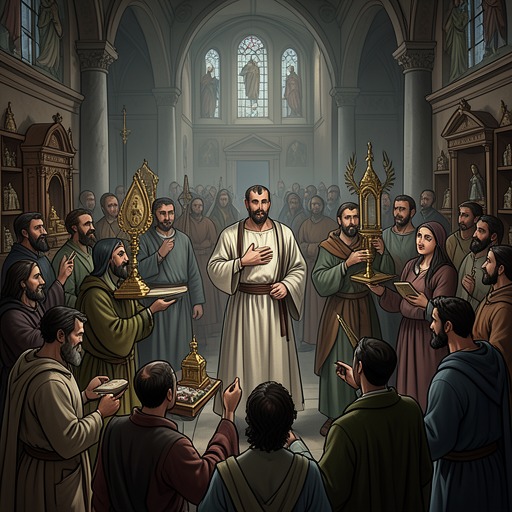
Samaritans worship the same God as the Jewish people within a broadly shared religious tradition, but their community developed its own culture and religious institutions. Its canon centers on a Samaritan version of the Pentateuch. In that text, worship is to take place on Mount Gerizim, rather than at Jerusalem; the Samaritan version modifies the relevant commandment to support that sacred geography.
Mount Gerizim also organizes Samaritan sacred history. Samaritans associate the area with events including the Garden of Eden, the resting place of Noah’s ark, and Abraham’s offering of Isaac. They hold that Moses founded the Samaritan religion, and they have their own priesthood and observances of Passover, Pentecost, and Booths. These features mark a recognizable communal tradition, not simply a variation in custom within Jewish worship. The account describes Samaritanism as Judaism’s first cousin, stressing kinship alongside difference.
The community is not presented only as a feature of the ancient past: Samaritans remain alive today near Mount Gerizim and near Tel Aviv. This continuing presence underscores the need to treat the group as a living religious community rather than merely a biblical symbol.
A Borderland between Communities
In the narrative geography of Acts, Samaria lies between Jerusalem and the ends of the earth. The sequence of witness moves from Jerusalem, the symbolic heart of Judaism, through Judea and onward into Samaria. Samaritans therefore occupy a boundary position: they share beliefs and practices with the Jewish people, yet have developed a distinct culture and religious life. Their inclusion makes the movement’s expansion a crossing of difference within a closely related religious world, before the narrative’s further extension to Gentiles.
That boundary should not be reduced to permanent hostility. The account acknowledges tensions between Jewish and Samaritan communities, but also notes periods of tolerance and even cooperation. Acts 8:4–25 depicts disciples entering Samaritan territory and interacting with its residents; this welcome is consistent with Luke’s earlier positive portrayals of Samaritans. The community’s place in the story thus complicates any simple picture of two groups defined only by antagonism.
Welcome through Philip’s Mission
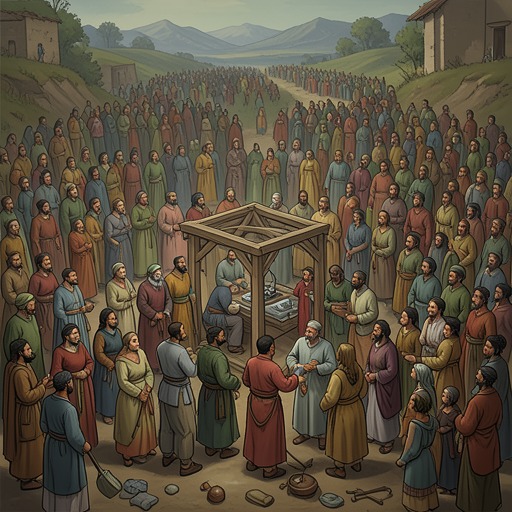
In Acts 8:4–13, Samaritans welcome the presence and coming of the Realm. Philip is the principal witness in this mission. Because he is one of the seven appointed by the community, his presence signals that the mission is authenticated by the church, rather than being an isolated initiative detached from it. Peter and John subsequently come from the apostolic circle to join Philip and the converts, reinforcing the connection between outreach and the community’s recognized leadership.
Philip’s work is described through both preaching and signs: God works signs through him, and Luke explicitly identifies the message he preaches as news of the Realm. The response is broad. Many Samaritans receive that news gladly, and people who respond—including Simon, a widely known magician—are baptized. Their welcome changes the social and ethnic composition of the movement: until this point, the community had been wholly Jewish; now Samaritans are included among its disciples.
Religious Encounter and Expansion
Simon’s place in the episode makes the encounter more than a change in communal membership. In antiquity, magic was understood as an attempt to affect the forces governing life through incantations, formulas, ceremonies, and related practices; it was not simply entertainment of the modern kind. Many Jewish people regarded magic as false or demonic. Yet the account says that when Philip preaches the news of the Realm, Simon responds positively and seeks baptism. The movement’s message therefore meets an established religious practice in Samaria, and its welcome includes a figure associated with that practice.
The source does not explain why large numbers of Samaritans joined the movement. It offers, as a possibility rather than a stated cause, that the news may have appealed amid the general brokenness of the world and the particular strain of life under the Roman Empire, alongside occasional animosity with the Jewish community. It also interprets the church as promising a strong community able to resist imperial power and calls for Jewish-Samaritan tensions to give way to mutual support. These reflections frame the Samaritan welcome as a possible response to social fractures without claiming access to the converts’ unreported motives.
Significance for the Movement
The Samaritan mission shows the church’s recognized leadership on the side of outreach: Philip carries the witness, and Peter and John join him and the converts. The episode thus connects expansion across a cultural boundary with the community’s authorization and shared life. Samaritan inclusion is not an abandonment of the movement’s Jewish inheritance; it is an enlargement of the community across a neighboring tradition that is both related and distinct.
The account also resists treating Jewish-Samaritan relations as an unchanging story of hostility. Its emphasis on welcome, prior positive portrayals, and the possibility of tolerance and cooperation makes mutual support a central implication of the encounter. The Samaritan religious community is consequently significant both for its own richly specified religious identity and for the way its reception of Philip’s message marks a widening circle of belonging.