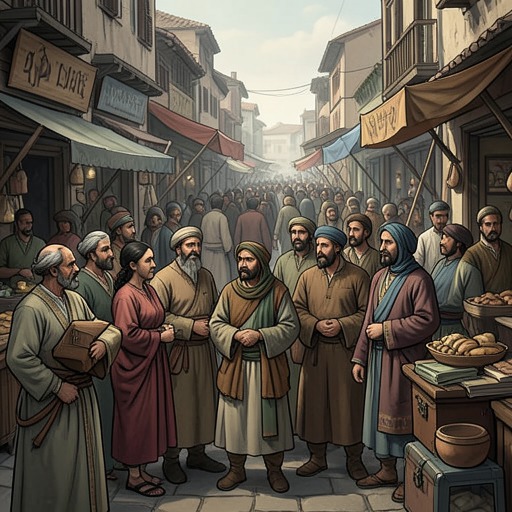
Sergius Paulus
Acts of the ApostlesSergius Paulus is a Roman proconsul in Paphos whose belief, in the face of Bar-Jesus’s opposition, gives concrete form to the narrative’s turn toward Gentile witness. He summons Paul, Barnabas, and John to hear their message, then confronts a choice between the familiar alliance represented by the magician and the claim that the God of Israel is bringing the Realm through Jesus. When Bar-Jesus becomes blind, Sergius Paulus believes. The episode makes a Roman governor the discerning hearer and a Jewish religious figure the obstacle, a pointed reversal that the commentary reads both as a key moment in the Gentile mission and as a passage with an anti-Jewish edge.
Identity and Setting
Sergius Paulus is identified as the proconsul, or Roman governor, of the province and is associated with Paphos, on the southwestern shore of Cyprus. Paul, Barnabas, and John reach him after sailing to Cyprus and traveling from the island’s eastern edge, stopping at synagogues along the way. His office places him within Roman government: he is responsible for enacting Roman rule in Paphos, not merely a private listener with no public standing.
The narrative presents his political position as part of the episode’s stakes. The Realm announced by the witnesses challenges values and representatives of the old age; belief in that message therefore entails more than agreeing with a new religious idea. For a proconsul who governs under Rome, hearing the witnesses brings the claims of the God of Israel into the space of imperial authority.
The Encounter with Bar-Jesus
Sergius Paulus summons the witnesses to hear their message. Bar-Jesus, also called Elymas, is already with the proconsul and may have served as a religious adviser. The commentary describes him as a Jewish magician: ancient magic sought to manipulate forces in the universe, a practice forbidden by the Jewish community. Bar-Jesus opposes the disciples and tries to turn the proconsul away from faith.
His opposition is tied to his relationship with the governor. If Sergius Paulus believes in the coming Realm, Bar-Jesus risks losing both the proconsul’s attention and the social standing bound up with that connection. The encounter is thus not only a dispute over teaching. It stages a choice between a familiar alliance, maintained through Bar-Jesus’s influence, and a message that could unsettle the relationship and the values it represents.
The Choice and Reversal
The commentary frames the proconsul’s decision explicitly: will Sergius Paulus retain his familiar alliance with Bar-Jesus, or believe that the God of Israel is bringing the Realm through Jesus? The second course could bring him into conflict with some representatives and values of the old age. His high office makes that choice especially resonant, since the person exercising Roman power is also being asked to recognize a claim that challenges the order around him.
Under the influence of the Holy Spirit, Paul names Bar-Jesus’s theological and ethical failure and becomes the channel through whom God’s judgment is pronounced. Bar-Jesus is struck blind. His physical blindness is presented as an embodiment of his spiritual condition, turning the conflict’s language of discernment into a visible reversal: the magician who sought to divert the proconsul is himself rendered unable to see.
Sergius Paulus believes when he sees Bar-Jesus become blind. His response is the episode’s decisive change: the governor who was summoned to choose does not remain attached to the adviser who tried to dissuade him. The commentary emphasizes that Sergius Paulus, a Gentile and an agent of Roman rule in Paphos, displays greater theological discernment than Bar-Jesus, who is Jewish yet portrayed as compromised by magic and cooperation with the devil.
Narrative and Theological Significance
The episode belongs to the narrative’s widening witness to Gentiles. The commentary treats Paul’s mission as part of the larger movement in Acts toward Gentile audiences and identifies the proconsul’s belief as an instance of a Gentile receiving the message. Sergius Paulus’s status sharpens the effect: a person with high social standing, and a representative of a power capable of repression, becomes a believer rather than simply an opponent of the movement.
The passage also makes a contrast between Sergius Paulus and Bar-Jesus that demands careful reading. The commentary says Luke uses the vignette to explain why many Jewish people turned away from the Realm and why the church should direct its energy toward Gentiles. It connects the magician’s blindness with a broader literary parallel: in Acts, Bar-Jesus is associated with dishonest management and theological blindness, while the Gentile proconsul believes. The commentary explicitly cautions preachers to bring the anti-Jewish tone of this contrast to congregants’ attention rather than letting the polemic pass unexamined.
At the same time, Sergius Paulus serves as a challenge to assumptions about who can discern truth. The commentary asks whether people of high standing or institutions that wield power may sometimes show more theological and ethical insight than ordinary Christians, even when those figures are linked to a potentially repressive empire. It calls for welcoming proconsul-like people into the community, while also using the relationship between governor and magician to expose manipulative practices through which people preserve influence. Sergius Paulus’s narrative role consequently rests on both sides of the encounter: his belief advances the Gentile mission, and his contrast with Bar-Jesus exposes the dangers of compromised counsel and unexamined religious polemic.