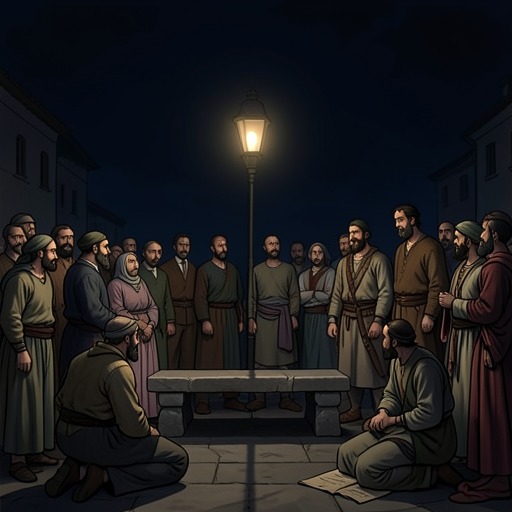
Stephen
Acts of the ApostlesStephen is presented as the first person martyred for witnessing to the Realm. In the long account spanning Acts 6:8–8:3, he moves from public debate to false accusation, from a defense grounded in Israel’s history to a mob’s violence. His death resembles Jesus’ death, while his response—entrusting himself to God and asking forgiveness for those who oppose him—makes him a model of witness under pressure. The account is also sharply polemical about Jewish leadership; its enduring use therefore involves both learning from Stephen’s example and refusing to turn Luke’s hostile portrait into anti-Judaism or antisemitism.
Identity and Role in the Narrative
Stephen is a disciple whose public witness provokes opposition. The book describes his story as a long narrative with a simple course and a savage climax: he is falsely arrested, interprets Israel’s history in his defense, and is killed by stoning. His death is not only the conclusion of his individual story. It becomes an example through which Luke addresses a community that may face hostility and needs a memory of courage, theological acuity, confidence in God, and concern for opponents.
The account also connects Stephen’s fate to that of Jesus. Luke shapes the disciple’s death after the pattern of Jesus’ death, so the story presents Stephen not as an isolated victim but as a witness whose conduct continues the pattern established in the Gospel. Saul is present at the stoning, a detail that places Saul at the scene of the killing and connects the event with the subsequent persecution of the community.
Accusation and Defense
Stephen’s arrest follows public debate. After losing arguments in discussion with him, a group of freed slaves from Cyrene, Alexandria, and other places secretly arranges false charges against him before the council. The accusations concern blasphemy against Moses and God, the Temple, and the Torah. The account emphasizes that Stephen is not guilty of these charges. It also recalls the false accusations against Jesus in the Gospel, making Stephen’s prosecution part of a recurring narrative pattern in which a witness’s ministry is misconstrued to secure condemnation.
In keeping with Jewish legal practice, Stephen is given an opportunity to answer the charges. His defense retells Israel’s history and reverses the accusation: rather than Stephen being the one who resists God, he presents those who resist the Holy Spirit and persecute the prophets as the guilty party. The book describes this as an interpretation of Israel’s story, not a claim that the charges against Stephen have been substantiated. The reversal gives the defense its argumentative force, while also contributing to the narrative’s severe portrayal of its opponents.
Stephen begins with God’s call to Sarah and Abraham and recalls the promises made to them. The only direct words of God he quotes at this point are, “I will judge the nation that they serve.” He then recounts God’s providential care for Sarah and Abraham’s descendants through Joseph. These elements ground his account in God’s activity and promise: his defense is not simply a rebuttal of legal charges but a theological reading of Israel’s history.
Death and the Pattern of Jesus
After Stephen finishes speaking, the crowd, enraged by his words, drags him out of the city and stones him. The book presents this as vigilante action rather than a fair hearing. Readers know Stephen is innocent; the mob violates its own traditions, acts without the proper Roman authority to put someone to death, and kills a prophet. In the book’s account, the manner of the killing confirms the substance of Stephen’s accusation that the community is resisting God’s messengers.
Stephen is described as filled with the Holy Spirit. He sees Jesus at the right hand of God, a vision that assures the reader that the mob’s power is not the ultimate power in the scene. The sequence places spiritual assurance beside political and communal violence: the crowd can kill Stephen, but the vision directs attention to a power the crowd cannot command.
The account further aligns Stephen’s final actions with Jesus’ death. Like Jesus, Stephen yields his spirit to God; his last words also ask God to forgive the mob. These actions give the narrative’s model of witness its ethical shape. Stephen does not answer violence with reprisal. His forgiveness is not an incidental detail but the culmination of a story that presents courage, trust in God, and concern for opponents as practices of the Realm.
Meaning, Reception, and Caution
The account gives Luke’s community a remembered example for circumstances different from Stephen’s own. The book notes that Luke’s congregation did not face martyrdom, but argues that the story was meant to strengthen its resolve when it encountered hostility. Stephen’s defense supplies a model for responding thoughtfully to false accusation; his conduct during the mob’s violence offers a model for resisting the impulse to retaliate. Communities facing persecution may find in him an example of courage, while congregations confronting social or psychological threats may draw on the same pattern of witness without equating their circumstances with his death.
At the same time, Luke’s account sharply caricatures Jewish leadership and associates the crowd’s response to Stephen with the response to Jesus at his trial. It explains later hostility toward the community by presenting many Jewish people as stiff-necked and as persecutors of prophets. The book explicitly warns that this polemical picture must be recognized as such. A preacher should not allow it to reinforce anti-Judaism or antisemitism, or carry an ancient family dispute into the present as a general indictment of Jewish people. The text’s history of conflict calls for interpretation in its historical context, not repetition of its hostility as a contemporary judgment.
Stephen’s story consequently holds together an exemplary figure and a difficult narrative legacy. His defense and forgiveness offer a demanding pattern for communities under pressure; the account’s polemic requires those communities to examine how that pattern is taught. The book also observes that Stephen’s image of Israel as resisting God is one way of telling Israel’s story, not the only possible one. Reading the account responsibly means attending both to the force of Stephen’s witness and to the danger of turning the narrative’s conflict into an enduring religious antagonism.