The Twelve
Acts of the ApostlesThe Twelve are the close followers of Jesus whom Luke calls apostles, and their number carries a meaning larger than a count of individuals. It recalls the twelve tribes of Israel and represents community as God intends: a people whose covenantal life can be a light to other peoples. In Acts, the Twelve model the church’s vocation and serve as an authoritative body for its witness to the Realm. Their story also shows authority at work in a community preparing for mission, restoring a disrupted circle, and responding to the needs of its members.
Identity and Significance
In Luke’s Gospel, Jesus gathers twelve close followers, and Luke reserves the term “apostles” for this group. The number connects the apostolic community with Israel’s twelve tribes. The book understands this connection as a sign that the church continues Israel’s mission, representing a complete community whose life points beyond itself. The Twelve are thus both a particular group in the narrative and a model for the church that follows them.
Their importance lies not only in symbolic completeness but also in their role within the community. Luke uses them to authorize, or partly authorize, significant developments in the church’s witness. Jesus is the model for the Twelve, and the Twelve in turn become models for the church. Their authority is presented as serving the community’s mission rather than as an end in itself.
Waiting, Prayer, and the Restoration of the Twelve
After the resurrection, Jesus instructs the community to wait in Jerusalem for the Holy Spirit, the power that comes from on high. The Twelve and the wider community follow that instruction, but their waiting is active: they pray, support one another, and confront the theological meaning of Judas’s death. This interval is preparation for representing the Realm, not an empty pause before public action.
Judas’s death leaves only eleven active apostles, making incomplete the circle that represents the Realm. The community therefore seeks to restore the number twelve. The stated qualifications are having accompanied Jesus throughout his ministry and being a witness to the resurrection. Two candidates meet those criteria: Joseph Barsabbas and Matthias. The community puts both forward, and Matthias is chosen by casting lots. In the account’s ancient setting, lots were understood not as a matter of luck but as a means through which God disclosed a choice; the selection therefore restores the Twelve as a divinely guided community.
The selection also gives the waiting period a forward direction. The community does not merely mourn what has been lost: it attends to the rupture, prays, and reconstitutes its leadership so that its witness can continue. The book links this preparation to the later fulfillment of Jesus’s promise: the Holy Spirit comes in Acts 2. The sequence of instruction, communal response, and fulfillment presents the narrative as a guide for a congregation waiting between the ascension and Jesus’s return.
Authority and Service Within the Community
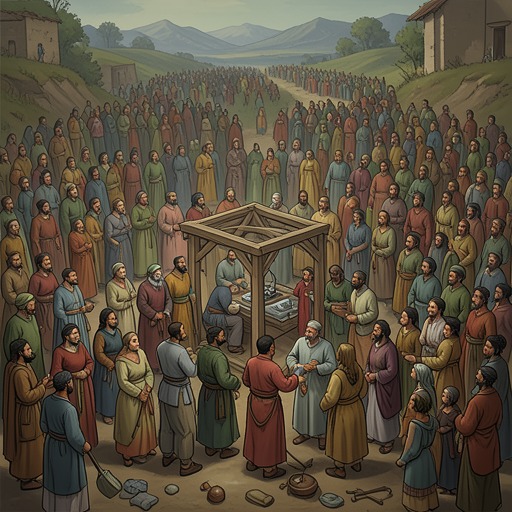
The Twelve’s authority is visible in their response to a practical failure of communal care. When Hellenist widows are reported to receive less in the daily distribution than Hebrew widows, the Twelve identify their particular ministry as teaching and prayer. They recognize that someone must ensure practical solidarity with the widows, but that taking on the distribution themselves would diminish the work they do best. The community selects seven people to serve the widows, while the Twelve maintain their teaching and prayerful leadership.
The description of the seven’s work as “waiting on tables” can also mean keeping accounts, in this context ensuring that the distribution reaches the widows equally. The book emphasizes that this service is not marginal: Jesus describes his own ministry in the same language. The seven are therefore agents of the Realm in relationship with the widows, while the Twelve help the community respond to the inequity by organizing its gifts for the mission. The apostles lay hands on the seven, an act understood both as conveying the power needed for service and as commissioning them to represent the community. They act not merely on their own authority but as representatives of a shared vocation.
This episode complicates any reading of the Twelve as simply officeholders in a fixed institutional hierarchy. The book presents leadership as a response to a particular need and as a means of embodying the Realm. It also warns that roles initially developed to serve mission can lose their purpose when structures harden and focus on preserving institutional power. The Twelve’s example matters because their authority makes room for others to undertake necessary work rather than absorbing every task into their own ministry.
Witness, Conflict, and Continuing Influence
The Twelve belong to a narrative in which witness encounters resistance. The book places the danger faced by Paul and Barnabas in that broader pattern: they encounter hostility in Iconium, and Paul is stoned and left outside Lystra as though dead. Their declaration that entry into the Realm comes through many persecutions frames the cost of public witness. The Twelve’s earlier work of preparing and authorizing the community supplies part of the narrative’s account of how that witness is sustained, even as later episodes show it carried by other leaders and believers.
The book also notes a limit on appeals to apostolic authority in the present. Churches today seldom cast lots, and the apostles are no longer present to give direct guidance; moreover, the Twelve did not address many questions that confront contemporary churches. The account therefore does not provide a ready-made procedure for every later decision. Instead, it directs attention to the sources communities use—including the Bible, tradition, experience, and reason—and to the need for honesty about how those sources are interpreted and weighted.
Across these episodes, the Twelve signify continuity, completeness, and authorization, but their significance is bound to the community’s practical life. They pray and teach, help restore the apostolic circle, and organize a response when widows are not treated equally. Their authority is most intelligible in relation to what it enables: a community prepared to represent the Realm and to continue its witness.