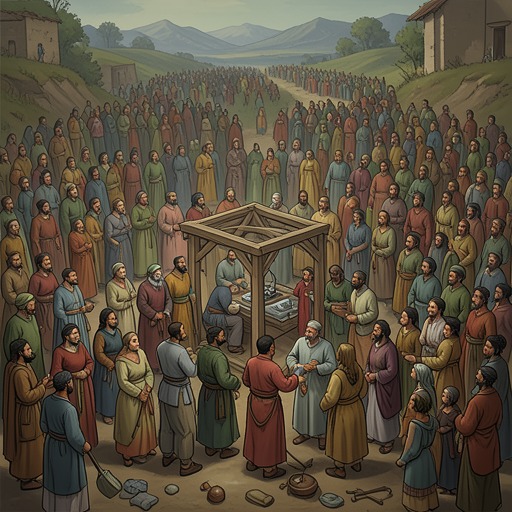
The reunion of Jews and Gentiles
Acts of the ApostlesThe reunion of Jews and Gentiles is the developing inclusion of Gentiles in a movement that Luke presents as arising from Israel’s story, not as a rejection of Judaism. Its decisive claim is that God’s purpose to bless all peoples continues through Jesus and the church: Gentiles join the movement toward the Realm while its Jewish origins and witnesses remain integral to its identity.
Roots in Israel and the Gentile Mission
Luke understands the mission of Jesus and the church as continuous with Israel’s mission. God’s intention, in this account, is to bless all peoples through Israel; Jesus signals that history is in its final days, and the church welcomes Gentiles into the movement toward the Realm. The church is therefore portrayed not as a separate religion replacing Judaism, but as an extension of Judaism. Its leading figures, including Jesus, Peter, and Paul, are presented as faithfully Jewish.
This continuity does not mean that Luke depicts a conflict-free process. The commentary locates a central disagreement in what faithful Jewish life required in the last days, particularly whether Gentiles had to enter Judaism fully in order to be saved. Luke shares the view that Gentiles should believe in the one living God, repent, and adopt core Jewish attitudes and behaviors, but he does not think they must adopt dietary practices or circumcision. This account makes inclusion a contested question of communal boundaries, rather than a simple opposition between restrictive Judaism and liberating Christianity.
Crossings and Shared Experience
The movement outward is marked by successive crossings of social and religious boundaries. In the account of Samaria, the Samaritans are described as sharing a broad religious tradition with Jews while maintaining their own culture and practices. Samaria stands between the Jewish world and the ends of the earth. Philip’s mission there, followed by the arrival of Peter and John, presents outreach to Samaritans as welcomed and authenticated by the church; the community that had previously been entirely Jewish now includes Samaritans.
The narrative gives the inclusion of Gentiles a further authorization through Cornelius, a Gentile centurion and God-fearer who prays and gives alms but has not fully converted to Judaism. Peter’s role links this individual encounter to the apostolic community: he accompanies Cornelius toward conversion, witnesses the Spirit’s coming among Gentiles, and later interprets the mission to the Jerusalem congregation. The account thus reminds Jewish members that the Gentile mission is God’s work, while reminding Gentile members that the good news reaching them is of Jewish origin.
The event often called the Gentile Pentecost makes the shared basis of belonging explicit. The Holy Spirit comes upon Gentiles who hear Peter’s preaching; they speak in tongues, extol the God of Israel, and are baptized. Jewish believers are present as witnesses, and Peter asks whether water for baptism can be withheld from people who have received the Holy Spirit just as the Jewish believers did. The Gentile experience is shown to match the Jewish experience, while the latter remains the originating pattern. Luke’s account consequently calls Gentiles to respect the Jewish community from which their faith comes.
Dispute, Deliberation, and Recognition
The inclusion of Gentiles also produces conflict within the Jerusalem community. When Peter returns, some Jewish believers criticize him for eating with Gentiles. The meal is the immediate issue, but the deeper question is the place in the community of Gentiles who have not fully converted to Judaism. Peter answers by explaining, step by step, the events that led to the Gentiles’ reception of the Holy Spirit. The episode portrays communal discernment as an account of how a theological conclusion was reached, not merely an assertion of authority.
At the Jerusalem council, Peter and Paul and Barnabas offer eyewitness testimony about the Gentile mission, and James interprets that experience through scripture. James connects the welcome of Gentiles to God’s longstanding purpose, reading the prophetic tradition as evidence that God planned to bring Gentiles into the community. His reasoning presents the decision as faithful to Jewish tradition: the council does not turn away from Judaism, but turns Gentiles toward it. The reunion is therefore represented through testimony, scriptural interpretation, debate, and a negotiated decision about the requirements for Gentile belonging.
A Widening Community and Its Tensions
The pattern of inclusion continues beyond the central disputes. In Philippi, Lydia, a Gentile worshipper of God and seller of purple cloth, is baptized along with her household and becomes part of the community of the Realm. Her story locates belonging in a household as well as in an individual’s response. Later, in prison, the jailer who had been responsible for Paul and Silas takes them home, washes their wounds, and is baptized with his household. The narrative describes a reversal in his role: a representative of Roman authority becomes a healer and provider within the community.
The book’s larger movement reaches Rome, where believers come to meet Paul, including people who have traveled from the Forum of Appius and Twin Taverns. Under house arrest, with a soldier guarding him, Paul receives a community that gathers around him and strengthens one another. This scene gives the widening mission a communal ending: the movement’s reach is expressed not only in geographic arrival but in relationships of mutual support.
Luke’s presentation nevertheless needs critical care. The commentary notes that Luke-Acts is not a systematic hatred of Jews, yet it includes bias against Jewish people who reject the validity of the mission and can portray them harshly. Such depictions may reflect tensions between Luke’s congregation and some Jewish leaders of Luke’s time. The reunion should therefore not be recast as Christianity’s victory over Judaism. Its own governing claim is continuity, shared origins, and Gentile inclusion; its conflicts and caricatures remain part of the history that readers must assess rather than repeat.