The witness mission from Jerusalem to the ends of the earth (Acts 1:8)
Acts of the ApostlesThe witness mission from Jerusalem to the ends of the earth (Acts 1:8) is both the programmatic route of Acts and a test of what the church’s witness is meant to become. Empowered by the Holy Spirit, the disciples are to carry news of the Realm outward from Jerusalem and Judea, through Samaria, and toward the ends of the earth. As this movement crosses geographical and communal boundaries, it makes visible the church’s widening inclusion and the continuing work of the ascended Jesus.
Commission and Meaning
The mission answers the disciples’ question about when God will restore the Realm to Israel. Their question imagines restoration chiefly as the recovery of Israel’s political independence; Jesus redirects attention to a broader social and cosmic restoration. The disciples are not given a timetable for the final consummation. Instead, they are promised the Holy Spirit’s special empowerment to bear witness, beginning in Jerusalem and Judea and extending through Samaria to the ends of the earth.
The sequence has three related meanings. It outlines the narrative geography of Acts: the story moves from Jerusalem and Judea through Samaria and onward to the wider world. As that predicted route unfolds, it gives readers grounds to trust Luke’s account of history’s larger movement toward consummation. And the expanding geography expresses the character of the Realm itself: witness begins among Jewish people, includes Samaritans, and reaches gentiles. The route is therefore not merely a travel itinerary; it represents a community whose boundaries are meant to grow.
A Journey Through Distinct Communities
Jerusalem is presented as the symbolic heart of Judaism, while Judea is largely Jewish territory. Samaria occupies a border position between the Jewish world and the “ends of the earth.” Samaritans shared beliefs and practices with Jewish people but had developed their own culture and religious tradition. They worshipped the same God in a broad historical tradition, while their version of the Pentateuch located proper worship on Mount Gerizim; they also had their own priesthood and observances. The mission’s passage into Samaria thus crosses a real communal boundary, not an empty stretch of geography.
The account does not require the relationship between Jewish and Samaritan communities to be reduced to perpetual hostility. Though tensions existed, periods of tolerance and cooperation also occurred. When disciples enter Samaritan territory, their interaction with its residents continues Luke’s earlier positive portrayals of Samaritans. The route signals an expansion of fellowship without erasing the particular history or religious identity of the people it reaches.
The next movement extends the mission further. After the witness passes through Samaria, God guides it onward in the encounter between Philip and the Ethiopian eunuch on the wilderness road from Jerusalem to Gaza. That episode carries the movement toward the ends of the earth in geographical, ethnic, political, and gender-related terms. Its significance is not captured by a simple contrast between a supposedly exclusionary Judaism and a welcoming church: Luke’s interpreter warns against oversimplifying ancient Jewish attitudes toward eunuchs or using the story to strengthen anti-Jewish sentiment. The church must also examine its own ambiguity and failures toward people represented by the eunuch.
Witness in Practice
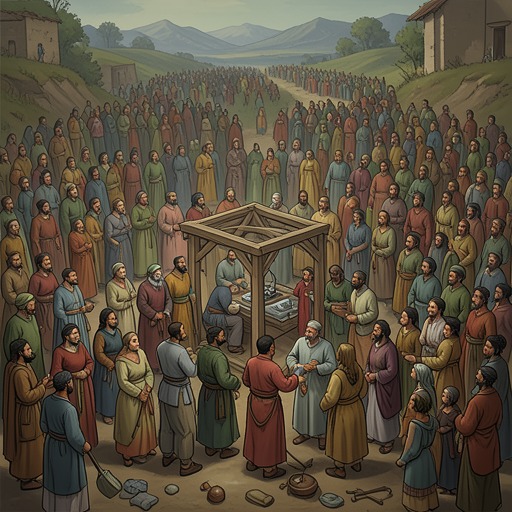
The outward movement is carried by people and communities rather than geography alone. Philip, one of the seven, becomes the principal witness in Samaria. His role connects outreach with the community’s recognition of the mission: Peter and John come from the apostolic circle to join Philip and the converts, and their presence underscores that the initiative is authenticated by the church. Through Philip, God works signs, and his preaching is explicitly described as announcing the news of the Realm.
The response changes the community’s composition. Many Samaritans welcome the presence and coming of the Realm; Simon, a widely heralded magician, is among those who respond to Philip’s preaching and are baptized. In antiquity, magic was understood as an attempt to influence the forces governing life through incantations, formulas, ceremonies, and other practices—not as a modern stage trick. With Samaritan converts, the circle of disciples, previously altogether Jewish, now includes another people. The episode makes the question of further inclusion unavoidable: if Samaritans have been welcomed, whom might the mission reach next?
Authority, Inclusion, and the Church’s Task
The route from Jerusalem and Judea through Samaria to the ends of the earth supplies a measure for evaluating the church’s witness. Luke presents faithful witness as an enlargement of community. The church remains in continuity with Acts when it, too, extends the boundaries of belonging; a mission that leaves its established limits untouched fails to reflect the movement traced by the narrative.
This expansion does not mean that every initiative is automatically supported by institutional power. In the Samaritan episode, the apostles stand alongside Philip’s outreach, showing the church’s authority supporting an initiative that widens participation. The account also makes that alignment a live question for congregations: what should happen when those who hold power resist a faithful effort to extend the community?
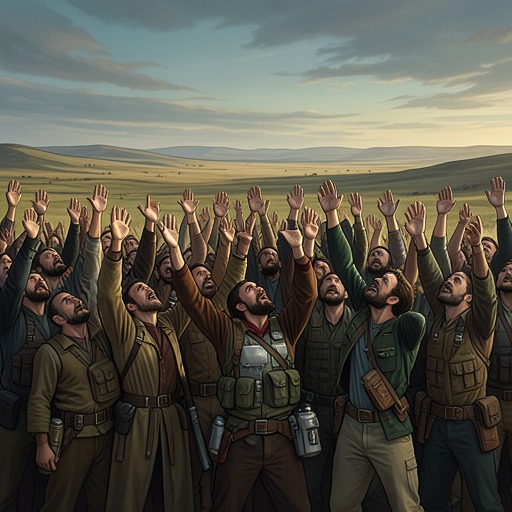
The mission is consequently more than a command to travel farther. The ascended Jesus’ followers are not meant simply to gaze upward; the heavenly figures’ question challenges them to engage in the work entrusted to them. The Spirit-enabled witness continues from the story’s first setting toward the gentile world, embodying the Realm through a community that becomes ever more inclusive. Its geographical reach and its social consequence belong together: the church bears witness to the Realm by carrying its invitation across boundaries and making room for those newly reached.