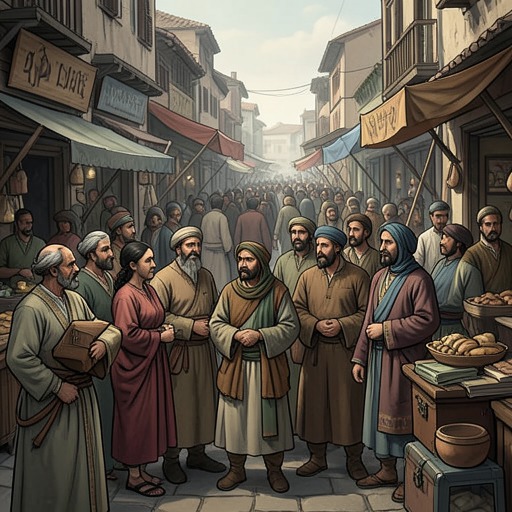
Thessalonica
Acts of the ApostlesThessalonica is the first stop in an episode of Paul and Silas’s journey that contrasts a synagogue’s divided response with a citywide uproar. The city gives the witness to the Realm a socially diverse audience, but it also becomes a place where opponents recast that witness as a threat to Roman order. The authorities’ use of bail releases Jason, while the missionaries slip away by night; the conflict follows them to Beroea, sharpening the contrast between the two cities’ receptions.
Setting in the Missionary Journey
Acts places Thessalonica within a sequence of reversals and contrasts: uproar here, welcome in Beroea, philosophical dialogue in Athens, disputes over legal jurisdiction in Corinth, and finally a return to Antioch. Paul and Silas follow their established pattern of beginning their witness in a synagogue. This setting brings the message into contact with Jewish religious life while also drawing in non-Jewish hearers and people of standing in the city.
The narrative does not present Thessalonica as an isolated episode. The witnesses’ departure leads directly to Beroea, about fifty miles southwest, and the dispute there is not over: opponents from Thessalonica travel after them to stir up unrest. The city therefore functions as a point of departure as well as a scene of conflict, connecting the mission’s local reception to its continued movement across the region.
A Diverse Response to the Message
Luke describes several kinds of response to Paul and Silas’s synagogue preaching: a few Jewish people join the movement, along with a great many devout Greeks and not a few leading women. Their differing religious and social positions make the response more than a single group’s conversion. Together, they exemplify the reunion taking shape in the community of the Realm. The leading women are described as acting on their own in joining the movement, not merely as extensions of another group’s decision.
This gathering of Jewish people and Greeks also gives Thessalonica a role in the book’s larger movement toward an increasingly inclusive community. The witness has moved beyond its initial setting in Jerusalem and Judea, while still taking shape through encounters with Jewish communities. Thessalonica’s diverse respondents embody that expanding fellowship even as the hostility surrounding the episode threatens it.
Uproar and the Charge Against the Witnesses
The episode turns on the reaction of many Jewish opponents, whom Luke describes as jealous. They recruit ruffians and set the city into an uproar while searching for Paul and Silas. Unable to find them, the mob attacks Jason’s house, which may have served as a house church, and drags Jason before the authorities. The household setting becomes a target because it is associated with the missionaries and their local supporters.
The accusation gives the episode its political edge. Paul and Silas are charged with “turning the world (oikoumenē) upside down” and with claiming that Jesus should be the emperor. The charge works in two directions. In the immediate events, it is false: the mob has disturbed the peace, and the Jesus movement has no plan to dethrone Caesar. Yet the accusation also touches a real tension in the witness. Announcing that the old world is ending and will be replaced by the Realm challenges the assumptions and arrangements of that order. Jesus does not simply take Caesar’s place in Rome; he rules from the right hand of God.
Legal Procedure and Departure
The city officials and the people are distressed by the charges, but the officials act according to Roman law. They take bail money from Jason and release the witnesses, a procedure that protects them from possible vigilante harm. The episode thus distinguishes official handling of the disturbance from the mob’s violence: the authorities accept security and release those brought before them rather than handing them over to the crowd.
Afterward, Paul and Silas leave Thessalonica by night and travel to Beroea. Their departure does not end the opposition’s pursuit. People from Thessalonica reach Beroea and stir up unrest there as well, and the Bereoans send Paul on to safety in Athens. In the narrative’s pointed contrast, Paul is safer in Athens, a city described as full of idols, than in the Thessalonian synagogue where his mission began.
Narrative and Political Significance
Thessalonica brings together two sharply different meanings of disturbance. The mob’s actions create the immediate disorder, yet its accusation also registers how a message of social and cosmic restoration can appear threatening to institutions invested in the old age. To those committed to the existing order, the Realm’s rejection of repression, exploitation, injustice, and violence can look like an attack on peace; within the episode, however, the witnesses are not the ones who set the city into an uproar.
The city’s role is therefore defined by a contrast: it produces a diverse response to the message, but also a public accusation, a threatened household, and a departure under pressure. Roman legal procedure offers Jason and the witnesses a measure of protection without making the city a safe place for the mission. By carrying the conflict onward to Beroea, the episode shows both the vulnerability of the community and the persistence of its witness as it moves beyond Thessalonica.