idolatry and social disorder in Ephesus
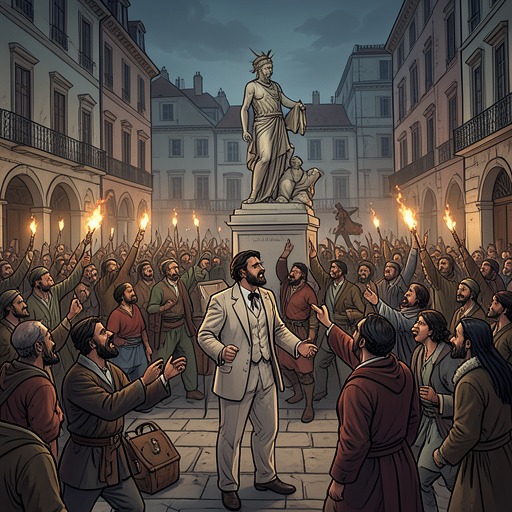
Acts of the ApostlesIdolatry and social disorder in Ephesus is the collision between Paul’s witness to the Realm and a city’s religious and economic investment in Artemis. Luke’s account does not treat the uproar as a simple contest between belief and unbelief: devotion to the goddess, the silversmiths’ income, and communal anxiety about the temple’s standing reinforce one another, until a public gathering becomes disorder. The town clerk eventually quiets the crowd by insisting on ordinary legal process, giving the episode its pointed contrast between idolatrous agitation and civic restraint.
Ephesus, Artemis, and local religion
The episode assumes that readers know Artemis as a popular goddess in first-century Asia Minor and a figure associated with fertility. Archaeological images described in the commentary represent her with a chest covered either with breasts or with bull’s testes. This local religious setting matters to the account: the dispute concerns a deity whose worship was embedded in civic life, not an abstract question about whether religion should exist.
The commentary places this setting within a wider world of multiple deities. Many people in the Mediterranean world believed that different gods held responsibility for particular territories or spheres of life. The altar to an unknown god in Athens is offered as a likely example of this religious logic: its builders may have wanted to cover the possibility that named gods did not protect every place or interest. That account of religious plurality helps explain why the worship of Artemis could be understood as a practical source of protection as well as a form of devotion.
The book also sets the Ephesian conflict against Paul’s earlier witness in the city. His powerful preaching prompts many people to stop buying Artemis shrines. The change in religious practice has an immediate economic consequence, and it also signals that the Realm’s influence is changing what people support and honor. The resulting conflict joins questions of worship, livelihood, and public allegiance rather than keeping them separate.
Economic interests and idolatrous allegiance
Demetrius, a silversmith, identifies both the loss of income to artisans and the danger that people will begin to scorn the temple of Artemis. His argument links the silversmiths’ trade to the goddess’s public honor: if the temple loses adoration, he assumes, Artemis may in turn fail to care for the Ephesians. The commentary reads this as intertwined idolatry, in which worship of money and worship of Artemis reinforce each other. The religious claim protects the economic interest, while the economic interest gives that claim an immediate material stake.
The silversmiths respond in anger by professing faith in Artemis. Yet the crowd’s later conduct exposes the instability of the appeal to religious devotion: it becomes a prolonged uproar rather than a settled expression of communal order. In the book’s broader account of the old age, idolatry belongs with injustice, exploitation, enmity, violence, and social fracture. The Ephesian episode gives that theological pattern a particular civic form: a perceived threat to worship and income fuels collective disorder.
This interpretation does not reduce every participant’s religious attachment to financial calculation. Rather, the evidence shows how the episode binds the artisans’ income to concern for Artemis’s honor and the city’s welfare. The narrative’s criticism falls on this convergence, where claims about a goddess’s protection and the defense of a trade become mutually supporting reasons for agitation.
The crowd and the town clerk
Demetrius’s companions draw Gaius and Aristarchus, two companions of Paul, into the theater. Paul wants to enter as well, but both disciples and some friendly local officials try to prevent him from taking that risk. The detail complicates the scene: the account depicts not only public confrontation but also disagreement about whether joining it is a wise course of action. The commentary presents that hesitation as a question of judgment, without resolving it into a single rule for when a witness should step forward or hold back.
Alexander attempts to address the crowd, but it dismisses him because he is Jewish. The assembly then erupts into two hours of uproarious confession of Artemis. The crowd’s rejection of Alexander and its repeated acclamation of the goddess expose a social division within the gathering, while the duration makes the disorder more than a brief disturbance. In the commentary’s interpretation, this chaos is one of idolatry’s primary social consequences.
A town clerk, a civic official approved by the Roman Empire, quiets the crowd. He argues that the witnesses have neither robbed the temple nor blasphemed Artemis, and directs Demetrius and his companions to take legal complaints to the courts or to raise further matters in a regular assembly. He then insists that the group disperse lest its members be charged with rioting. His intervention does not decide the theological dispute; it contains the immediate threat by distinguishing lawful complaint from an unlawful assembly.
Social order, empire, and the Realm
The clerk’s appeal to legal procedure makes the episode more complicated than a simple opposition between the Christian mission and Roman authority. The account identifies him as an imperial civic official, yet his actions serve the purposes of the Realm by calming the crowd and requiring those with complaints to use established procedures. In this scene, an official of the empire protects the witnesses from a disorderly accusation by requiring the artisans to follow the law.
That resolution sits within Luke’s larger contrast between the old age and the Realm of God. The old creation includes empires that seek ultimate allegiance and demand subservience; the Realm is associated with justice, mutual support, social equality, peace, and life. The book also cautions that people and institutions invested in the old age may perceive Realm-like values and practices as threats. The Ephesian uproar makes that tension concrete: the challenge to Artemis shrines unsettles both the cult’s standing and an economic arrangement tied to it, while the city’s official restores order without endorsing the crowd’s religious claims.
The episode therefore treats social disorder not as an incidental backdrop to religious disagreement but as a consequence of allegiances and interests joined together. Artemis worship, the silversmiths’ livelihood, and concern for the city’s welfare converge in Demetrius’s appeal; the crowd turns that appeal into an uproar; and the clerk ends the immediate crisis through legal restraint. The result is a layered portrait of public religion in Ephesus and of the Realm’s encounter with a society whose inherited structures can interpret change as a threat to order.