tent maker ministry
Acts of the ApostlesTent maker ministry names a form of ministry in which an outside occupation provides financial support for religious work. In Acts, Paul’s work with Priscilla and Aquila in Corinth gives the expression its concrete model: their trade sustained the mission and located its practitioners in the marketplace, while the pair’s later shared teaching with Apollos connects their working partnership to collaborative leadership.
Work and Mission in Corinth
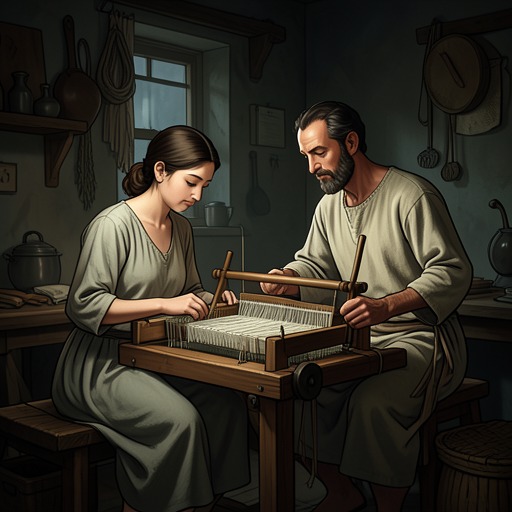
After leaving Athens, Paul travels to Corinth and meets Priscilla and Aquila, Jewish refugees who had come from Rome after Emperor Claudius expelled the city’s Jewish population, probably in 49 CE. The three are evidently tentmakers. Because tents were often made from leather or heavy cloth, tentmaking commonly involved leatherworking or weaving more broadly.
The work had a practical and a public dimension. It helped explain how Paul financed his missionary activity, and it put him in the marketplace, where people also gathered to discuss philosophy in workers’ stalls. His trade was therefore not simply an economic detail separate from the mission: it provided material support while placing him in a setting of public exchange.
The Expression and Its Later Use
The phrase tent maker ministry is used for ministers who hold outside jobs to support their ministry, as tentmaking did for Paul. The term draws on the account of Acts 18:1–4, but its application to later forms of church work extends beyond the circumstances Luke describes.
The discussion distinguishes the ancient example from present-day institutional concerns. Luke does not present tentmaking as a solution to modern questions of church leadership. Yet congregations with dwindling resources and ministers facing reduced support have increasingly adopted comparable arrangements. The passage can thus prompt consideration of how a ministry sustained partly through other work functions in different settings, and of its possible long-term effects.
Partnership and Shared Leadership
The Corinth episode also introduces a working relationship among Paul, Priscilla, and Aquila. Acts 18:24–28 gives the partnership a further dimension: Priscilla and Aquila jointly teach Apollos, a learned and wealthy Jewish person from Alexandria. Their shared responsibility for teaching models an egalitarian approach to leadership associated with the community of the Realm.
This account cautions against imposing a later institutional label on the pair, but it does show them acting together as teachers. Tent maker ministry, in this broader narrative context, is linked not only to the means of financing mission but also to a collaborative pattern of work and leadership. The narrative’s emphasis falls on practical labor, public presence, and shared responsibility rather than on a formal office or a prescribed modern model.