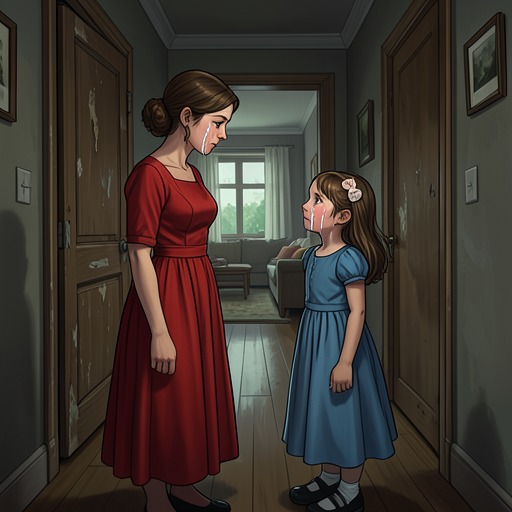
Carol
After Ever HappyCarol, Tessa’s mother, is initially seen as a hard and impatient presence around her daughter’s silence after Richard’s death. Her later breakdown complicates that impression: grief over the man who left her coexists with anger, shame, and relief that he is gone. Across these moments, she remains difficult for Tessa to reach, even as the loss makes visible what her guardedness has concealed.
Identity and Presence
Carol appears in the aftermath of Tessa discovering her father’s body. Tessa is not speaking, and Carol asks what is wrong with her and what she is supposed to do if her daughter will not talk. The questions register fear and helplessness, but their sharpness makes them feel like demands placed on someone who is still in shock. Ken explains that Tessa is shocked and will come around; Noah, addressing Carol directly, reminds her that Tessa found her father’s body only a few days earlier and asks her to be gentle.
The contrast matters: Carol is physically present, but Noah is the person Tessa needs beside her. As Noah lifts Tessa from the floor, she buries her face against his chest and closes her eyes. She feels relief at being near the old friend who knew her before, and wants to be taken away from the house. Carol’s presence, then, does not provide the comfort Tessa can accept in that moment. The scene establishes a painful gap between a mother’s proximity and her daughter’s need for care.
Conflict over Hardin
Carol also challenges Hardin’s return. She asks how he arrived when he had been in London; he answers that he came by plane. Her objection is not simply to his sudden appearance before sunrise. She insists that Tessa has made clear he has no place with her, accuses him of hurting Tessa, and says she will not stand by and allow it. When Hardin rejects the need for her approval, Carol answers that Tessa does not need him either. She takes the glass from Tessa’s hand and slams it onto the counter, a forceful gesture that turns the disagreement into a confrontation unfolding directly beside her daughter.
Carol’s intervention is protective in its stated aim: she believes Hardin is hurting Tessa and tries to keep him away. But the scene also places her authority in tension with Tessa’s own position. Carol speaks for what her daughter needs while Tessa is present, and her anger escalates the pressure around someone already grieving. The exchange does not resolve whether Hardin should be there; instead, it shows Carol trying to control his access to Tessa while the family’s grief remains raw.
Richard’s Death and the Grief Beneath the Anger
Hardin’s argument with Carol breaks open when he tells her to be there for Tessa. Carol asks who is there for her. Her voice cracks, and she leans against the counter to keep from falling. Though it is five in the morning, her makeup is still carefully applied; tears run down her face as she describes Richard leaving her after promising them a good life. She says she could never look at another man after him and that his departure ruined her life. In her distress, she sweeps jars of utensils off the counter.
Then Carol reaches for Hardin, grips his shoulder, and buries her head against his chest, sobbing. He does not push her away. Her grief briefly makes her resemble the girl he loves, and he responds by putting an arm around her and staying silent. The reversal is striking: Hardin and Carol have just been opposing one another over Tessa, yet he becomes the person who receives Carol’s grief. Her vulnerability does not erase the earlier confrontation; it reveals the hurt that has been living behind the hard manner Tessa’s family sees.
Carol admits that she had wished Richard would die. She had waited for him and told herself for years that he would return; now that he is dead, she can no longer sustain that hope. Her shame at feeling glad about his death sits alongside the pain of abandonment. She stays against Hardin for a long time, crying and expressing, in different words, her self-hatred over that relief. Richard’s death therefore brings no simple reconciliation or release: it ends the possibility of his return while forcing Carol to face how long she had continued to wait.
Withdrawal and Unresolved Loss
Carol’s grief remains difficult to discuss openly with Tessa. In a later conversation, she pauses with lipstick held near her lips while they look at one another through a mirror. Tessa notices that Carol’s eyes are swollen and understands them as evidence that her mother has taken Richard’s death harder than she will admit. When financial matters arise, Carol calls Tessa Theresa and ends the discussion, walking into the living room. Tessa does not pursue the argument, unwilling to start a fight on a day she already expects to be hard.
The scenes offer two different forms of Carol’s guardedness. With Hardin, grief erupts into tears, confession, and physical dependence; with Tessa, the conversation closes before its financial subject can be addressed. Her sorrow is visible to her daughter, but visibility does not make it easy to share. Carol is thus defined less by a single attitude toward Richard than by the unresolved contradiction his death exposes: she resented his abandonment, continued to hope he would return, and feels ashamed that his death has brought relief as well as grief.