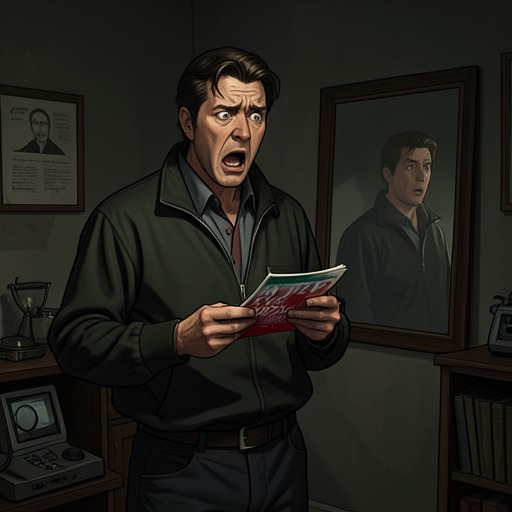
Ken Scott
After Ever HappyKen Scott’s place in Hardin Scott’s life is shaped by a painful distinction between biological paternity and lived fatherhood: Christian Vance is revealed as Hardin’s biological father, but Ken raised him, loved him, and remained a figure of hope even when the truth was unresolved. The revelation reframes Ken not simply as the man Hardin assumed to be his father, but as someone whose attachment persisted amid betrayal, alcoholism, and uncertainty.
Identity and Paternity
Ken is introduced through Hardin’s resemblance to him. Remembering their first meeting in a yogurt shop, Tessa immediately concluded that Ken must be Hardin’s father: his dark hair and height seemed to settle the question. Kimberly, however, points to Hardin’s shared eyes and facial structure with Christian Vance, as well as their dimples. The contrast between these impressions captures how convincing the presumed family likeness had been—and how appearance alone cannot resolve the secret.
Marriage, Betrayal, and Alcoholism
Ken and Christian Vance had grown up as close friends, nearly brothers, before Vance became involved with Ken’s wife, Trish. The affair continued on and off for years while Ken worked and studied for his master’s degree and Trish stayed home with Hardin. Vance eventually moved closer, directly across the street from the family home. Ken knew about the affair, and Vance associates that knowledge with the beginning of Ken’s drinking. The betrayal thus altered the household in which Ken was raising Hardin: as Vance’s drinking grew heavier and more frequent, he tried to persuade Trish to let him take Hardin, but she would not acknowledge that Vance was the boy’s father. Vance eventually left.
Ken’s alcoholism damaged his appearance and, through it, complicated how others read the family resemblance: Tessa recalls that it made him look older than Vance, though she still regarded Ken as Hardin’s father. Yet Ken’s attachment to Hardin endured the uncertainty. Vance describes him as hopeful rather than foolish: despite suspecting that Hardin might be another man’s son, Ken loved him and continued to act as his father. According to Vance, Hardin was the reason Ken stopped drinking and returned to finish his degree. Ken also regretted the suffering he had caused Hardin and Trish, making his later effort at recovery a response not merely to the secret of paternity but to the harm within the family.
Presence During a Family Conflict
Ken’s later presence in the family is visible during a confrontation between Hardin and Landon. When Hardin grabs Landon by the shirt and shoves him against a wall, the argument escalates until Hardin threatens to smash his cast; after lowering his fist, he leaves without striking Landon. Ken and Karen speak quietly and move toward Landon, while Sophia comforts him. The scene gives Ken no speech or direct intervention, but places him among the family members responding to the rupture. Hardin’s decision to walk away from violence is the decisive change in the moment; Ken’s quiet presence belongs to the family setting in which that restraint occurs.
Fatherhood Across Generations
A decade later, the epilogue places Hardin in the role of a father: he refuses to let seventeen-year-old Emery go on a senior trip, while she argues that Landon let Addelyn Rose go the previous year. After Emery and Auden leave for school, Hardin jokes with Tessa and draws her into his arms; she reflects that it has been a long road. Ken is not present in this scene, and the text does not connect his later life directly to his grandchildren. Its relevance to Ken’s story lies instead in the contrast between the uncertain, painful conditions under which he raised Hardin and the domestic future the novel shows Hardin building with Tessa.