Ken Scott’s alcoholism
After Ever HappyKen Scott’s alcoholism is a defining absence in Hardin Scott’s childhood: a father physically present in the home but often passed out, emotionally distant, and remembered through the liquor at his feet. Later disclosures connect the beginning of Ken’s drinking to the affair between Christian Vance and Hardin’s mother, though that explanation comes from Vance and does not erase the harm Hardin experienced. Ken eventually becomes sober and returns to finish his degree; Vance says that love for Hardin helped prompt both changes, giving the history a late, difficult counterpoint to its years of neglect.
Childhood and the household
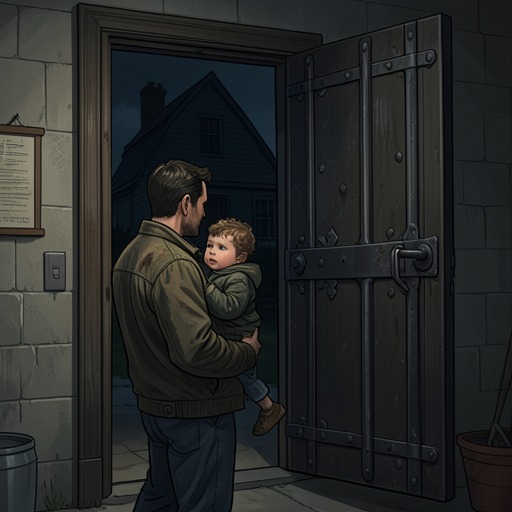
Hardin recalls a small living room and Ken asleep in a chair, a bottle of brown liquor on the floor beside him. On the morning after one of Hardin’s essays was selected for the local paper, his mother called to praise Hardin as brilliant, like his father. Ken stirred in the chair, and she quickly ended the call. The scene brings parental praise and domestic distress into the same moment: the father invoked as a source of brilliance is, to the child watching him, plainly unwell.
Hardin remembers many similar occasions, too numerous to count. When he was young, he could not understand why Ken was so distant or why he did not hug him as his friends’ fathers hugged their sons. Ken never played baseball with him or taught him practical skills; in Hardin’s bitter recollection, what he learned from Ken was how to be drunk. The repeated absence of affection and ordinary shared activities makes the alcoholism more than a private habit: it is the condition through which Hardin remembers the failure of everyday fatherhood.
The affair and the onset of drinking
As an adult, Hardin learns that Vance and his mother had resumed their relationship repeatedly over a period of years. Vance says he moved closer to the family home, directly across the street, and that Ken knew about the affair; after recounting this, he says Ken began drinking. Vance’s account therefore places the onset of the alcoholism within a family history of secrecy and betrayal. It is his explanation of the timing, not a resolution of every question about Ken’s drinking or a justification for what followed.
Vance describes Ken as working and studying for his master’s degree while Hardin was young. He says that Ken’s drinking became heavier and more frequent each week. Vance also recalls trying to persuade Hardin’s mother to bring the child to live with him, but she would not. She did not acknowledge that Hardin was Vance’s son, even to Vance, and Vance eventually left. He says he continued to support mother and child financially, but returned to America after Hardin’s mother began sending his checks back and stopped answering his calls. In this telling, the affair, the disputed paternity, and the adults’ decisions form the circumstances around Ken’s worsening alcoholism, while Hardin remains the child living with its consequences.
Years of drinking and their cost
Vance says Ken stayed a drunk year after year, until something finally led him to decide he had had enough. Hardin’s own account fills in what that duration meant at home: lonely teenage years, with company sought among the wrong crowd. His anger at Vance is intensified by the contrast he draws between the childhood he endured with an alcoholic and Vance’s life elsewhere. The revelation does not simply supply a family secret; it forces Hardin to reconsider who his father was and how much of his childhood can be understood through decisions made by the adults around him.
The uncertainty over Hardin’s biological paternity sharpens, rather than cancels, the question of Ken’s fatherhood. Vance says Ken always had suspicions but remained hopeful that Hardin was his son. When Hardin challenges the idea that Ken could still believe this after the affair, Vance insists that Ken was not foolish: he loved Hardin, and continued to love him. He says Hardin was the reason Ken stopped drinking and went back to complete his degree, and that Ken regretted the suffering he had caused Hardin and his mother. These statements come from Vance, but they offer Hardin a different account of Ken than the child’s memories of the bottle and the unanswered need for affection.
Sobriety and the meaning of fatherhood
By the time Ken contacts Vance again after moving to the States, Vance says, Ken is sober. The account does not describe the process of recovery in detail; it establishes the change through this later meeting and Vance’s description of Ken’s return to education. Sobriety therefore appears as a turning point reported after years of drinking, not as a retroactive repair of the childhood Hardin remembers.
The state’s significance lies in that unresolved contrast. Ken’s alcoholism deprived Hardin of ordinary paternal care and left him lonely, angry, and uncertain about his place in the family. Yet Vance’s account presents Ken’s later sobriety and completed degree as actions connected to enduring love for the boy he raised, despite uncertainty about biology. The narrative holds these facts together: recovery matters, but it does not make the past disappear; the father who failed Hardin in repeated daily ways is also described as a man who changed and continued to hope that Hardin was his son.