Lookout
After Ever HappyLookout is a newly opened, highly priced modern restaurant in Manhattan where Tessa works as a waitress. Its strict uniform, dim dining areas, and briskly changing lunch and dinner crowds give shape to her working life in the city; its tables and lobby also become places where her effort to build a separate routine meets the people closest to her. The restaurant’s significance lies in that double role: it is a job she takes seriously in its own right, but it is also where Hardin’s arrival becomes a practical, visible interruption to the life she is trying to establish.
Setting and Design
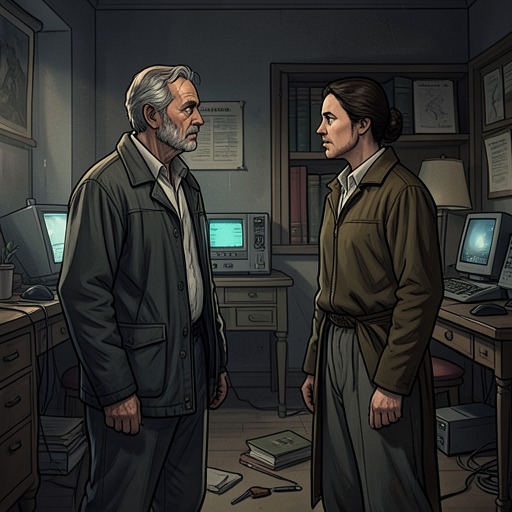
Lookout is presented as upscale and expensive, with small portions of food served on decorated plates. The dining room is dark enough that Tessa’s eyes take several seconds to adjust when she comes in from the afternoon sun. The hallways are darker still: a clock’s red glow and deep-blue numbers help make the time legible there, while the kitchen and break room have standard lighting. The contrast separates the restaurant’s customer-facing darkness from the brighter spaces where staff prepare for work and take a pause.
The staff areas are part of Tessa’s working routine rather than incidental scenery. Before a shift, she follows Robert through the dim restaurant to the break room, puts her purse in a small locker, and watches him place his phone on a shelf. These concrete details give the workplace a working back end behind its polished, low-lit public face. The entrance, hallways, break room, kitchen, and lobby form a sequence of spaces through which the story moves between service work and private encounters.
Tessa’s Work and Routine
Tessa’s uniform consists of a black button-up shirt, black pants, and black shoes, with a neon-green tie as the one part she dislikes. It takes her two weeks to get used to wearing it. She is nevertheless grateful for the position, which she gets through Sophia, Lookout’s head pastry chef. The job therefore begins through a connection, but Tessa’s account also emphasizes her own commitment to working: when Landon worries that she is working too much and says she does not need to help pay for anything, she insists she will not keep revisiting the argument.
Tessa walks twenty minutes each way to the restaurant. She is still finding her way through the large city, and getting lost among busy crowds gradually becomes a source of connection rather than only disorientation. Street noise that initially kept her awake—the voices, sirens, and horns—comes to feel almost calming as she blends into the crowds. Lookout is one anchor in that process: a regular destination within a city she is still learning, reached through a commute that lets her experience its scale and activity.
The shifts themselves are organized by the restaurant’s changing crowds. One shift moves quickly as the lunch customers leave and dinner customers begin to arrive. On another, a difficult table keeps Tessa occupied: a drunk woman cannot decide what to order and sends her food back three times, while her husband pays more attention to his phone than to the meal. Tessa is grateful for the interruption because it limits how often she must stop at the table where Landon and Hardin are sitting. The encounter shows service work shaping not only her schedule but also how much contact she can manage with people from her private life.
Encounters at the Restaurant
Two blocks from Lookout, Tessa nearly collides with Robert, who reaches out to stop her. His joke about their shared workplace and his comically adjusted lime-green tie turn the approach to the restaurant into a moment of easy collegiality. As they cross the street, a group of teenage girls giggles at Robert; Tessa notices that he is handsome. The scene places the restaurant within a social world that begins before its doors, and it establishes Robert as a familiar presence on the walk to work as well as inside the building.
Robert also offers Tessa room to talk about Hardin, though she decides not to open what she describes as a long-closed subject. When Landon and Hardin arrive and request her section, Robert tells her they are there while anxiously handling the hem of his apron. Tessa expects to panic but instead nods and goes toward the entrance, trying to look for Landon rather than Hardin. The restaurant’s ordinary assignment of tables thus becomes a test of composure: the men have entered her workplace, but she still has to approach them as their waitress.
The meal is restrained. Hardin orders lamb ravioli and water; Landon orders his usual and asks whether Sophia is busy in the kitchen. Tessa limits her visits to filling their drinks and clearing their plates, helped by the other table that holds her attention. Sophia writes off their bill, while Hardin leaves Tessa an unusually large tip. Tessa refuses to keep it and makes Landon return it to Hardin at the apartment. The exchanged favors and rejected money bring their personal history into the workplace without dissolving the distinction Tessa is trying to maintain between the two.
The Workplace and Tessa’s Independence
Lookout’s demands become especially tangible during a later shift. The restaurant is swamped with customers drinking wine or brandy, and Tessa has no break for more than five hours. A child spills a plate of spaghetti onto her uniform, and by the time she clocks out her feet hurt. The scene sets the polished presentation of the restaurant against the physical costs of serving there: the decorated plates and expensive food are the customers’ experience, while Tessa carries the long shift and the stains home with her.
Hardin waits for her in the lobby as promised, with Sophia standing beside the bench where he is sitting. Tessa is embarrassed by her dirty clothes and the smell of garlic and tomato sauce on her shirt, but Hardin does not appear to mind; as they walk outside, he removes a small piece of something from her ponytail and gives her a tissue. Lookout remains a workplace even at the close of the shift, marked by the soiled uniform and the fatigue Tessa has earned, while its lobby allows Hardin to meet her at the end of that labor.
Across these scenes, Lookout is neither merely a backdrop for romance nor simply a symbol of independence. It gives Tessa a job, a repeated route through Manhattan, and the demands of work that continue regardless of her feelings about Hardin’s arrival. At the same time, its tables and lobby repeatedly draw her personal relationships into that routine. The tension between those functions is central to the location: Tessa’s new life is real and effortful, but it is not sealed off from the people she is trying to keep at a distance.