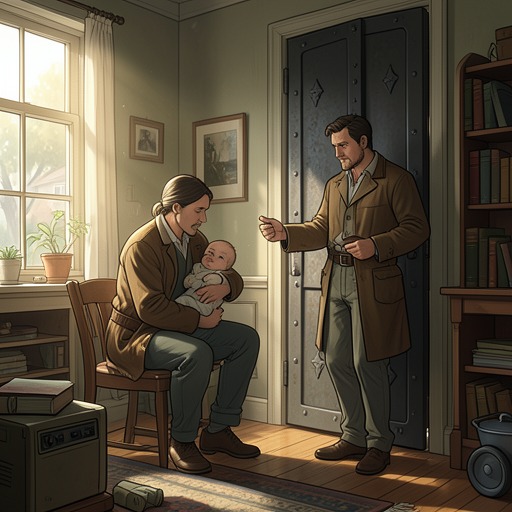
Tessa discovers her second pregnancy
After Ever HappyTessa discovers her second pregnancy in winter, at a point when she and Hardin have just decided to stop trying for a while. The positive test changes a pause meant to protect them from the strain of trying into a moment of cautious hope. Because the news follows medical warnings about Tessa’s cervix, a long period of trying, and a miscarriage, the announcement carries both excitement and the knowledge that pregnancy does not guarantee a safe outcome. Seven months later, Tessa gives birth to Emery.
Medical Concerns and the Road to the Announcement
The pregnancy comes against a history of reproductive uncertainty. After going to a doctor for birth control, Tessa tells Kimberly that a scan showed her cervix was shorter than average and that further testing was needed; the doctor had also mentioned infertility. At a later examination, Dr. West describes her cervix as both very narrow and very short. Tessa has already researched what the finding might mean, and the diagnosis weighs on her before the later pregnancy announcement.
The possibility of infertility also touches a desire that Tessa has expressed in intimate terms. While discussing Hardin’s self-destructive sense of himself as a villain, she tells Kimberly that she is trying to save him even as she struggles to keep herself afloat. Then, embarrassed, she discloses the medical concern. Kimberly responds with laughter at Tessa’s whispered mention of birth control, but listens as the conversation turns serious. She recounts another woman’s years of difficulty conceiving and attempts at fertility treatment, a story that offers no simple reassurance: the woman eventually became pregnant, but Kimberly’s manner suggests she may be withholding part of what happened.
Tessa’s own fear becomes more explicit when she holds her hands over her stomach and tells Hardin that she cannot have a child. He answers that they can. His certainty is an expression of support, not a medical resolution: the earlier diagnosis remains, and the prospect of parenthood is still uncertain. That distinction matters when the couple’s later efforts bring hope, loss, and then another pregnancy rather than a straightforward path to a family.
Trying, Loss, and the Decision to Pause
By the time of the announcement, Tessa and Hardin have been trying to conceive for more than a year. They have attended fertility appointments and followed ovulation schedules, while also trying wives’ tales and a bitter, chunky mixture Tessa believes helped a friend’s husband. Hardin remembers the effort as a repeated alternation between sex and making love, a description that conveys how the attempt to conceive has become part of their daily intimacy as well as a practical routine.
Their hopes exist alongside other people’s approaching parenthood. Landon and his wife are expecting a girl, and Tessa and Hardin are to be the child’s godparents, Addelyn Rose. Tessa helps plan the baby shower and paint the nursery, and Hardin wipes away her tears while pretending not to feel sad for them. The scene places their private longing beside the preparations for a friend’s baby: Tessa can care for another family’s happiness while grieving what remains uncertain in her own.
The couple’s previous pregnancy ended in miscarriage. After a call from their doctor, Hardin carries Tessa to the car and drives her to the hospital. Thirty minutes after arriving, they learn that the baby has been lost. Tessa apologizes through her sobs, and Hardin repeatedly tells her she has nothing to be sorry for. His memory of that devastation gives the later positive test its emotional weight, while also explaining why neither of them can treat pregnancy as an uncomplicated promise.
A year after that loss, they have just decided to take a break from trying to conceive. The decision marks a change in their immediate approach, not the end of their wish to have a child. It is against this temporary pause, after so much effort and grief, that Tessa brings Hardin the test.
The Positive Test
The reveal unfolds at home on an otherwise ordinary winter morning. Hardin has just finished a call with Christian and is sitting on a kitchen stool when Tessa enters, dressed in a light pink lace dress, her hair arranged in an elegant bun. He gestures for her to sit on his lap, and the moment begins with their familiar physical ease rather than a formal announcement. Tessa leans against him; he kisses her neck, and she rests her hands on his knees.
Tessa reaches into the front pocket of her dress and takes out a folded piece of paper. Hardin does not immediately understand what she is showing him. When he asks what it is, she scolds him for spoiling the moment; he lifts the paper closer and reads the result: “Urine test positive.” The small, plain wording is the announcement itself. There is no elaborate reveal, only a test result placed in his hand and the pause as he understands its meaning.
Hardin’s first response is a stunned “Shit.” Tessa laughs, but admits that she is afraid to become too excited. Her caution follows naturally from the couple’s history: a possible fertility impairment, a long stretch of trying, and the recent loss have made hope difficult to separate from fear. Hardin takes her hand, crumpling the paper between them, and urges her not to hold back her excitement. He acknowledges that they do not know what will happen, but says they should be as excited as they want to be. His response does not deny uncertainty; it makes room for joy within it.
Tessa calls the pregnancy a miracle, trying to make the remark a joke even as her seriousness shows through. The exchange holds the event’s central tension in a few gestures and words: the test confirms a pregnancy, but not its outcome. The paper is evidence of new possibility, not yet a guarantee, and their happiness remains inseparable from what they have already endured.
Outcome and Significance
Seven months after the announcement, Tessa gives birth to Emery, whom Hardin remembers as their blond little miracle. That later birth gives the discovery a joyful outcome, but does not erase the uncertainty with which the couple receives the test. The pregnancy is significant not simply because it fulfills their wish for a child, but because it follows a diagnosis that raised the possibility of infertility and a miscarriage that made the danger of loss immediate.
The scene also revises the meaning of the couple’s decision to pause. They had agreed to take a break from trying; the pregnancy arrives without being presented as the result of a renewed schedule or another treatment. The narrative does not explain how conception occurred, and the event is not framed as proof that effort or optimism can overcome medical risk. Instead, it records an unexpected opening after prolonged attempts and grief, allowing the characters happiness without pretending they can control what comes next.
Hardin’s narration gives the announcement a retrospective shape. He recounts the ordinary morning, his failure to recognize the significance of the paper at first, and Tessa’s fear of being too hopeful, while the later birth supplies the outcome he could not know in that moment. The distance between the uncertain test and Emery’s arrival lets the scene hold two truths at once: the pregnancy begins as fragile possibility, and it becomes the birth of a child the couple had long hoped for.