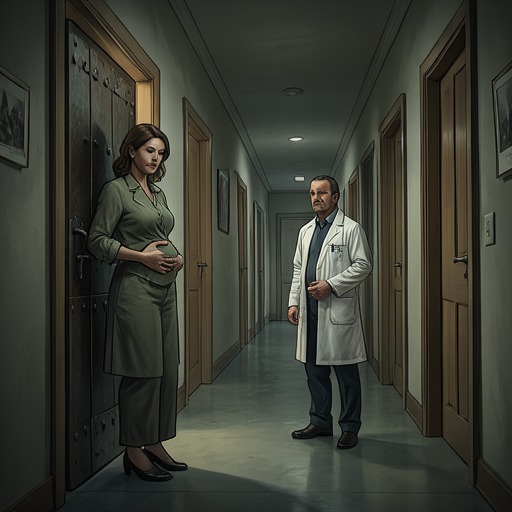
Tessa learns she may have difficulty getting pregnant
After Ever HappyTessa learns she may have difficulty getting pregnant when a cervical examination leads to a stark assessment of her reproductive prospects. The event is not a declaration that pregnancy is impossible: the doctor describes it as highly unlikely and raises adoption as one possible route. Its significance lies in the distance between that cautious medical language and the life-altering certainty Tessa feels, as well as in how the finding shadows her and Hardin’s later attempts to become parents.
First Warning and Disclosure
Tessa first learns of the concern after going to the doctor for birth control. During a quick scan, her doctor notes that her cervix is shorter than average, recommends further testing, and mentions infertility. The discovery arrives as a possibility rather than a settled diagnosis, but the word is enough to make a hoped-for future feel suddenly uncertain.
She tells Kimberly about the examination, and the disclosure sits amid a larger confession about her fear for Hardin. Tessa describes feeling as if she is struggling to keep herself above water while trying to save him, then admits she is frightened by what she has heard about her fertility. Kimberly responds warmly, urging her not to whisper the news. The scene places two kinds of strain side by side: Tessa’s concern for Hardin and the possibility that her own body may complicate the future she wants.
At Tessa’s request, Kimberly recounts the experience of an unnamed woman who struggled for years to become pregnant. The couple tried fertility treatments and other approaches before she eventually conceived. Kimberly presents that story as a reason for hope, though Tessa senses that she may be withholding or softening part of it. The conversation offers no medical resolution; it gives Tessa another person’s account to weigh against the frightening uncertainty of her own.
Examination and Medical Assessment
At the later appointment, Dr. West reviews the images from Tessa’s examination. He describes her cervix as very narrow and, from what he can see, very short, then asks whether she would like him to explain the images. Tessa agrees. She has already researched the implications and has anticipated his conclusion since leaving his office two and a half weeks earlier; the consultation confirms rather than introduces the fear.
After ten minutes of detailed explanation, Dr. West tells her that pregnancy is “Not impossible, but highly unlikely.” He also explains that adoption is an option many people choose. His phrasing preserves a distinction between impossibility and a very low likelihood, but it does not soften the prospect Tessa must absorb. He apologizes, addressing her as Ms. Young, while reminding her that she is young and that she and a partner can explore options as she gets older.
Tessa leaves without calling on anyone for immediate comfort. On the way to her car, she calls Hardin three times and reaches his voicemail each time; she then puts her phone away. She tells herself she can handle the news alone, that she already knew it and had filed it away. The repeated calls and abrupt withdrawal reveal a tension between wanting to reach him and trying to make the diagnosis something she can contain by herself.
Hardin and the Hope of Parenthood
When Tessa later tells Hardin that she cannot have a child, he counters that they can. His response is an expression of shared resolve, not a medical rebuttal: the earlier assessment remains part of their reality, and neither character can simply will it away. Tessa looks down at her stomach and holds her hands over it as she insists that she cannot. Hardin’s confidence and her grief occupy the same moment without cancelling each other.
Two years later, Hardin narrates that he and Tessa have been trying to get pregnant for more than a year. They know the odds are against them, but continue to hope through fertility appointments and ovulation schedules. Their efforts include both practical routines and remedies Tessa has heard about from others: she tries wives’ tales, while Hardin drinks a bittersweet, chunky concoction she says worked for a friend’s husband. The diagnosis thus persists not as a single conversation but as a repeated condition of planning, waiting, and trying.
Their hope unfolds alongside other people’s impending parenthood. Landon and his wife are expecting a girl, and Tessa and Hardin are to be the child’s godparents. Tessa helps plan the baby shower and paint the nursery, while Hardin wipes tears from her cheeks and pretends not to share her sadness. These scenes make the contrast concrete: they are welcomed into another family’s preparations even as their own efforts remain uncertain.
Pregnancy Loss and Continuing Significance
The couple’s later pregnancy does not erase the earlier warning or the strain of trying. When their doctor calls, his tone and Tessa’s expression tell Hardin that something is wrong. He carries his fiancée to the car, and during the long drive to the hospital, he hears her sob. Thirty minutes later, they learn that Tessa has lost the baby. Hardin comforts her after the nurse leaves, telling her she has nothing to be sorry for.
The evidence does not establish that Tessa’s cervical condition caused the loss, and the events should not be collapsed into a simple medical explanation. Instead, they mark distinct pressures within the couple’s experience: first, a warning that pregnancy is highly unlikely; later, the labor of trying against those odds; and then the grief of a pregnancy loss. The event’s lasting force comes from that accumulation. Medical possibility, personal desire, and emotional pain remain intertwined, while neither the diagnosis nor Hardin’s promise that they can provides an easy answer.