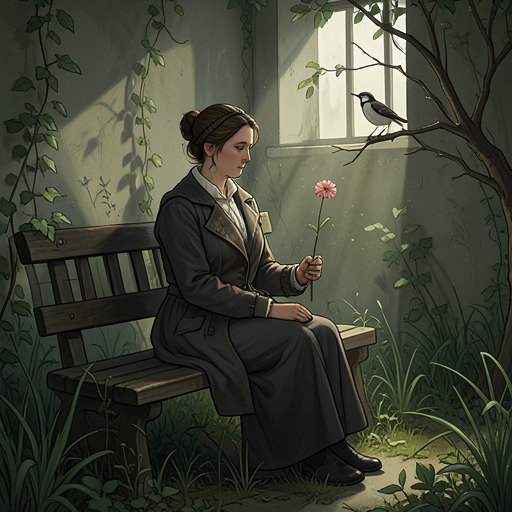
Tessa's greenhouse
After Ever HappyTessa's greenhouse is a small, neglected structure that changes meaning with the crises Tessa carries into it: once a hiding place from her father, it becomes a refuge from a world she cannot bear, and later the setting for a difficult exchange with Hardin Scott. Its cracked roof, muddy ground, and long neglect make it no ideal sanctuary. What gives it force is the return to the same enclosed space under different pressures: first as a place to withdraw, then as a place where another person can sit beside Tessa without demanding that she speak.
Setting and condition
The greenhouse stands in a corner of the yard, partly screened by trees. In the storm when Hardin finds Tessa, its metal door is already ajar. Inside, pots of dirt line the small space, but the arrangement speaks more of abandonment than cultivation: no one has been in the greenhouse since Tessa left home. Cracks in the ceiling let rain stream down at scattered points, while the floor beneath Tessa is not a proper floor at all but mud. Her jeans are dirty, her bare feet are caked with it, and the rain has made the cramped shelter an extension of the weather outside.
Later, when Tessa steps out through the back door of the house, the sun has dried much of that mud. Dark, wet patches still occupy half the floor, leaving her a dry place to stand, though she worries about ruining the high-heeled shoes her mother could barely afford. The contrast is small but concrete: the greenhouse has not been repaired or transformed, yet the weather has changed its immediate conditions. It remains a precarious space, its neglect visible even when the rain has stopped.
From hiding place to refuge
Tessa's connection to the greenhouse predates the scenes of grief. She used to hide there from her father, Richard Young, and later returns to the same shelter when she is trying to hide from the world and from Hardin. The repetition gives the location a history that is emotional rather than restorative. It offers concealment, but it cannot undo what has happened or make Tessa feel at home again.
That distinction emerges in a separate moment of crisis, when Noah promises to take Tessa home. Rain falls on her face, and she rests against his chest with her eyes closed; the beat of his heart recalls the time she pressed her ear to Richard Young's chest and found no heartbeat or breath. Noah's reassurance resembles an earlier pattern in which he came to her rescue when her father's addictions caused havoc. But Tessa's memory of the greenhouse as a place to hide cannot offer a solution this time. She feels there is darkness and no escape, and when Noah says they are going home, she thinks she has no home. The refuge is therefore not a simple answer to homelessness or loss: it is a remembered place of retreat, while her sense of belonging remains unsettled.
Hardin's silent company
When Tessa disappears during a brief argument, Noah searches the neighborhood, but Hardin recognizes that knowing the town is not the same as knowing Tessa. He believes he knows where she has gone, follows the open greenhouse door, and finds her curled on the muddy ground with her knees drawn up and her hands over her ears. She kicks and thrashes when he approaches; when he releases her wrists, she covers her ears again and begs for quiet. Hardin has words he wants to use to bring her out of herself, but her distress makes speech feel inadequate. Instead, he sits beside her on the mud and places his hands over hers, helping block the noise as her whimpers soften into quiet sobs. The scene turns the greenhouse from a private hiding place into a place of witnessed distress: Hardin does not make Tessa explain herself before remaining with her.
In a later encounter, Tessa returns to the greenhouse to get air after feeling angry in her mother's crowded kitchen. She is startled by movement behind a shelf and finds Hardin there. His eyes are clear, but dark circles and pallor make him look fragile and haunted. Tessa immediately apologizes and begins to leave. Their exchange shifts from the awkward discovery of one another to her anger at Richard Young for dying by suicide. Tessa feels guilty that anger has overtaken sadness and worries that saying so disrespects her father. Hardin tells her not to be ashamed, acknowledges that Richard Young chose to throw away the renewed relationship by getting high, and reminds her how excited she had been when her father returned to her life. His response is blunt rather than soothing in a conventional sense; it gives Tessa permission to name anger alongside grief. When Hardin recognizes that he is hardly in a position to judge, he closes his eyes and shakes his head, bringing his own history into the moment without turning the conversation away from Tessa's pain.
Narrative significance
The greenhouse gathers two kinds of withdrawal. Tessa once used it to get away from her father; after his death, she retreats there from the world and, in the later scene, from Hardin. Its repeated appearance links those moments without claiming that the causes are identical. The earlier hiding place carries the memory of family trouble, while the later refuge holds the shock of bereavement and the difficulty of speaking honestly about a dead parent.
Weather and silence shape how the space works. Rain enters through the damaged roof and pounds against the glass while Hardin sits with Tessa; later, sunlight dries part of the mud but does not erase the greenhouse's disrepair. In the first encounter, care takes the form of quiet and physical presence. In the later one, it takes the form of listening to a confession Tessa is ashamed to make. Neither scene shows the greenhouse curing grief or repairing the relationships around it. Instead, the place makes room for withdrawal without making it absolute: someone can find Tessa there, sit beside her, and hear what she has not been able to say elsewhere.