Trish and Hardin's former home
After Ever HappyTrish and Hardin's former home is both a material remnant of Hardin Scott's painful childhood and the setting for a night when its memories overwhelm the present. Partly emptied in preparation for demolition after Trish's move, the house holds the couch associated with his trauma and a bottle of liquor hidden beneath the kitchen sink. Hardin's return turns these ordinary objects into triggers for a crisis that culminates in fire.
Setting and History
The house is identified as the place where Hardin spent a painful childhood. By the time he enters it with Tessa, however, it is already in transition: Trish has moved, demolition is planned, and much of the furniture has been packed into boxes or removed. The rooms are neither fully lived in nor yet reduced to rubble. This unsettled state leaves familiar features exposed, especially the couch that Hardin associates with a traumatic event from his childhood.
The house stands on a quiet street. After Hardin breaks the glass in the front door to reach its lock, Tessa looks around and sees no one outside; no lights come on. She worries that Trish and Mike might be staying at the neighboring house, but the disruption draws no visible response from the street. The contrast between the broken entrance and the apparently undisturbed surroundings makes the crisis feel contained inside the house, even as Tessa fears what might happen next.
Hardin's Return
Hardin reaches the house in an intoxicated and agitated state, after trying to destroy it from outside. Tessa follows him across the street and into the front yard, stumbling on her bare feet and briefly falling onto one knee. At the open screen door, Hardin fumbles with the doorknob and then pounds on the wood. When he cannot get in, he picks up a fist-size rock, breaks the glass pane, reaches through without cutting himself, and unlocks the door. Tessa urges him to leave for the hotel, but he ignores her and enters.
Inside, the house makes his anger more specific. He calls it a source of torment and catches himself on the arm of a small couch as he stumbles. Then he identifies that couch as the place where the childhood event happened. The recognition turns a piece of leftover furniture into a witness to the past: its continued presence makes the remembered harm immediate in a home already being cleared out. Tessa recalls that Hardin had previously told her he destroyed the couch, a detail that shows this object had remained charged for him even before this return.
Hardin bitterly remarks that one of his fathers could have thought to buy a new couch. His complaint connects the object not only to what happened there, but to the adults he believes failed to intervene or even erase its physical reminder. Tessa tries to comfort him and persuade him to leave, but he does not engage with her efforts.
The Hidden Liquor and Escalation
In the kitchen, Hardin drops to his knees and searches the cabinet beneath the sink. He finds a bottle of clear liquor; dust transferred to his black shirt as he rubs it suggests it had been hidden there for months. The house thus contains another remnant of his past, one that offers him an immediate means of drinking. Tessa does not know whose bottle it was or how it came to be there, and the scene leaves those questions unresolved.
Hardin carries the bottle back to the living room and points toward the couch as he recalls that a woman had been there and that neither of the men he blames came to stop what happened. He opens the full bottle and gulps from it. Tessa steps closer and demands that he stop, prepared to take the bottle from him, while warning him that they need to leave. He drinks again before pausing, wipes liquor from his mouth, and finally looks at her. The movement from searching the house to drinking in the room where his memory is fixed binds the physical setting to his relapse and makes Tessa's attempts to get him out increasingly urgent.
Fire and Narrative Significance
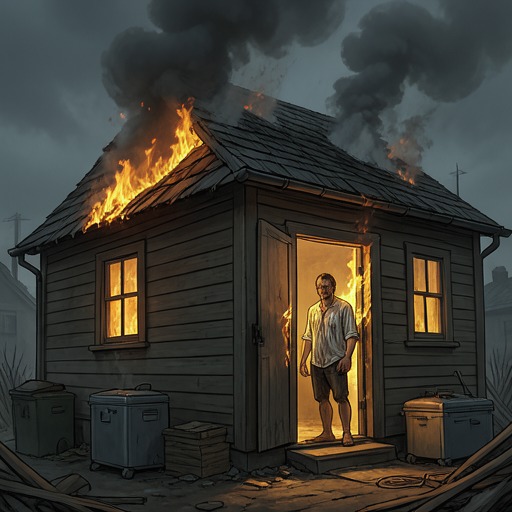
Christian Vance rushes into the living room after hearing sirens. He finds liquor covering nearly every inch of the small room and sees a lighter in Hardin's hand. His arrival interrupts Tessa's isolation with Hardin, but it does not immediately end the crisis. The scene's focus has shifted from escape to the danger inside the house, where Hardin reaches for an old magazine, applies a flame to its corner, and throws the burning pages onto the couch.
The fire catches quickly. Hardin watches the couch burn and experiences the flames as if they were consuming his memories along with the furniture. A trail of rum burns across the floorboards, carrying the fire beyond the couch and into the rest of the room. The house that was already slated for demolition becomes the site of a more immediate destruction, initiated by Hardin in a moment when remembered injury, alcohol, and anger converge. The passage establishes the fire's spread but does not, in these scenes, confirm the house's ultimate fate.
As a location, Trish and Hardin's former home gives the past a concrete form: an unlocked-by-force entrance, an old couch, a hidden bottle, and rooms awaiting removal. Its impending demolition might suggest that its history is about to disappear, but Hardin's return shows that physical clearance cannot by itself remove what the house signifies to him. The fire makes that tension literal without resolving it: the object tied to memory is consumed, while the intensity of the remembered event remains central to the scene.