Anger and Violence
After We CollidedAnger and Violence is a recurring pattern in Hardin Scott’s family life and romantic relationships, where pain that remains unspoken repeatedly erupts into aggression. The novel distinguishes anger from violence through Tessa Young’s responses: she can understand the history behind Hardin’s fury and still insist that hurting people and destroying things are wrong. His outbursts expose the lasting damage of his childhood, but their effects fall on others as well, making sympathy and accountability difficult to separate.
Anger, History, and the Scott Family
The deepest and most persistent source of Hardin Scott’s anger is his father, Ken Scott. At Christmas dinner at Ken and Karen’s house, Hardin turns a tentative family gathering into a confrontation by drawing attention to Ken’s past drinking. What begins as a cutting remark about wine opens the larger dispute: Hardin believes Ken abandoned him and Trish Daniels without money, a car, or reliable support. Ken counters that he sent money and offered a car, while Trish reveals that some of the money went toward household bills as well as Hardin’s education. The disagreement is therefore not only about what Ken provided, but about what his departure meant to the family and what Hardin was told about it.
Hardin’s accusations sharpen around the personal abandonment he remembers: Ken left without even calling on his birthday. Ken says he had been a worthless drunk and believed Trish and Hardin deserved better than what he could offer. He connects his decision to leave to a particular night, but Hardin rejects any attempt to soften the memory. He recalls witnessing what happened and having to clean up afterward while Ken was still drinking. The gap between Ken’s guilt and Hardin’s recollection gives their argument its force: Ken speaks as someone haunted by what he did, while Hardin speaks as someone who had to live through its consequences.
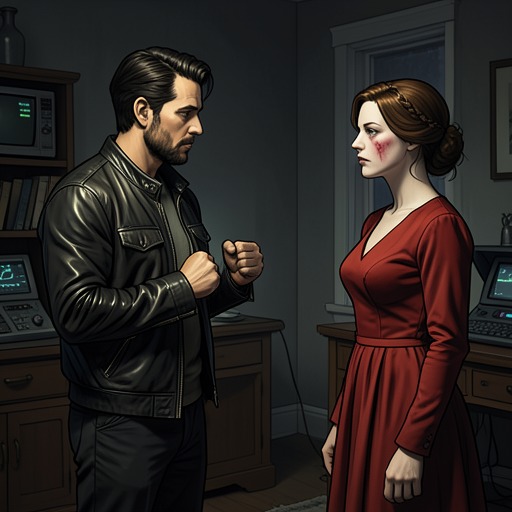
The argument becomes physical despite attempts to stop it. Hardin rises, shakes off Tessa when she tries to restrain him, and lunges at Ken. He pushes his father against the china cabinet, the replacement for one Hardin had broken months earlier, and then punches through the cabinet’s glass door. The earlier damage and its replacement make the violence feel recurrent rather than isolated: the family has already had to live with one broken cabinet, and the new confrontation produces another breach in the household’s fragile attempt at repair. Landon Gibson tries to intervene, while Karen Gibson leaves the room in distress. Tessa is also caught in the struggle as she tries to pull Hardin away.
Tessa’s Opposition to Violence
After the fight, Tessa does not reduce Hardin to his worst action. In the car, she is silent and uncertain whether to be angry, yet she also feels for him and sees his father’s history as a source of his nightmares, anger, and disrespect toward women. That explanation complicates her response without excusing what happened: Hardin has ruined dinner and assaulted Ken in front of the family. Her sympathy coexists with a judgment that violence has crossed a line.
Tessa makes that distinction explicit when she tells Hardin that she has not forgotten Ken’s conduct, but has chosen to forgive him rather than remain consumed by anger. For her, forgiveness is a way to move toward happiness; it is not a claim that the past was harmless. She urges Hardin to consider the burden of Ken’s guilt, while also telling him that he cannot respond to anger by beating people. Hardin acknowledges her criticism and lowers his gaze. Tessa then takes his hands and leads him to the bathroom to clean his bleeding knuckles, an act of care that also recalls how often she has tended the consequences of his violence since meeting him.
The difference between Tessa and Hardin becomes especially clear in their attitudes toward forgiveness. Tessa says that forgiving Ken has made happiness easier for her, whereas Hardin insists that he cannot forgive his father after the confrontation. Tessa sees the danger in letting anger take over a life; Hardin sees forgiveness as something he cannot yet grant without denying what happened. His own capacity to seek Tessa’s forgiveness, despite refusing it to Ken and struggling to forgive himself, creates an irony she recognizes. The novel presents forgiveness as an ethical choice, but not a cure that can simply be demanded of someone still carrying the injury.
Violence Beyond the Family
Hardin’s anger also affects Tessa’s ability to feel safe in their relationship. When Trish tells him that she encouraged Tessa to leave because she fears Tessa will end up like Natalie or the other women he has hurt, Hardin asks what will happen to him if Tessa goes. He admits that he knows he has not been good for Tessa and regrets what he did, while insisting that he could change. Trish questions whether even this appeal is part of his familiar effort to get what he wants. Her concern places his declarations of love beside a history of harm rather than allowing them to stand in for change.
The account of Natalie gives that history a concrete consequence beyond Hardin and Tessa’s arguments. Hardin explains that when Natalie refused James, James showed other people a video of her. The video spread rapidly; Natalie’s parents learned of it in less than a day, her family expelled her from their home, and she lost the scholarship to the private university she had planned to attend. Tessa recognizes that Hardin helped ruin Natalie’s life and fears that she may be vulnerable to the same pattern. The harm here is not presented as a single outburst: it spreads through exposure, family rejection, and the loss of an educational opportunity. That history helps explain Trish’s warning and makes Tessa’s concern about Hardin’s capacity for change more than a private romantic doubt.
A later episode links Hardin’s anger to jealousy and property destruction. After Tessa kisses Zed Evans and brings him to Hardin’s home, Hardin, drunk and upset, breaks glasses against the wall, smashes a lamp and a vase, and hits the wall. Tessa tries to stop him from breaking their belongings; he blames her and tells her to leave him alone. His fury is directed at the betrayal he believes he has suffered, but the objects in the shared home become targets, turning their domestic space into another site where conflict takes material form. Tessa tries to calm him, even as his drunkenness makes him intimidating. The scene repeats the association between anger and destruction without making the earlier family violence a one-time episode.
Consequences, Restraint, and Recurrence
The pattern reaches Zed directly when Hardin attacks him. Tessa later visits Zed to ask whether he intends to press charges. Zed says that he does, and Tessa asks him not to. She tells him that if he declines, Hardin will not have to contact him again; Zed agrees, but asks Tessa to think seriously about how much easier her life might be without Hardin. He points out that Hardin attacked him and that Tessa is once again cleaning up the aftermath. Tessa acknowledges to herself that she is using Zed’s feelings for her to persuade him. His decision not to pursue charges ends the immediate legal threat, but it does not undo the assault or settle the question of why Tessa remains responsible for managing the consequences.
Anger and violence thus recur in different forms: the unresolved father-son conflict, Hardin’s destruction of household objects, and his attack on Zed. Tessa repeatedly occupies the position between the person who has acted violently and the person who has been harmed, offering comfort or asking for restraint while also naming the wrong. Her care does not erase her judgment, and Hardin’s remorse does not by itself repair the damage. The recurring pattern matters because each reconciliation or appeal to forgiveness is tested against what Hardin does when anger returns. The novel leaves that tension active: understanding the history behind violence may explain its recurrence, but the people around Hardin still bear its consequences.