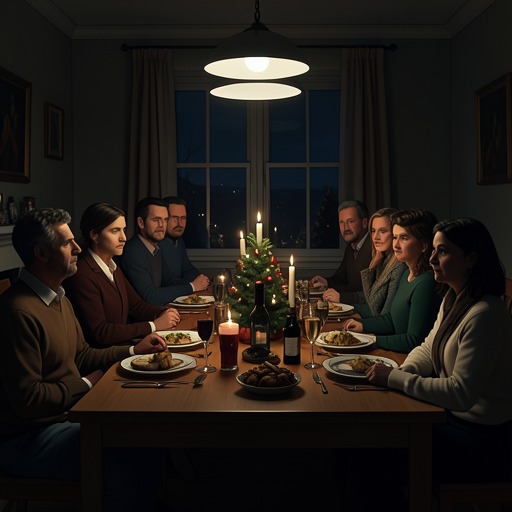
Christmas Eve
After We CollidedChristmas Eve brings Tessa and Hardin back together just as the holiday exposes the secrets, family loyalties, and competing claims over Tessa’s choices that still divide them. Its movement is from tentative private reconciliation to a public confrontation with Tessa’s mother, then to Tessa’s decision to remain with Hardin: not because the past has vanished, but because she insists that the decision is hers.
The Approach to Christmas Eve
The approach to the holiday finds Tessa and Hardin trying to establish what their renewed relationship can require of them. Tessa asks for more than a promise of affection: if they are to move past what happened, Hardin must open up and tell her how he feels. He counters that she, too, keeps her feelings closed. Their exchange makes clear that getting back together has not settled the problem that brought them to a breaking point. The work of reconciliation is still ahead.
Even so, their shared preparations acquire the shape of a life being resumed. Tessa finishes writing Ken’s name on a gift tag, and, before they sit down to talk, she asks Hardin to help print tickets for Landon. They produce two Seattle Thunderbirds tickets, wrap them in a small box, and put the practical task aside. The gift is a concrete sign that Landon remains part of the holiday they are arranging, even while Tessa and Hardin have unfinished matters between them.
Tessa’s decision to be with Hardin carries a cost beyond the couple. She expects her mother to object, and recognizes that this will be the first Christmas in eighteen years that she does not spend with her. She is no longer willing to make every life choice a war with her mother simply to keep her happy. That resolve is not indifference: Tessa knows the decision will hurt and provoke conflict, but chooses not to let her mother’s disapproval decide the relationship for her.
A Family Christmas Takes Shape
On Christmas Eve, Tessa wakes with Hardin’s head resting on her stomach when her phone vibrates. Her mother’s name appears on the screen. The interruption brings the family conflict into the intimate space Tessa and Hardin have just reclaimed, even before her mother arrives in person.
Later, Trish is at the stove making pancakes. She wishes the couple a merry Christmas, and Hardin points out that it is not yet Christmas; the small exchange gives the occasion a domestic ease without disguising the strain beneath it. Over raspberry pancakes, Trish asks whether they will open gifts that day, since she assumes Tessa will be at her mother’s the next day. Tessa struggles to explain her plans, and Hardin answers for her: she has promised Landon she will go to his father’s house and cannot cancel. The response places Tessa’s promised visit alongside her choice to reunite with Hardin, rather than treating the two commitments as mutually exclusive.
Trish jokes about Karen, her ex-husband’s new wife, and Tessa offers to tell Landon that they are all coming. She reflects that she never expected to spend Christmas with Hardin and both sides of his family. The family gathering is therefore more than background holiday activity: it represents a possible widening of Tessa’s place in Hardin’s family, even as her own relationship with her mother is coming under pressure. When Tessa switches on her phone, she sees three voicemails from her mother, leaves them unanswered, and calls Landon to confirm the plan.
The calm is temporary. While Hardin sleeps, Tessa looks through her e-reader for The Great Gatsby because his calling her Daisy has made her want to read it again. Hardin has already loaded the book. Then an angry woman’s voice breaks into the room. Tessa recognizes her mother and throws the e-reader to the end of the bed before getting up; Trish is already telling the visitor she has no right to enter. A device associated with Hardin’s thoughtfulness is abruptly set aside as the family dispute takes over the day.
The Bet Is Exposed
Tessa’s mother frames Hardin’s conduct as unforgivable and says he should be locked away. Trish answers that Tessa has chosen to forgive him and that her mother must accept her decision. But the confrontation brings forward the fact that makes forgiveness difficult: Tessa’s mother says Hardin took Tessa’s innocence as part of a bet with his friends, then boasted about it while Tessa was staying at the apartment. What had seemed to Tessa a decision about repairing a damaged relationship is suddenly exposed as a choice made without knowing the full measure of the betrayal.
The revelation pulls Trish and Tessa’s mother into a direct clash over who has the right to protect Tessa. Tessa’s mother orders her to come with her. Tessa instead grips Hardin’s forearm and stays behind him, needing time to comprehend what she has just heard. Hardin draws her close and warns her mother away. The gesture reads as protection in the moment, but also places Tessa between two people acting as though they know what is best for her.
Tessa finally interrupts that contest. She tells her mother to stop speaking as if she is absent, declares that she is an adult, and says she will stay if she chooses to. The statement is the day’s clearest shift in power: her choice is no longer merely inferred from whom she stands beside. Trish, who had defended Tessa’s adulthood against her mother, then urges Tessa to listen to her mother. Tessa feels the reversal as a sting, aware that Trish may know things about Hardin that she does not.
Forgiveness Under Pressure
The argument does not end with the revelation. Hardin later confronts Trish for telling Tessa to leave him. Trish explains that she believes he is not good for Tessa and fears Tessa will end up like Natalie or the other women Hardin has hurt. Hardin admits that he knows he has not been good for Tessa and regrets what he did, while insisting that he can change and be good to her. Trish’s objection prevents the reconciliation from becoming a simple endorsement of his promises: even his mother sees the possibility of harm as real.
Tessa’s choice to stay has, however, begun before the confrontation. After reading Hardin’s letter, she sits with it, rereads it twice, and considers the contrast between his claim not to be romantic and the letter alongside Tessa’s charm bracelet. He has borrowed the first paragraph of Darcy’s letter to Elizabeth. More importantly to Tessa, the letter shows him exposing himself to her; she acknowledges the terrible things he has done and the people he has hurt, but also the effort she believes he has made to change. She folds the letter and hides it in a dresser drawer rather than risk Hardin asking her to throw it away or destroy it.
When she tells Hardin that she had already decided to stay while he was gone, and that reading his letter has made her want to stay more than ever, the decision is not a sudden surrender to the day’s pressure. It joins her prior resolve to the new evidence of his confession. She tells him she loves him, but the surrounding events keep that declaration from erasing what remains unresolved.
By the close of Christmas Eve, the couple is together again, tired from a day that has included reconciliation, a family invitation, and the exposure of a defining betrayal. Tessa’s mother’s arrival has made the holiday anything but peaceful, and Tessa expects consequences for spending Christmas with Hardin rather than with her. The day’s ending is consequently provisional: Tessa chooses to remain, while the bet, Hardin’s history, and the conflict between protection and personal autonomy continue to shape what their renewed relationship must face.