Faith
After We CollidedFaith functions in the novel less as a settled religious doctrine than as a question of where trust should be placed, and what that trust can reasonably be expected to accomplish. Professor Soto’s journal assignment draws together belief in a higher power, the possibility that faith can improve a life, and the harder question of whether belief in another person can alter what happens. Tessa’s response turns the abstract prompt into a personal test: she writes about Hardin, whose absence makes faith feel at once sustaining and precarious.
Faith as an Open Question
Professor Soto asks his students to write about faith without prescribing a religious answer. They may consider belief in a higher power, faith’s effects on people’s lives, or whether trusting someone changes the outcome of a situation. He also raises the problem of faith in an unfaithful lover and whether religious belief makes someone a better person. The assignment therefore refuses to treat faith as automatically virtuous or effective. It asks what belief means in practice, and whether it can be distinguished from hope that circumstances will change.
For Tessa, the prompt brings a personal history into the classroom. She grew up going to church, but describes her relationship with God as not always strong. As she tries to begin the journal entry, her thoughts return instead to Hardin: he usually calls, and a note has reassured her that he is safe, but she does not know where he is or when he will contact her. The gap between knowing that he is safe and knowing what his silence means gives the assignment its urgency. Faith appears not as certainty, but as an effort to live with what remains unknown.
Tessa’s Journal and the Test of Trust
Tessa’s writing makes that uncertainty explicit. As her messages to Hardin go unanswered, her panic grows; she recognizes that his behavior has improved, yet still wonders whether she has placed too much faith in him and whether continued faith can help him change. The questions do not resolve into a simple judgment. Her hope rests partly on observed improvement, while the lack of a response keeps doubt active. The journal holds both at once rather than converting hope into proof.
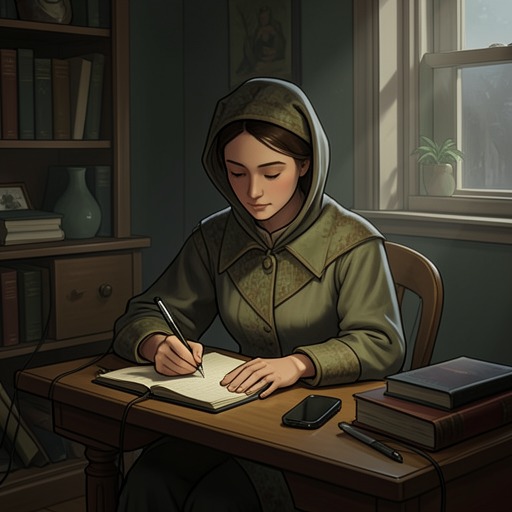
The act of writing itself changes her immediate experience. Before she realizes how much time has passed, she has filled three pages, most of them about Hardin. She feels that a weight has lifted, although she is unsure what to make of having written about him so completely. In this scene, faith does not bring Hardin back or answer Tessa’s questions; writing gives her a way to identify what she is hoping for and how strongly his absence affects her. The journal becomes a record of faith under pressure, not evidence that her expectations will be fulfilled.
That pressure continues beyond class. By early afternoon, Tessa has called Hardin three more times and sent eight more texts without hearing from him. She feels uneasy about the intensity of her attempts to reach him, especially after writing about her faith in him, and worries that he might be doing something that could harm their relationship. Her thoughts also turn to Molly, whom she associates with trouble, even as she believes Hardin would not cheat. Faith here includes trust in Hardin, but it coexists with anxiety and the return of fears that Tessa cannot simply decide to dismiss.
Pain, Belief, and Self-Reliance
A later class prompt shifts the subject from faith to pain, but Tessa again uses the assignment to examine belief. She considers how pain can draw people toward faith or push them away from God. Her writing arrives at a different emphasis: pain can change and strengthen a person, but ultimately a person needs herself and must not allow pain to steer her. This does not amount to a rejection of faith. Rather, it places a limit on what faith alone can do. Belief may be part of how people respond to suffering, but Tessa’s conclusion insists on personal strength and agency as well.
The contrast between the two journal entries matters. In the first, Tessa asks whether faith in Hardin can contribute to his change; in the second, she writes that she must not let pain determine her direction. Together, the entries show her testing the boundary between hope for another person and responsibility for herself. Her pages offer temporary relief and sharpen her thinking, but neither exercise settles what will happen between them. Faith remains a question to be worked through rather than a guarantee against hurt.
Faith in Relationships and Repair
Trish gives faith a more direct, interpersonal form when she tells Hardin that she believes he will do the right thing and fight for Tessa. Her statement is an expression of confidence, but also an appeal: she connects belief in him to an action he must choose. When Trish leaves, Hardin throws a small cup and platter against the wall. The gesture does not answer her appeal, and the scene refuses to make faith itself a resolution. Trish can express confidence in Hardin’s capacity to act differently; whether he will meet that expectation remains separate from her belief.
The conflict around Tessa’s forgiveness further complicates trust. Her mother condemns Hardin’s past conduct and rejects the idea that Tessa should forgive him, while Trish answers that Tessa is an adult who has chosen to do so. The disagreement places Tessa’s judgment between condemnation of past harm and the possibility of a changed relationship. It does not establish that forgiveness makes Hardin trustworthy; instead, it shows that the decision to believe in or remain with someone is contested, and belongs to Tessa rather than being settled by either mother’s verdict.
The same question of whether a damaged relationship can begin again appears in Hardin’s estrangement from Ken. During a family confrontation, Hardin accuses his father of leaving him and Trish without adequate support; Ken says that he sent money and offered a car, and describes himself as an alcoholic who believed they deserved better than he could give. The conflicting accounts make reconciliation difficult to ground in uncomplicated trust. Later, Hardin considers calling Ken, and Tessa encourages him to try not to let the previous day destroy the beginning of their relationship. This is not a guarantee of repair, but an opening toward it: as with Tessa’s faith in Hardin, the possibility of change depends on what someone does next.
Across these episodes, faith has no single object or assured result. It can mean religious belief, trust in a lover’s capacity to change, confidence offered as a challenge, or tentative hope for a family relationship after years of hurt. The novel keeps belief answerable to conduct: Tessa’s hope does not erase her fear, Trish’s confidence does not decide Hardin’s choices, and the prospect of repair does not undo the past. Faith matters because it makes room for change, while the narrative leaves the outcome dependent on action.