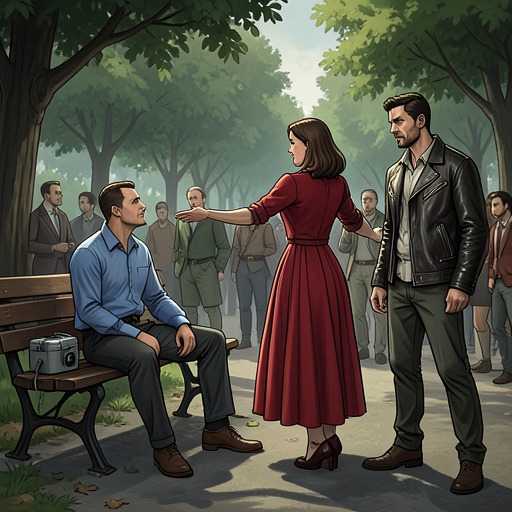
Hardin Asks Landon for Help Winning Tessa Back
After We CollidedHardin’s appeal to Landon is an early, uneasy attempt to win Tessa back after his betrayal: instead of approaching her directly, he asks her close friend for help and must hear how deeply he has damaged her trust. The exchange reveals both his desperation and the limits of a plea for assistance; Landon may try to speak to Tessa, but cannot promise that his intervention will repair what Hardin broke.
Context and setting
Hardin arrives at his father’s house uncertain whether to go inside. Karen has covered the exterior with lights, miniature Christmas trees, and inflatable decorations, a bright holiday display at odds with his hesitation. Torn airline tickets remain in the car. The scene gives his arrival the character of a pause at a threshold: he has come to ask for help, but has not yet found an easy way to begin.
Landon is reading when Hardin tries to explain why he has come. Hardin falters between saying he wants to speak to Landon, his father, or Landon’s mother, then finally identifies the real subject: Tessa. His hesitation makes the request more than a practical appeal. Hardin has to name the person he has hurt before he can ask anyone else to help him reach her.
The request and its cost
Landon responds skeptically. He asks why Hardin has come to him and says he does not think Tessa should speak to Hardin again; he had expected Hardin to have moved on. Hardin counters that he knows he has acted wrongly, insists that he loves Tessa, and believes that she still loves him but is hurt. His insistence conveys hope, but it does not erase the difference between his account of their feelings and Landon’s judgment of his conduct.
Landon names the injury directly: Hardin humiliated Tessa, who had trusted him, and what he did is difficult to forgive. Hardin does not contest the description. He acknowledges that he understands how badly the situation has gone, even as the exchange shows his frustration at being made to face it. Landon’s role is therefore not simply to help him pursue a reconciliation. He first makes Hardin hear that Tessa’s pain is a consequence of Hardin’s own actions, not an obstacle that can be bypassed by declaring his love.
Hardin then asks whether Tessa loves him. Landon answers that she does, but explains that the betrayal has convinced her Hardin never loved her. The distinction is crucial: affection may remain, yet Tessa’s understanding of their relationship has been altered by what he did. Hardin is devastated by the answer and asks Landon what he can do, and whether Landon will help. His appeal marks a shift from asserting that Tessa is merely hurt to recognizing that she may no longer believe his feelings are genuine.
Landon’s limited offer
Landon does not promise to bring them back together. After hesitating, he says he can try to talk to Tessa. He adds that her birthday is the next day and asks whether Hardin knows. Hardin does, then asks if Landon has plans with her; Landon says Tessa intends to stay at her mother’s house. The exchange gives Hardin a concrete piece of information, but it also exposes how little control he has over Tessa’s choices. Landon can offer to speak with her, not arrange her response or guarantee that she will see Hardin.
That limited offer matters because Hardin’s request depends on Landon’s own relationship with Tessa. Landon knows her well enough to describe both her continuing love and her belief that Hardin never loved her, yet he has already told Hardin that he doubts she should speak to him. His willingness to try is therefore cautious rather than an endorsement of Hardin’s behavior. The scene places friendship and accountability alongside one another: Landon may help, but he does not set aside his judgment of the harm.
Place in the reconciliation arc
The conversation establishes a pattern that becomes clearer in later exchanges between Tessa and Hardin: the emotional crisis cannot be settled by one person making a claim about love while the other remains unheard. Tessa later tells Hardin that, if they are to try to move past the betrayal, she needs him to open up and say how he feels. She also recognizes that she has left her own confusion unspoken, naming both their relationship and his betrayal as unresolved questions. The later conversation makes explicit what Landon’s account has already suggested: they may still love each other without sharing the same understanding of what that love means or what has to change.
Tessa’s later complaint broadens the conflict beyond the original lie. She says that Hardin has not treated her as a priority, has left her out of decisions affecting her future, and dismissed her concern about security and eventual marriage. She also points to his drunken absence with another woman. These concerns clarify why Landon cannot solve the problem simply by conveying Hardin’s feelings. The question is not only whether Tessa loves him, but whether Hardin will listen to her and make room for her needs.
The birthday thread likewise does not provide an automatic reconciliation. In a later confrontation, Hardin raises his voice before explaining that he did not know Tessa was waiting for him with a cake and had not understood what was happening. He then kneels before her and asks where their relationship can go from there, saying that their repeated movement back and forth is wearing him down. That scene leaves the outcome dependent on Tessa’s answer, not on Landon’s earlier willingness to speak with her.
Hardin’s visit is thus a modest but consequential step: he seeks counsel from someone who cares about Tessa, admits that he has made a serious mistake, and accepts a tentative offer of help. Its limits are as important as its hope. Landon can confirm that love remains, but he cannot restore Tessa’s trust on Hardin’s behalf; that work requires Hardin to face the injury and Tessa to decide whether she wants to continue the relationship.