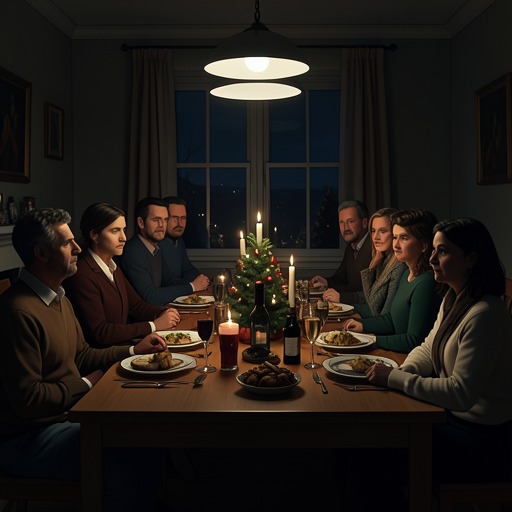
Tessa and Hardin's apartment
After We CollidedHardin and Tessa’s apartment is a shared home whose meaning shifts with the couple’s relationship: it first embodies the sudden intimacy of moving in together, then becomes a painful storehouse of Tessa’s belongings, and later a place where she attempts to decide for herself whether to remain. Its clothes, books, groceries, and photographs make the relationship tangible, while the conflicts that unfold around the home expose how love, betrayal, family intervention, and personal autonomy press against one another.
Setting and Shared Life
Tessa had moved in with Hardin only a week before she told Zed that she did not live in a dorm. The move had been Hardin’s idea, and the timing made the apartment a newly established home rather than a settled arrangement. For Tessa, the revelation of his betrayal therefore carried a practical shock alongside its emotional force: she had to find somewhere else to live and work out how to retrieve everything she had left behind.
The apartment held necessities she could not simply abandon. Tessa had few clothes apart from those still there, and she needed her textbooks. The home thus remained tied to her education and daily life even when she no longer knew whether she could bear to return. Her first response was to consider leaving everything behind; the need for clothes and books made clear that separation could not be completed by feeling alone.
Departure and Material Remains
When Tessa returned to collect her belongings, panic overtook her as she struggled with the keys. She went straight to the bedroom and roughly packed her clothes from the closet. The bedside table still held a small framed photograph of her and Hardin smiling before Ken’s wedding. Tessa regarded the image as false in light of what she had learned, threw the frame onto the concrete floor, and tore the photograph into pieces. She was sobbing by the time she had finished, turning the apartment’s intimate display of a shared past into physical fragments.
The packing also joined what belonged to her with an object that belonged to Hardin. She boxed her books and instinctively took Hardin’s copy of Wuthering Heights, reasoning that he would not miss it and that she was owed it after what he had taken from her. The choice gives the departure a pointed material edge: she leaves with what she needs, but also carries away a book associated with the man whose actions have changed the meaning of their home.
Return and Temporary Refuge
Later, Tessa considers staying in the apartment while Hardin is away, intending to use it only until she can get into a dorm. Landon agrees that she should do so. Her plan is conditional and uneasy: she wonders what will happen if Hardin appears, and when she reaches the parking lot she searches for his car before deciding that he has left. The snow falling harder around the parked cars marks her return as a practical errand made under emotional strain, not a confident restoration of the relationship.
Inside, the apartment is warm and immediately recognizable as a place she loves, but Tessa revises that attachment as she thinks: it could be a home for the two of them, for Hardin, or for her alone. The distinction captures the uncertainty of their separation without erasing her connection to the space. The kitchen makes that uncertainty concrete. The cabinets and refrigerator are already stocked with food Hardin must have bought; Tessa puts away the groceries she brought wherever they will fit, then goes back for her belongings.
Landon has also told her that Hardin sought his advice and that Landon believes Hardin loves her. Tessa already knows this possibility but has tried to suppress it because admitting it would give her hope and make the situation harder. The apartment therefore holds more than the objects left behind: ordinary signs of care, such as food in the refrigerator, coexist with the knowledge that love does not by itself repair the damage between them.
Family Conflict and Tessa’s Choice
Tessa is at the apartment when Hardin arrives with his mother, Trish. The apartment has been cleaned from top to bottom; Tessa’s food is in the cabinets and her clothes are in the washer. She freezes, suddenly conscious that the evidence of her return will be visible to Hardin’s mother. Trish recognizes Tessa and approaches her warmly, while Hardin drops Trish’s floral-print luggage in surprise. The home’s domestic details, which might have signaled a settled reunion, instead leave Tessa exposed at a moment when she has not resolved what staying means.
The apartment becomes the setting for a confrontation between Tessa’s mother, Mrs. White, and Trish over Tessa’s decision to remain with Hardin. Mrs. White condemns Hardin’s treatment of Tessa and identifies the bet with his friends as the betrayal at issue. Trish responds that Tessa is an adult who has chosen to forgive him. When Mrs. White orders Tessa to come away, Tessa grips Hardin’s forearm and stays behind him, wanting time to understand what has just been revealed. Hardin wraps an arm around her protectively and tells Mrs. White to stay away, but Trish points out that he has no right to come between a mother and daughter.
Tessa ultimately interrupts the adults’ argument herself. She objects to being spoken about as if she were absent and declares that she is an adult who can choose to stay. That assertion matters because the apartment is being treated by the others as a place from which Tessa should either be removed or defended. Her decision is not the same as a resolution of every secret or conflict: she has just forgiven Hardin, and the revelation of his past has reopened the question of what she knows. What she establishes in the apartment is narrower but decisive—her right to speak and to determine where she will remain.
Narrative Significance
The apartment’s significance rests on the contrast between its ordinary domestic life and the emotional instability surrounding it. Clothes in the closet, textbooks in a box, groceries in the kitchen, and a photograph by the bed give the relationship a material presence; when Tessa leaves, those same things become a list of unfinished practical ties or objects she must destroy, recover, or carry away. Her later return does not simply restore the home. It forces her to confront a place that can be shared, occupied separately, or temporarily used while she seeks a different living arrangement.
The apartment also concentrates competing claims over Tessa’s future. Hardin’s invitation into shared life, his mother’s concern that Tessa not suffer as Natalie and other women did, Mrs. White’s demand that Tessa leave, and Tessa’s insistence on choosing for herself all meet in the domestic space. The home can shelter her and still be entangled with betrayal and attempts by others to direct her. Its changing role—from new residence, to painful repository, to provisional refuge, to arena for her own declaration—makes the question of who gets to define home inseparable from the question of who gets to make Tessa’s choices.