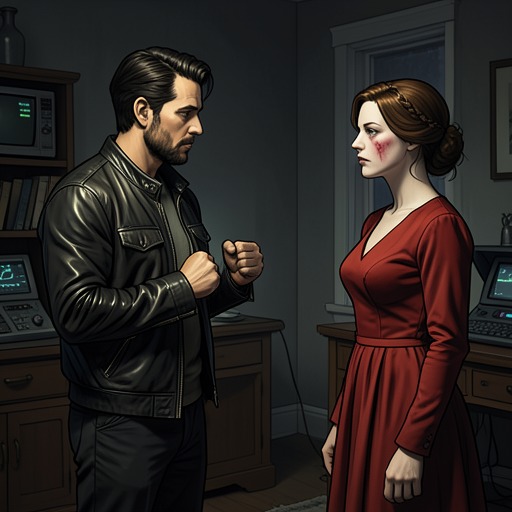
The father-son conflict at Ken's house on Christmas
After We CollidedThe father-son conflict at Ken's house where Hardin spends Christmas transforms a carefully arranged holiday dinner into a confrontation over abandonment, concealed support, and a family trauma neither father nor son has left behind. As Hardin Scott challenges Ken's account of their past, the argument escalates into violence in front of Tessa Young and their family; its consequences include a damaged cabinet, a shaken gathering, and an uncertain opening toward reconciliation.
Background and the gathering
The conflict unfolds at a Christmas meal prepared by Karen, whose formal table setting and carefully arranged goose establish the occasion as an effort at hospitality. The scene's domestic order matters: polished silverware, china, roasted potatoes, and a floral centerpiece offer a composed setting for relatives whose histories remain unsettled. The meal is not merely a backdrop. Its rituals bring Hardin, Ken, and Trish together, while the presence of Tessa, Landon, and Karen makes the consequences of their dispute visible to the wider family.
Alcohol is already a sensitive subject. Karen offers wine, then adds that there will be only one glass for the holiday. As she pours, Hardin turns to Ken and pointedly asks whether he wants some, implying that he misses drinking. The question punctures the dinner's careful calm: Hardin uses Ken's sobriety not as a neutral part of his recovery but as a provocation, drawing attention to the history beneath the gathering. The exchange also establishes that Ken's drinking remains bound up with the family's shared past, even though he has been sober for years.
The dinner follows other tensions around Hardin and Tessa. When Tessa's mother objects to Tessa staying with Hardin, Trish defends Tessa's right to decide for herself. Tessa's mother condemns Hardin for betraying her through a bet with his friends, while Trish insists that Tessa has chosen to forgive him. This earlier confrontation does not cause the argument between father and son, but it shows how the holiday gathering is already charged with judgments about Hardin's conduct and whether those close to him should trust his capacity to change.
The dispute over Ken's departure
Hardin first frames his challenge as anger at Ken and Trish for acting as though the past can be put aside. He calls Ken a failure and contests his father's authority to decide when the family should discuss what happened. Ken objects that Christmas is not the time: he has not seen Trish in years, and Hardin has chosen the reunion to raise old grievances. Hardin counters that Ken's long absence is precisely the point. He says Ken left the family without money or a car, and Ken replies that he sent money regularly and offered a car that Trish refused.
The argument changes when Trish confirms that Ken did send money. Hardin learns that it went toward his tuition and household bills. He had believed the family's hardship demonstrated that Ken provided nothing; the new information corrects that account without undoing the abandonment he feels. Hardin objects that money meant to keep them housed and fed should not have been used to pay his tuition, and insists that financial support does not erase Ken's leaving without even calling on his birthday. The revelation complicates the conflict rather than resolving it: Ken's contribution was real, but so was his absence, and Hardin understands the two facts as separate measures of what his father failed to provide.
Ken explains that he left because he was a drunk and believed Trish and Hardin deserved better than what he could give them. He connects his departure to a particular night, saying that it convinced him he had to go. Hardin rejects any account that treats the night as a reason Ken should have left. He says it happened because of his father and reminds him that he witnessed it and was left to deal with its immediate aftermath while Ken was out drinking. Ken acknowledges responsibility and says the night has haunted him for ten years. He also says he has been sober for years and cannot undo what happened. His words establish remorse and change, but they cannot make Hardin's memory or anger disappear.
Violence and immediate consequences
As the two men revisit the trauma, Hardin's response becomes physical. Trish calls for him to stop, and Landon moves to intervene, but Hardin pushes Ken against the china cabinet—the replacement for one Hardin had broken months earlier—and strikes him. Ken turns them before Hardin can hit him again; Hardin instead punches through the cabinet's glass door. The broken furniture makes the confrontation's damage literal, while its history as a replacement links the Christmas outburst to an earlier act of destruction.
Tessa has been holding Hardin's hand and tries to stop the fight, but his movement knocks her into a table and spills red wine over her white cardigan. Landon rushes to her, while Karen leaves the room in distress. Trish stands by the door, furious, and Ken looks from the damaged cabinet to Tessa. The scene has shifted from a private dispute between father and son to a family crisis with bystanders caught in its path. Tessa tells Hardin to stop and assures Landon that she is all right; her concern remains focused on Hardin's state as well as her own safety.
Hardin leaves, checking that Tessa follows. She apologizes to Ken for what has happened, and Ken answers that the fault is his. The exchange does not settle responsibility for the whole conflict, but it contrasts Tessa's attempt to acknowledge the harm done in the room with Ken's acceptance of blame. In the car, Hardin and Trish are silent. Tessa is cold, her cardigan wet, and she cannot decide whether to be angry with Hardin: he has ruined dinner and assaulted his father in front of everyone. Her uncertainty registers the gap between loving him and confronting the consequences of his actions.
Aftermath and a possible opening
The confrontation does not immediately produce an apology or reconciliation. Later, however, Hardin raises the possibility of contacting Ken. He hesitates over whether to call it an apology, then asks Tessa what she thinks about calling his father. Tessa urges him to ensure that what happened does not destroy the beginning of the relationship he and Ken had been forming. Her response recognizes the fragile progress that preceded the fight without pretending that the violence was harmless.
Hardin admits that after striking Ken he briefly thought Tessa might stay behind and make him leave. That fear shows how closely the conflict with his father is entangled with his relationship with Tessa: even in the aftermath of the dinner, he measures the consequences partly through the possibility of losing her support. The episode ends not with the family restored, but with a tentative question about whether he will reach out. Ken's concealed financial help, his prolonged absence, his sobriety, and his remorse all remain in view; none cancels the others. The dinner's significance lies in forcing those competing truths into the open, while leaving repair dependent on what Hardin does next.