Ken
After We FellKen is Hardin’s father and the chancellor at WCU, but his importance to the story rests less on his institutional position than on the history he shares with his son. He left Hardin and Hardin’s mother during a period of escalating alcoholism, and Hardin connects that absence to his own difficulty treating people well. Ken’s later attempts to apologize and help do not erase the past; they make the distance between his former failures and his present efforts visible.
Identity and Public Role
Ken holds a senior position at WCU: he is its chancellor, and Hardin’s professor is identified as Professor Soto. That authority matters when Hardin faces a university administrative proceeding. Ken arrives with his wife, Karen, and Hardin’s stepbrother, Landon. Their presence surprises Hardin, while Tessa is moved by their support, particularly because Hardin behaves as if he does not want their help.
Before they enter the administrative building, Ken says he hopes the proceeding will be brief and explains that he has been calling people to pull strings. He asks Hardin to let him do the talking and waits for his son to agree. The exchange shows Ken using the influence of his office on Hardin’s behalf, but also trying to manage the encounter himself. His readiness to intervene meets Hardin’s resistance: elsewhere on a family trip, Hardin angrily objects that Ken and another person are ganging up on him and insists he never wanted to come. Ken’s support is therefore not automatically welcome; it can feel to Hardin like pressure as well as care.
Absence, Alcoholism, and Responsibility
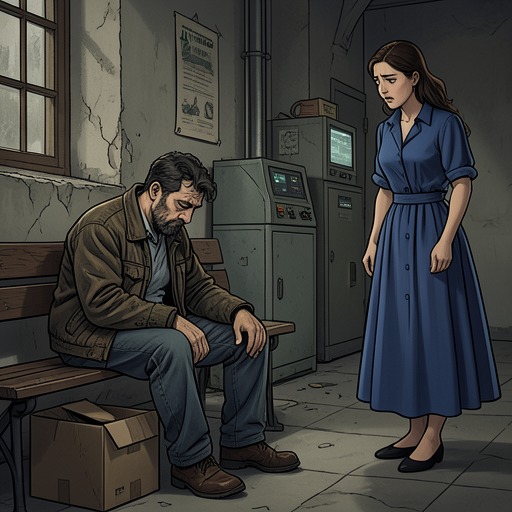
Hardin directly blames Ken for failing to be present as a father. He says that a father might have taught him how not to treat people badly, and links the lack of guidance in his childhood to the person he has become. He also fears that, without resolving his hatred of Ken, he will end up like the earlier version of his father. His comparison is pointed: he gestures toward Ken’s sweater vest and neatly pressed dress slacks, distinguishing the composed man in front of him from the person he remembers.
Ken does not dismiss the accusation. He surprises Hardin by agreeing that Hardin is right, then accepts responsibility for his son’s behavior and apologizes. He says he has blamed himself for the mistakes that led to it and will carry that guilt for the rest of his life. The apology is significant because Ken does not present his absence as something Hardin should simply get over. He names himself as a cause of the damage and addresses Hardin as his son, making an effort to acknowledge the relationship he failed to sustain.
Ken also describes how his drinking began. He and Hardin’s mother were already in a difficult period when he left one night and became so drunk that he could not walk home. He recalls that the feeling numbed his pain, and that drinking became a habit. He spent more time at a bar across the street than with his family, eventually finding that he could not function without liquor, while also admitting that he was not functioning with it. He frames the period as a losing battle rather than an excuse for what followed.
When Hardin asks whether Ken left after abandoning him and his mother, Ken confirms that he did. He says he was in no position to be a father or husband and believes they were better off without him. He credits Hardin’s mother with raising Hardin alone, while wishing she had not had to do so. The account makes Ken’s absence concrete: it was not merely emotional distance but a departure that left his mother to raise Hardin without him. Ken’s regret is clear, even as his claim that the family was better off without him reveals how thoroughly he understood himself as a failure at the time.
Attempts to Repair the Relationship
Ken’s apology does not instantly resolve Hardin’s anger. Hardin says he cannot stop hating him, and fears that unresolved resentment will affect how he treats Tessa. The conversation brings their conflict into the present: Hardin’s judgment of Ken is bound up with his anxiety about repeating the harm he associates with his father. Ken’s response is to accept blame and suggest that Hardin talk to someone. The suggestion offers a practical next step, though the evidence does not show whether Hardin follows it.
Ken’s later interactions with Hardin include ordinary, forward-looking concerns. Over a meal, he asks how Hardin’s graduation packet is coming along. He appears much better than he did in his office the previous week. The question turns their attention from past failure to Hardin’s immediate plans, without suggesting that their deeper disagreements have disappeared.
The contrast between Ken’s home and another house also registers in Tessa’s point of view. She notices the torn wallpaper in a narrow upstairs hall and compares it with Ken’s magnificent house, finding the differences impossible to ignore. The contrast gives Ken’s household a visible material presence in the story, but it does not establish that comfort or status can repair the family history between him and Hardin.
Support for Tessa and Richard
Ken’s involvement eventually extends beyond his son. He calls around and finds a facility for Tessa’s father, Richard. Tessa is uneasy about Ken spending that amount of money on Richard, since she does not consider it Ken’s responsibility and is not certain what condition Richard is in. Her hesitation makes the help complicated: it is generous, but it also enters a family crisis in which the person most affected has not been included in every decision.
Hardin later explains that he arranged an intervention for Richard and asked Landon to lead it. His proposed choice was rehabilitation paid for by Ken or losing contact with Tessa. Hardin says he chose Landon rather than himself because he thought the intervention would be less likely to become violent that way. He also admits that it bothers him that Ken will be the one helping Tessa by paying for treatment, but that he could not turn the offer down. Ken’s support thus becomes part of a strained chain of care: Ken supplies a practical resource, while Hardin tries to protect Tessa by imposing a severe condition on her father.
Narrative Significance
Ken’s role is defined by the gap between the father who left and the father who now tries to help. He cannot undo the years in which alcohol and absence shaped Hardin’s childhood, and Hardin’s anger remains explicit. Yet Ken does not answer the accusation with denial: he acknowledges fault, apologizes, and later offers concrete assistance with Hardin’s university troubles and Richard’s treatment. These acts do not settle whether Hardin can forgive him. They establish instead that their relationship has begun to include responsibility and support alongside its inherited hurt.