Landon
After We FellLandon is Hardin’s stepbrother and Tessa’s close friend, a steady presence whose loyalty becomes especially consequential when the couple’s conflict threatens Tessa’s independence and well-being. He does more than reassure her: he encourages her to follow through on the Seattle move, tells Hardin that change must last beyond a reconciliation, and later takes responsibility for intervening with Richard. His role is defined by practical care and candor, but the friendship also includes quieter exchanges and a glimpse of Landon’s own hurt.
Identity and Place in the Family
Landon is the son of Ken and Hardin’s stepbrother. His bond with Hardin is marked by familiar teasing rather than ceremony: when Landon approaches, Hardin asks whether he has anything better to do. Yet Landon’s presence is not incidental. Ken brings Landon and his wife, Karen, to support Hardin, surprising him. Tessa is moved by the family’s willingness to show up even when Hardin behaves as though he does not want help. The scene establishes the difference between refusing support and not having it: Landon and Karen remain present despite Hardin’s resistance.
Landon is also Tessa’s best friend. Their closeness appears in ordinary moments as well as crises. She asks his opinion while looking into a full-length mirror, and at another point he calls her from inside the house, his voice carrying from the room to the balcony. Such small exchanges place him within the texture of her daily life, not only at moments of emergency. When Hardin is away, Landon offers to leave campus and come to Tessa, making his concern concrete through the possibility of showing up in person.
Advice When Tessa Chooses Seattle
Landon’s clearest support for Tessa’s independence comes during her conflict with Hardin over Seattle. After she turns to him in distress, he makes room for her beside him on the bed and asks whether Hardin is likely to come in after her. His concern is immediate, but he does not make the conversation only about calming her down. He tells her that expecting reasonable things from Hardin is not wrong and that Hardin needs to recognize what he has in the relationship.
He is equally direct about the move itself. Landon reminds Tessa that she has talked about Seattle since they first met, and argues that she should not give up the plan if Hardin refuses to go with her. He predicts that Hardin may come after her once she has left, but treats that possibility as no reason to surrender her decision in advance. His advice is to let Hardin experience her absence and understand that she is serious. Landon’s loyalty here does not mean endorsing every choice Tessa might make; it means resisting the idea that preserving the relationship should automatically take precedence over her long-held aim.
That support continues through acts of companionship rather than speeches alone. Landon answers a call from Hardin while still sounding sleepy, and in another domestic scene he arrives carrying a dish towel, with soap dripping onto the floor. Tessa scolds him for not making Richard do the dishes, a small, familiar reproach that places Landon inside the household’s everyday arrangements. Later, while she and Hardin are travelling, she asks what Richard might be doing and recalls that Landon watched him during an earlier absence. Her concern makes visible how much practical responsibility Landon has already taken on for her family.
Candor About Hardin’s Effort
Landon’s relationship with Hardin combines affection, teasing, and accountability. While lifting bags of mulch, he asks Hardin about a kickboxing session and jokes that Hardin could help with the work. The physical labor gives their conversation an unceremonious setting, but Landon’s assessment is serious: he is proud that Hardin is trying to improve, while warning that a brief effort followed by a return to old behavior as soon as Tessa forgives him will not be enough. What matters, he says, is following through so that Tessa can see the changes are real.
This judgment makes Landon more than a sympathetic confidant. He knows the pattern in which Hardin’s attempts at self-improvement have previously faltered, and he names the distinction between a temporary gesture and sustained change. His willingness to praise Hardin is conditional rather than indulgent: encouragement comes with a clear account of what the relationship requires. Elsewhere, his theatrical handling of a wet hat and closed umbrella makes his effort to help conspicuous enough to invite Tessa’s amused irritation. The joke and the seriousness coexist; Landon can make care visible without pretending that helping is effortless.
Care for Richard and Responsibility in a Crisis
Landon’s practical support expands beyond his friendship with Tessa. He is asked to babysit Richard, Tessa’s father, and has previously watched him while Tessa was away. The wording is teasing, but the underlying task is substantial: Richard’s needs affect Tessa, and Landon is one of the people she trusts to keep an eye on him. When Hardin later arranges an intervention, he chooses Landon to deliver it rather than confronting Richard himself. Hardin reasons that the situation is less likely to turn violent with Landon in charge.
The intervention gives Landon a difficult role in a decision shaped by Hardin and Ken. Hardin has decided that Richard must enter rehabilitation, with treatment paid for by Ken, or lose contact with Tessa. He sends Landon to present that choice while he and Tessa are away for three days. Hardin feels guilty that Tessa was not included in the plan, but insists that Richard’s addiction must not become another burden on her. Landon’s part is therefore both personal and delegated: as Tessa’s friend he is helping protect her from the strain, while as Hardin’s stepbrother he carries out a confrontation Hardin fears would be more dangerous in his own hands. The evidence establishes the ultimatum and Landon’s assignment, not the intervention’s final outcome.
Friendship, Reciprocity, and Personal Change
When Tessa returns to Seattle after time apart, Landon leaps up from the couch, crosses the room smiling, and embraces her. The reunion breaks through the restraint of their separation: she begins sobbing against his chest, breathing deeply as he welcomes her back. The scene makes the friendship’s emotional weight bodily and immediate. Landon is not merely a reliable name in Tessa’s account of events; his presence gives her a place to release what she has been carrying.
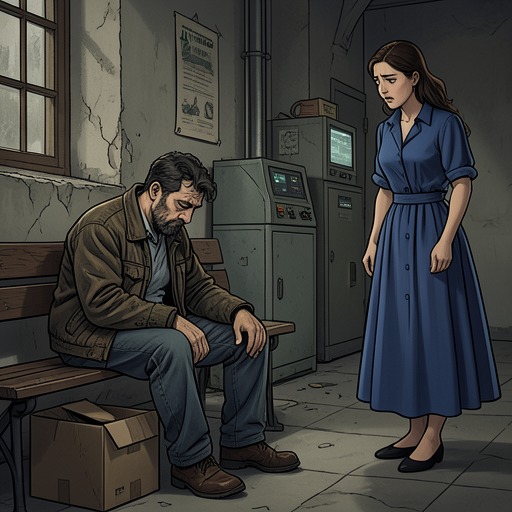
Their friendship also allows Tessa to notice when he is the one struggling. At a meal, Landon sits brooding at the table as Karen carries in a tray of sandwiches. Tessa sits beside him and asks if he is all right. He eventually admits, meekly, that he and Dakota have ended their relationship. The disclosure is brief, but it reverses the usual direction of care: a friend who has repeatedly steadied Tessa is now visibly troubled, and she turns toward him.
Landon’s significance rests on this reciprocity. He encourages Tessa not to abandon Seattle for Hardin, challenges Hardin to make improvement durable, helps care for Richard, and takes part in a consequential intervention; in return, Tessa recognizes and responds to Landon’s own sadness. His steadiness does not make him a figure without private difficulty. Rather, the relationship is more fully drawn because support moves in both directions, even as the available scenes leave the longer course of his breakup with Dakota unresolved.