Mike
After We FellMike is Trish’s fiancé and the man she plans to marry after selling their house and arranging for her son to leave for university. His place in the story is defined less by private disclosures than by the plans and crises that converge around him: he is first introduced through Trish’s exuberant wedding announcement, then appears in person during a violent confrontation that exposes her relationship with Christian. His silence and departure mark the immediate cost of that revelation, while the later insistence that the wedding will go ahead leaves their relationship’s future unresolved.
Identity and Introduction
Mike enters the narrative through a phone call from Trish to Hardin. Trish announces that she and Mike are going to be married, and her excitement contrasts with Hardin’s subdued response. She is disappointed that he is not surprised, but explains that she had been trying to reach him to tell him about the wedding and its timing. The news establishes Mike as Trish’s intended husband before he appears directly in the scene.
The wedding is connected to practical changes in the couple’s life. Mike had thought it would be a good idea to sell the house, and Trish tells Hardin that it has already been sold; the new owners are not due to move in until after the wedding. The couple had initially planned to wait until the following year, but Trish says that neither of them is getting younger and that Mike’s son is going off to university. In her view, there is no better time to marry. She invites Hardin to attend with Tessa, and clarifies with delight that the wedding is only two weeks away. These details make Mike’s engagement part of a larger transition, not merely an announcement: the sale and his son’s departure help set the schedule for the ceremony.
The Confrontation
Mike’s direct appearance comes amid the aftermath of Hardin and Christian’s fight. Trish calls for the fighting to stop, but neither man responds to her attempt to interrupt them. The back door is then pulled open and Mike appears, panicked by what he sees. He moves immediately into the conflict, stepping behind Hardin, taking hold of both his arms, and lifting him away from Christian before pushing him toward a wall. His physical intervention helps separate the two men; Trish pushes Christian against the opposite wall.
Once the immediate violence is interrupted, Mike demands to know what is happening. The scene gives him little dialogue beyond that demand, but his actions establish him as an active participant rather than a distant observer: he enters the disorder, restrains Hardin, and insists on an explanation. The confrontation is also a turning point in what he can see of the people around him. Tessa recognizes that Kimberly, who is planning her wedding with Christian, does not know about his betrayal. Mike, meanwhile, is silent as he looks at Trish’s tearstained face. The narration shows his attention fixed on his fiancée, but does not provide his thoughts or explain what he understands in that moment.
The Broken Engagement and Its Uncertain Future
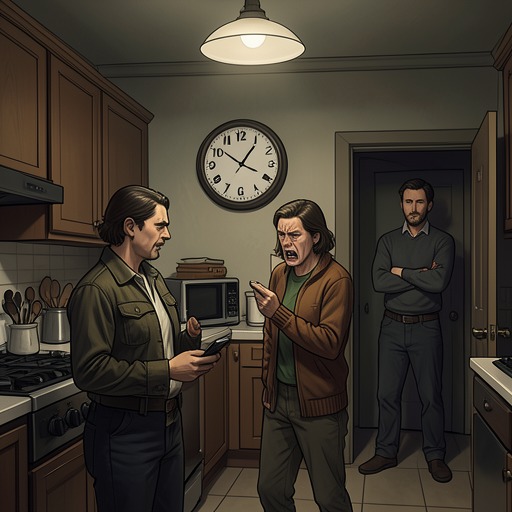
Trish apologizes, saying that what happened was not supposed to happen, but her voice breaks into sobs. Mike shakes his head, rejects the apology without speaking, and walks across the kitchen and out through the back door, slamming it behind him. His departure is the clearest immediate consequence of the revelation: he does not stay to accept Trish’s explanation, and the scene offers no conversation in which the couple negotiates what will happen next. Trish falls to her knees and covers her face as she cries. Christian then kneels beside her and draws her into his arms, while Hardin remains furious and Tessa tries to attend to him.
Mike’s exit does not, however, settle whether the wedding is canceled. Later, Christian tells Tessa that Trish is still getting married and that the ceremony has not been called off. He says that Mike loves Trish and that she loves Mike, and states that they will marry the following day despite his own mistake. This is Christian’s report, not a scene showing Mike’s decision or the wedding itself. The distinction matters: the story establishes an intention to proceed, but does not show how Mike arrives at it or confirm the ceremony’s outcome.
Narrative Role
Mike’s brief appearances frame the contrast between the orderly future Trish describes and the upheaval that follows. The sold house, the approaching university departure, and the wedding date make the engagement seem settled; his sudden arrival during the fight brings that plan into direct contact with Trish’s concealed relationship with Christian. His intervention prevents the confrontation from continuing unchecked, but it cannot undo the betrayal that becomes visible to him.
The narrative keeps Mike’s interior response largely outside the reader’s reach. Rather than giving him a speech or a private account of his feelings, it emphasizes his physical actions, his silence before Trish, and the force of his departure. Christian’s later assurance that the wedding will still happen offers a counterpoint to that exit, but does not resolve the emotional consequences. Mike therefore remains central to the aftermath without becoming its narrator: his engagement makes the betrayal consequential, and his unseen decision about the marriage leaves the promised future uncertain.