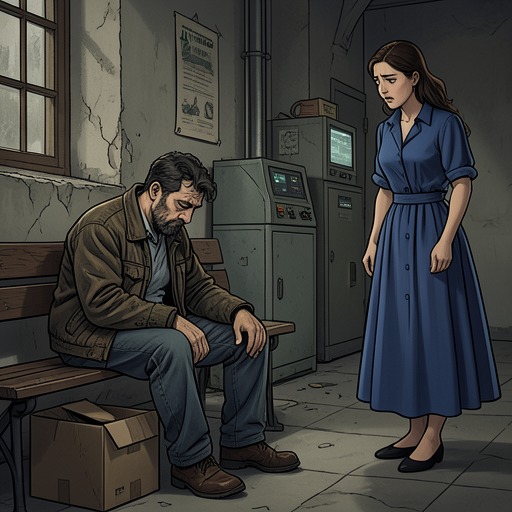
Richard
After We FellRichard’s return makes Tessa’s absent father a presence in her daily life, but not a stable one: he arrives hungry and without a reliable place to stay, and his drinking soon becomes inseparable from the strain he places on her household. His dependence draws Hardin into an uneasy role as both protector and caretaker, culminating in a plan to force Richard to choose rehabilitation or lose access to Tessa.
Identity and Introduction
Richard is Tessa’s father, though the years of absence have left her with little sense of who he is. Hardin’s first encounter with him is awkward and revealing. When Richard reaches out a dirty hand and introduces himself, Hardin identifies himself as Tessa’s boyfriend; Richard takes in Hardin’s appearance and asks what the two of them are doing there. The exchange establishes the relationship’s imbalance: Richard can claim the title of father, but he is a stranger to the life Tessa has built.
At Tessa’s home, Richard eats two plates of food before pausing, a small but concrete sign of how precarious his circumstances have become. He compliments her cooking and calls her “Tessie,” using a familiar endearment that contrasts with Tessa’s limited knowledge of him. Hardin sees the meal through the sharper lens of abandonment and alcoholism: he resents Richard for leaving his daughter and has little patience for his hardship. His hostility shapes the uneasy atmosphere around Richard’s return, even as Richard’s need for food and shelter makes turning him away difficult.
Richard’s presence initially appears temporary. Hardin finds him awake on the couch and reluctantly offers him a ride, explaining to himself that he does not want to leave him alone with Tessa. Later, Richard admits that he has come to the apartment to eat and shower. These visits make the home a refuge for someone without stable shelter, but also bring his needs into the couple’s private space. For Tessa, the renewed contact opens a painful uncertainty: she does not want to believe her father may be using drugs, while Hardin reads signs she is not ready to face.
Suspicion, Exposure, and Violence
The apartment’s apparent break-in turns Richard’s precarious return into a source of suspicion. Tessa notices that the books beside Hardin’s side of the bed have been moved, including a highlighted book she had given him, but nothing seems to have been taken. Hardin abruptly blames Richard, reasoning that he would know when they were away and might enter without stealing. Tessa admits the possibility had occurred to her, yet resists treating it as fact. When Hardin points to Richard’s scratched forearms and the appearance of the man who had come to collect him, she insists that her father is not a drug addict, even as she acknowledges privately that she is unsure. Hardin says Richard broke in; Tessa answers that he does not know that. Their argument exposes the limits of both their certainty: Hardin’s suspicion may fit what he has seen, but his anger makes accusation come before proof, while Tessa is not ready to accept what the evidence might mean.
The accusation also carries an uncomfortable irony. Hardin condemns Richard for drinking, although Tessa knows that Hardin himself can drink until he remembers little the next day. His judgment is entangled with his protective instinct and his contempt for a father who abandoned Tessa, not simply with concern about Richard’s conduct. Tessa’s resistance, meanwhile, is bound up with how little she remembers of her father and how much she still wants to believe that he is not the person Hardin describes.
Richard’s return also reaches Tessa’s mother, Carol, through Hardin’s inadvertent disclosure. Carol says she sometimes blames herself for Tessa attaching herself to Hardin, fearing that Richard’s behavior before he left shaped her daughter’s choice of partners. Hardin rejects the comparison and says Tessa barely knows her father; he then reveals that they have encountered Richard recently. Carol’s composure falters. She asks whether Richard found Tessa, and when Hardin clarifies that Tessa ran into him, Carol asks where. The exchange makes clear that Richard’s disappearance was not a settled family history for Carol: news of his renewed contact is alarming, and Hardin’s attempt to explain instead exposes how much has happened without her knowledge.
The danger becomes immediate when Hardin returns to the apartment and finds Richard slumped there, covered in blood, with movement in the hallway behind him. The man is Chad, who demands money and kicks Richard below the ribs when Hardin refuses to help him. Richard slides to the floor and does not get up. Hardin had dismissed the confrontation as none of his concern, but the assault makes Richard’s vulnerability impossible to treat as a private inconvenience. Richard later tells him that he had come to the apartment before, knowing Tessa had moved out and would not be there. His appearances are not a stable return to family life; they are brief attempts to meet basic needs, set against addiction, danger, and a household already strained by distrust.
Withdrawal, Care, and the Intervention
Richard’s attempt to get sober turns the apartment into a place of close, uncomfortable supervision. Hardin tells Tessa that Richard is trying to stop drinking and that he has thrown away the liquor, refusing to leave him alone there. The explanation reframes Hardin’s role: the man he had treated as an intruder and burden is now someone whose access to alcohol and safety he is actively managing. Even so, Hardin’s care remains blunt and resentful rather than tender. During Richard’s withdrawal, he vomits, shakes, sweats, and whines throughout the day; as Richard apologizes and wipes vomit from his chin, Hardin leans against the doorway and considers walking away. The scene makes sobriety a physical ordeal, while showing how little ease or trust has developed between them.
That care is practical as well as supervisory. After a long drive through freezing rain, Hardin finds Richard sprawled on the couch in his own clothes: cotton pajama pants and a black T-shirt that fit Richard tightly. Richard explains that the one shirt Hardin had given him had retained its smell. Landon is in the kitchen, suggesting that Richard’s needs are being handled collectively rather than by Hardin alone. Yet the exchange also preserves the friction of shared space: Hardin is disgusted by Richard’s presence and clothing, while Richard asks after Tessa as soon as Hardin comes through the door. His attention remains fixed on his daughter even as he depends on others for shelter and basic care.
The prospect of leaving Richard alone unsettles Tessa when she and Hardin are preparing to be away for three days. She recalls that Landon watched him during an earlier absence and asks what her father will do this time. Hardin assures her he will be fine, but his confidence is not the same as a solution; the question exposes how their lives have become organized around monitoring Richard’s recovery. A residential rehabilitation placement has been considered, but Tessa objects that it costs too much and that Ken should not have to pay for her father. Her reluctance also reflects uncertainty about whether Richard is addicted, a possibility she has resisted even after Hardin named it.
Hardin decides that concern cannot remain a private worry or an informal arrangement in the apartment. After spending hours punching and kicking a gym bag while thinking through the problem, he settles on rehabilitation as the condition for Richard’s continued place in Tessa’s life. He accepts Ken’s offer to fund treatment despite feeling uncomfortable that his father will be the one helping Tessa, and sends Landon to deliver the intervention rather than confronting Richard himself. Hardin believes Landon is less likely to make the meeting violent; he also knows Tessa has not been included in the plan and feels guilty about that secrecy. The ultimatum is stark: Richard must enter rehab or lose contact with Tessa. Hardin frames it as a way to keep Richard’s addiction from burdening her, while admitting to himself that he already causes her enough stress. The intervention therefore joins protection to control: it offers Richard a route toward treatment, but makes access to his daughter depend on accepting Hardin’s terms.
An Unsettled Outcome
Richard’s recovery remains unresolved at the point where the narrative leaves him: Hardin plans to call Landon after they land to learn how the intervention went, but the account does not establish whether Richard accepts treatment. The uncertainty is sharpened by the gap between what Tessa believes and what Hardin has arranged. She says she is glad they declined Ken’s offer, while Hardin’s private account makes clear that he has accepted the possibility of Ken paying and sent Landon to present the choice. Richard’s future therefore hinges not only on whether he enters rehabilitation, but on a decision being made around him and concealed from his daughter. The episode leaves his return to Tessa’s life conditional rather than secure: the prospect of help is real, but neither his response nor the family’s reckoning with Hardin’s secrecy is yet known.