Tessa and Hardin's Apartment
After We FellTessa and Hardin's Apartment becomes more than a shared address when Tessa brings her father, Richard, inside. Its living room, kitchen table, and ordinary routines turn into a difficult negotiation over hospitality: Tessa sees a man in need whom she can invite into her home, while Hardin is uncomfortable with the decision and fears leaving her alone with him. The apartment's significance lies in that tension between domestic welcome and guarded intimacy, sharpened by the question of whether it belongs to both partners or, in a moment of strain, to Hardin alone.
Shared home and contested belonging
The apartment is presented as a place Tessa and Hardin have made together. Richard learns that they moved in a few months earlier when their car reaches the apartment complex, and Tessa later insists that she has as much right as Hardin to decide who comes over. Her claim makes hospitality a question of agency as well as kindness: she is not asking merely for permission to offer dinner, but asserting that the shared home is hers to use too. Hardin's visible frustration, expressed through the familiar gesture of running his fingers through his hair, shows that the decision unsettles him even before Richard enters the apartment.
The narration also registers how quickly a shared address can become a fault line. After a drive during which Hardin complains about the Seattle conflict and Tessa's call to Zed, he asks whether her father is still there. In his own narration, he catches himself referring to the place first as their apartment and then as his. That small correction does not settle the question of ownership; it exposes how emotionally unstable the idea of a shared home has become. Tessa's claim that it is her place too and Hardin's possessive slip coexist, making the apartment a concrete setting for disagreement over whose wishes govern their life together.
Richard's arrival and the offer of shelter
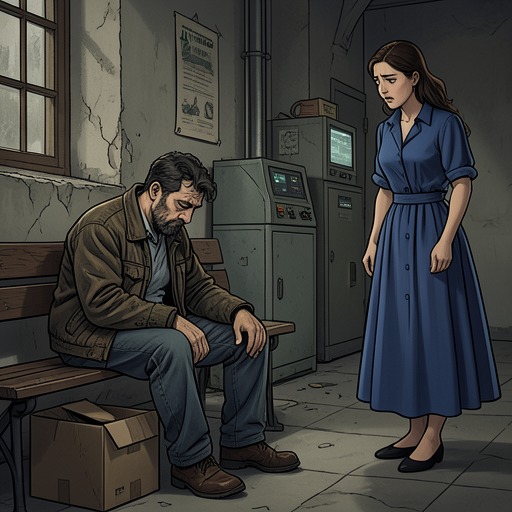
Richard arrives in visibly poor condition: his clothes are dirty, and Tessa wonders when he last slept in a bed or had a meal. The apartment offers an immediate contrast to that uncertainty. Rather than leave him outside, Tessa asks Hardin to let her hear him out and proposes bringing him home for the evening so they can make dinner. When Richard looks up and meets her eyes, she looks away as he starts to smile; the moment records both the possibility of renewed connection and her discomfort at the situation. The home is not presented as an effortless refuge: inviting him in means confronting the distance between father and daughter at close quarters.
The journey there extends that unease into the apartment's threshold. Richard gapes at the complex when they arrive, while Hardin gives Tessa a subtle look that anticipates trouble. In the elevator, Hardin watches her protectively; she answers with a small smile in the hope of softening him. Yet being in their home area with someone she experiences as a virtual stranger makes her regret the invitation. The sequence makes entry feel consequential: the private space they share with one another is now being entered by a parent whose presence Tessa herself finds awkward, and the decision cannot simply be withdrawn once they reach the door.
Rooms, routines, and uneasy care
Inside, Richard appears out of place as he looks around at the apartment and notices the books on the shelves. Those books quietly mark the space as a lived-in home with its own habits and objects, rather than a neutral place to put him for the night. Tessa offers to make dinner and suggests he watch television; Richard asks whether he can help. Their exchange gives the visit a practical, domestic shape. Care is expressed through food and an invitation to participate, but the hesitation in the offers also keeps the emotional difficulty visible.
Hardin's resistance remains present within these routines. He has already worried about Richard coming home with them, and after speaking with Tessa he apologizes for making her cry, says he will try not to be so difficult, and kisses the corner of her mouth. As they leave their bedroom, however, he refers to Richard dismissively as someone they must feed. The movement from bedroom to living room thus carries the couple's conflict into the same space where their guest is waiting. The apartment allows an outward gesture of reconciliation between Tessa and Hardin, but it does not make Hardin's resentment disappear.
A temporary domestic arrangement
At dinner, Richard stands and says he can leave, thanking Tessa for the meal. Tessa instead offers to let him stay that night and says they can take him back home in the morning, choosing her words slowly because she is unsure how to describe his circumstances. Richard accepts, rubbing his arms. The offer is deliberately limited to one night; it establishes a short-term act of care without claiming that the larger family situation has been repaired. Hardin's dislike of the arrangement remains explicit, so the apartment's hospitality is an accommodation Tessa has chosen despite their disagreement, not a resolution they have reached together.
The rooms recur as the visit continues. Hardin later finds Richard awake on the couch, arms crossed as he stares blankly out the window, and asks whether he needs a ride somewhere. He says he is not pleased about taking Richard anywhere but hates the thought of leaving him alone with Tessa even more. Later, Tessa emerges from the bathroom to find Hardin and Richard seated at the kitchen table; Hardin complains that he is wasting away, and Richard sheepishly says he could eat. The couch and table register the visit through ordinary, repeated acts of waiting and feeding. In this way, the apartment holds together two unsettled relationships at once: Tessa's attempt to care for her father and Hardin's uneasy participation in a home whose boundaries Tessa has insisted she can help define.