
The Carrier Enters the Black Sea
AfterburnThis flow traces the carrier group's passage into a confined and politically volatile sea, where a peacekeeping mission rapidly becomes a military trap.
increasing Bearing strength in each event
 decreasing
Bearing strength in each eventdecreasingA Fleet in Decline
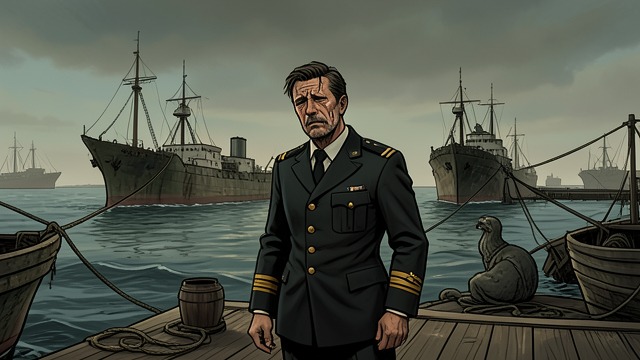
A Fleet in Decline
A weakened defense
Nikolai Sergeivich Dmitriev surveys the reduced strength of the Russian Black Sea Fleet and recognizes that the old balance of power has collapsed. Its ships and crews are too depleted to challenge a U.S. carrier group directly.
A symbolic arrival
The American passage is therefore more than a tactical event: it is visible proof that waters once dominated by Russia are no longer secure from foreign power. Dmitriev restrains his anger because Ukraine presents the more immediate danger.
A Narrow Passage
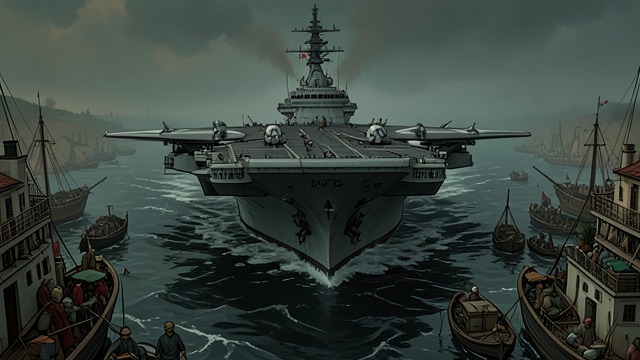
A Narrow Passage
The carrier threads through
Matthew Magruder watches the Thomas Jefferson move through the Bosporus Strait, grounded aircraft leaving the ship unusually dependent on its escorts and sensors. The crowded channel makes the carrier feel exposed despite its size.
Doubts follow the ship
The transit makes the deployment's political risks tangible. Turkey has allowed passage but withheld broader cooperation, while the crew cannot know whether the uneasy truce will hold once they enter the Black Sea.
A Sea Without Depth
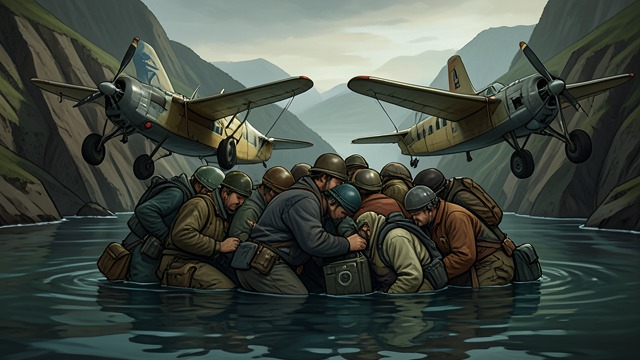
A Sea Without Depth
Defenses draw inward
Once the carrier enters the Black Sea, the group resumes flight operations and arranges its ships and aircraft around a compressed defensive perimeter. The confined geography denies it the oceanic room normally used to detect and intercept threats.
Supply becomes a weakness
Magruder recognizes that fuel and replenishment must pass through the same narrow straits. The route that admitted the group could also be blocked, leaving its aircraft and escorts with a finite operational life.
The Mission Expands
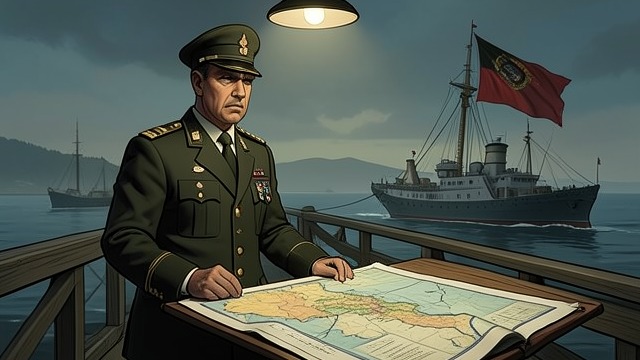
The Mission Expands
A new assignment
Washington redirects the carrier group from its Georgia-centered mission toward the proposed transfer of Crimea to United Nations control. The force is now expected to back a political arrangement whose security guarantees exceed ordinary relief operations.
Command changes hands
Rear Admiral Douglas E. Tarrant explains that operational authority will pass to a United Nations envoy. The change alarms officers who must obey orders even as they doubt the command structure and the mission's strategic logic.
A Carrier in the Pocket
A Carrier in the Pocket
Passage is cut
Attacks on the Bosporus Bridge and the Falcon Patriot tanker leave the carrier group trapped without dependable fuel resupply. Russian probes and air attacks force it to keep flying just when its reserves matter most.
Escape requires action
The group ultimately secures fuel at Arsincevo and helps open a route for people ashore. Its return through the straits becomes possible only after the fighting and emergency clearance operations change the situation.
Before the carrier enters the straits
Friday, October 30, in the Bosporus Strait
Friday, October 30, after the carrier clears Turkish waters
Tuesday, November 3, before the transfer ceremony
By the evacuation and the Battle of Kerch
