
Dmitriev's Defeat and Asylum
AfterburnThis flow traces Dmitriev's evolution from a proud but constrained fleet commander to the defeated opponent who seeks refuge aboard an American carrier.
increasing Bearing strength in each event
 decreasing
Bearing strength in each eventdecreasingA Realist in Command
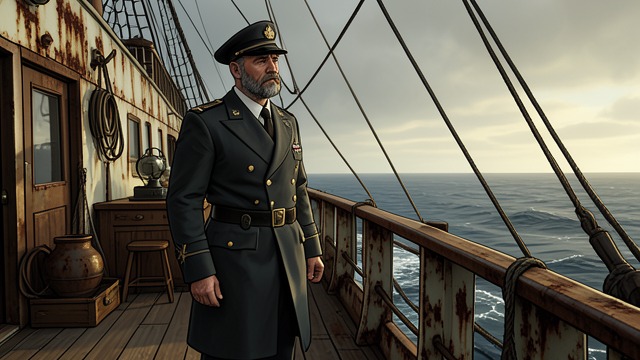
A Realist in Command
Pride meets weakness
Nikolai Sergeivich Dmitriev resents the American presence but knows his depleted fleet cannot safely challenge the carrier group. He judges that preserving what remains may matter more than a symbolic attack.
The homeland unravels
He sees the Russian state breaking apart and worries that the struggle over Crimea will draw in Ukraine. His sense of duty is shaped by a nation whose institutions no longer reliably support its military.
Refusing the Handover

Refusing the Handover
A challenge to authority
Dmitriev hears Boychenko's proposal to transfer the district to the United Nations as an abandonment of Russian duty. He frames the plan as treason and begins organizing resistance.
A personal calculation
His decision also responds to command loyalty, military pride, and the prospect of losing influence. He believes his forces can change the political outcome even though he recognizes their weakness.
The Admiral Takes Power

The Admiral Takes Power
Boychenko is branded a traitor
Dmitriev announces that he has assumed command and claims the Americans have been neutralized. His public declaration attempts to turn uncertain control into an authoritative fact.
Power needs force
His claim is challenged by Boychenko's supporters and by the American presence at sea. The coup begins an armed contest whose outcome cannot be secured by statements or intimidation alone.
The Carrier's Fuel Defeat

The Carrier's Fuel Defeat
Dmitriev sees an opening
Dmitriev expects American aircraft operations to exhaust the carrier's remaining aviation fuel. He believes the blocked straits and repeated engagements have left the enemy vulnerable near Kerch.
An assumption proves costly
He does not know that the carrier has secured fuel at Arsincevo. His planned attack is based on an outdated picture of American capabilities, even as the force he is targeting restores its mobility.
Asylum on the Jefferson
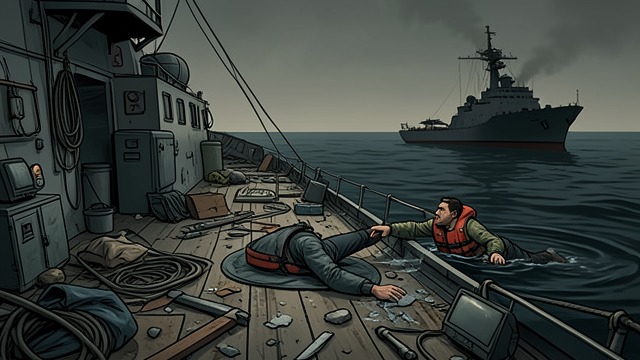
Asylum on the Jefferson
His final sortie fails
The Pobedonosnyy Rodina is destroyed by missiles launched from Orlando, ending Dmitriev's attempt to force the carrier group to surrender. His fleet is no longer capable of determining the outcome in Crimea.
The former enemy becomes a survivor
Dmitriev is rescued from the sea and requests asylum aboard the Jefferson. His return to the ship where he once saw American power as an insult makes the ending personally and politically circular.
Friday, October 30, before the American entry
Friday, October 30, after Boychenko's proposal
Thursday, November 5, after the Yalta ceremony is attacked
Saturday, November 7, before Dmitriev orders the sortie
Near the ending, after the carrier engages the Russian fleet
