
Terrorism, Tatar Claims, and the Ambiguous Assassins
AfterburnThis flow follows the competing interpretations of the assassination attempt and the political grievances that make its authors difficult to identify.
increasing Bearing strength in each event
 decreasing
Bearing strength in each eventdecreasingThe Tatar Question
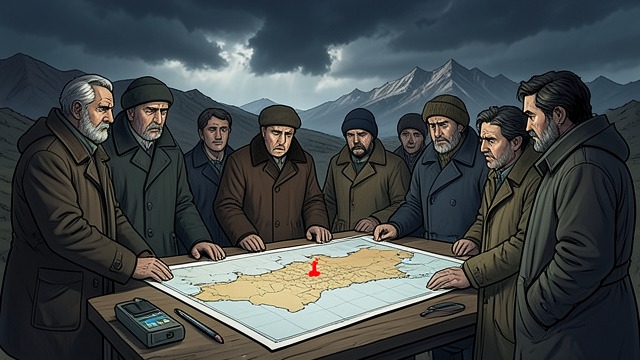
The Tatar Question
A displaced community returns
Crimean Tatars have a history of forced exile and return, and some demand autonomy or an independent homeland. Their claims complicate the already contested future of Crimea.
Grievances create suspicion
The community's political demands make it a plausible scapegoat when violence occurs. Yet the existence of grievance does not establish responsibility for a particular attack.
An Attack at the Ceremony

An Attack at the Ceremony
Gunmen approach the stage
Several men emerge from the crowd with concealed weapons and fire at the officials. Magruder protects Boychenko, while guards return fire and the ceremony collapses into panic.
The target list is unclear
The attackers strike multiple people, not only the general. Their methods and timing create immediate uncertainty about whether the goal is assassination, disruption, or a prelude to a larger operation.
Abdulhalik Names a Suspect
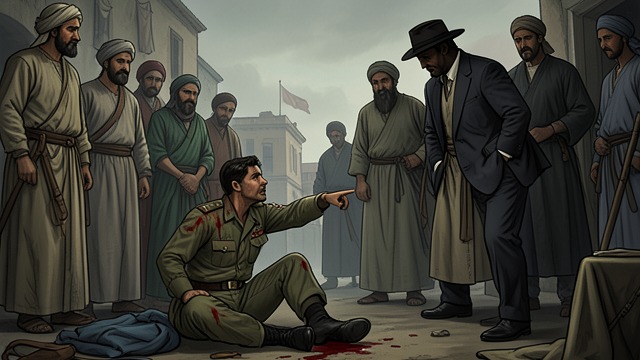
Abdulhalik Names a Suspect
A quick attribution
Wounded security officer Abdulhalik tells Magruder that Tatars may be responsible. He cites the existence of radical independence groups and the community's claim to Crimea.
Magruder doubts the motive
Magruder questions what Tatar militants would gain by killing Boychenko, whose removal could strengthen forces opposed to them. His skepticism preserves uncertainty rather than accepting the first available explanation.
Violence Creates a Pretext
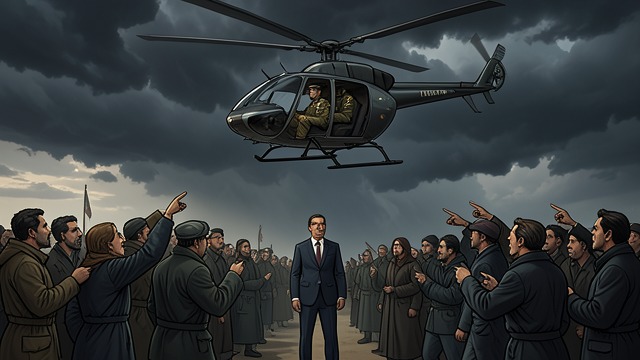
Violence Creates a Pretext
A surviving target changes the outcome
Because Boychenko lives, the attack does not immediately remove the leader of the proposed handover. The subsequent air strike on the helicopter further prevents his escape to the carrier.
Attribution becomes political
Dmitriev's forces can portray Boychenko as a traitor regardless of who ordered the attack. In the confusion, the assassination attempt serves several political narratives without conclusively identifying its sponsor.
No Certainty After the Shooting
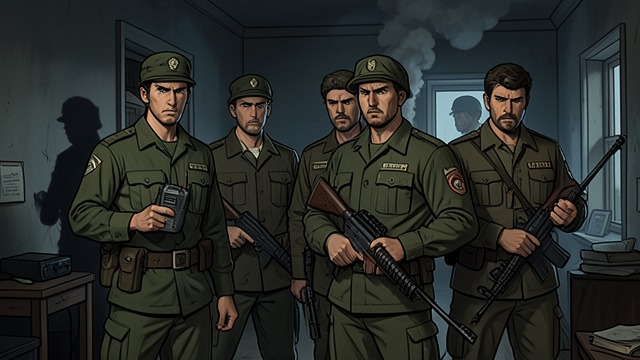
No Certainty After the Shooting
The investigation is overtaken
Magruder must focus on keeping the party safe and communicating with the carrier group, not on discovering who planned the attack. The immediate military crisis overtakes the question of culpability.
Suspicion remains unresolved
The narrative connects the attack to Dmitriev's effort to stop Boychenko but does not provide a courtroom-style resolution of every participant's role. Political violence remains powerful partly because uncertainty itself can be exploited.
Before the assassination, as the delegation arrives in Crimea
Thursday, November 5, during Boychenko's speech
Thursday, November 5, immediately after the shooting
After the assassin fails to kill Boychenko
By the time the shore party leaves Yalta
