Duchess
Alice's Adventures in WonderlandThe Duchess is one of Wonderland's most unstable and contradictory figures, a noblewoman whose household runs on violence and pepper, and whose conversation lurches between savage threats and saccharine moralizing. She embodies the arbitrary, rule-bound absurdity of Wonderland's social order, shifting from a terrifying harridan to a clingy philosopher in the space of a few chapters, and her trajectory—from kitchen tyrant to condemned prisoner to pardoned companion—mirrors the capriciousness of power in the Queen of Hearts' domain.
Identity and Introduction
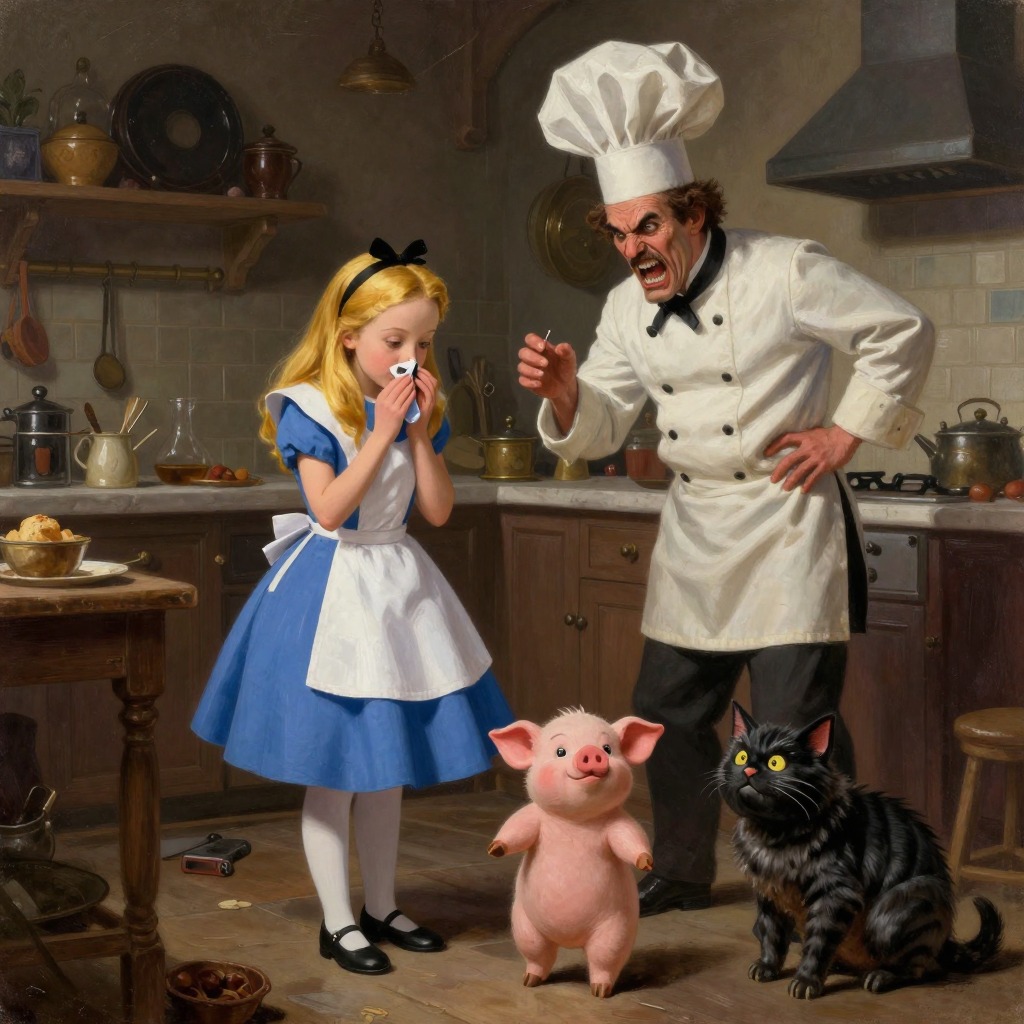
The Duchess first appears in her own kitchen, a space so saturated with pepper that everyone except the cook and a grinning cat is sneezing uncontrollably. She sits on a three-legged stool in the middle of the room, nursing a baby that howls and sneezes without pause, while the cook hurls fire-irons, saucepans, plates, and dishes at both mother and child with complete impunity. The Duchess takes no notice of the bombardment, even when hit, and when Alice asks why her cat grins, the Duchess answers "It's a Cheshire cat, and that's why. Pig!"—the last word addressed not to Alice but to the baby, delivered with such sudden violence that Alice jumps. When Alice tries to demonstrate her knowledge of the earth's rotation, the Duchess responds by shouting "chop off her head!" to the cook, though the cook ignores her. She then nurses the child while singing a lullaby that instructs the listener to "Speak roughly to your little boy, And beat him when he sneezes," punctuating each line with a violent shake. The kitchen is a scene of domestic terror, and the Duchess is its undisputed, unhinged sovereign.
Arc Through the Plot
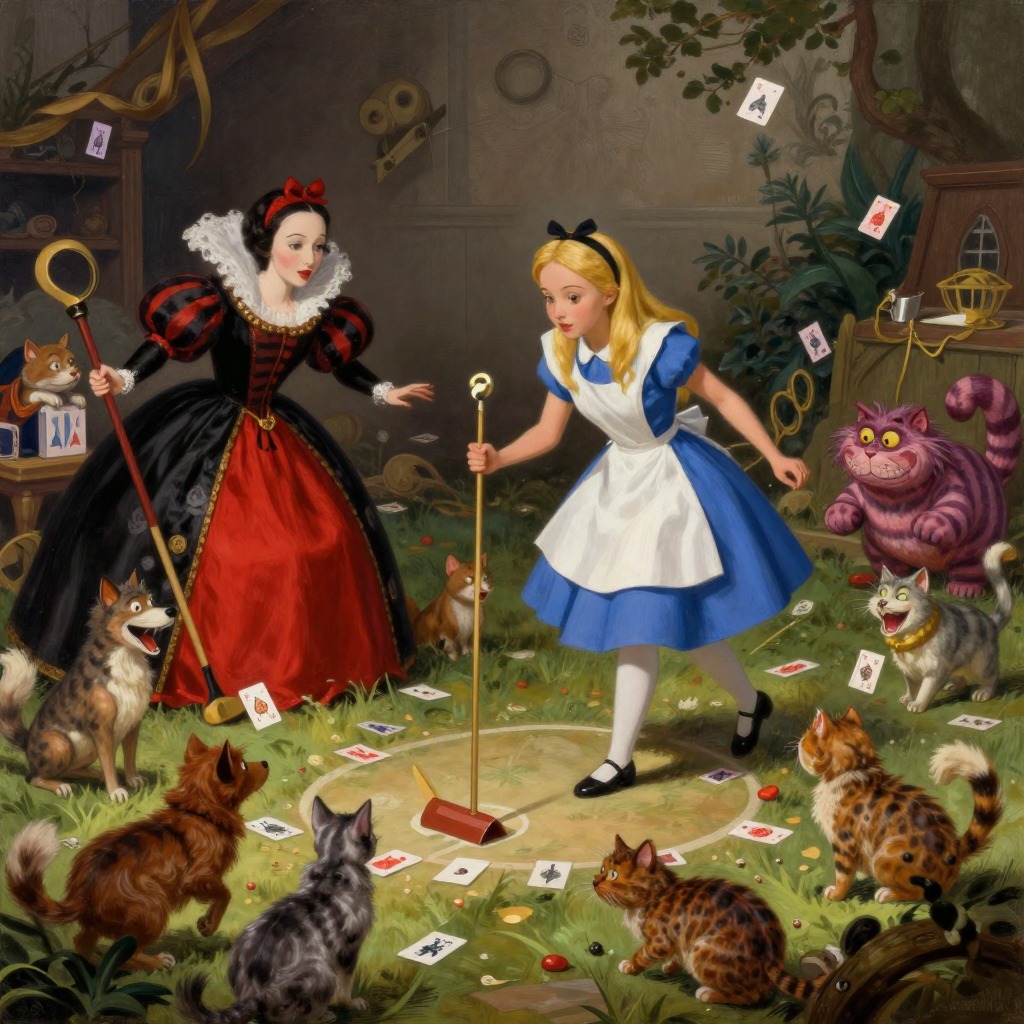
The Duchess's role changes dramatically after her first appearance. She is next mentioned by the White Rabbit, who whispers to Alice that the Duchess is "under sentence of execution" for boxing the Queen of Hearts' ears—a revelation that makes Alice laugh aloud. When the Cheshire Cat's head appears in the croquet-ground and a dispute arises over whether it can be beheaded without a body, Alice suggests consulting the Duchess, who is in prison. The Queen orders her fetched, but by the time the executioner returns with her, the Cat's head has vanished entirely. When the Duchess finally reappears, she is transformed: she tucks her arm affectionately into Alice's and walks off with her, speaking in a pleasant temper. Alice attributes the earlier savagery to the pepper in the kitchen, resolving never to have pepper in her own kitchen when she becomes a Duchess. The Duchess now finds a moral in everything, squeezing uncomfortably close to Alice and digging her sharp chin into Alice's shoulder while delivering aphorisms: "Everything's got a moral, if only you can find it," and "'Oh, 'tis love, 'tis love, that makes the world go round!" When Alice quotes the cook's earlier remark about minding one's own business, the Duchess equates it with love and produces another moral. She engages in a long, increasingly nonsensical exchange about mustard, minerals, and vegetables, each time extracting a moral—"Birds of a feather flock together," "The more there is of mine, the less there is of yours," and the famously convoluted "Never imagine yourself not to be otherwise than what it might appear to others that what you were or might have been was not otherwise than what you had been would have appeared to them to be otherwise." This garrulous, moralizing phase is abruptly cut short when the Queen of Hearts appears, arms folded, frowning like a thunderstorm. The Queen gives the Duchess a choice: "either you or your head must be off, and that in about half no time!" The Duchess takes her choice and vanishes instantly.
Relationships and Conflict
The Duchess's primary relationship is with the Queen of Hearts, whose authority she has directly challenged by boxing the Queen's ears—an act that earns her a death sentence. The Queen's power over her is absolute: the Duchess trembles and speaks in a low, weak voice when the Queen appears, and she flees without a word when given the choice between exile and execution. Her relationship with Alice is a study in contrast: in the kitchen she is violent and dismissive, ordering Alice to nurse the baby and then flinging it at her; later, she is cloyingly affectionate, linking arms and pressing her sharp chin into Alice's shoulder while delivering unsolicited morals. Alice finds her physically unpleasant—the Duchess is very ugly, and her chin is uncomfortably sharp—but bears it to avoid rudeness. The Duchess's household is defined by conflict: the cook throws everything within reach at her, and she responds with indifference, while the baby is subjected to violent shaking and neglect. The Cheshire Cat, which grins from the hearth, is the only creature in the kitchen that does not sneeze, and the Duchess identifies it as a Cheshire cat as if that explains everything.
Change and Ending
The Duchess undergoes a remarkable transformation between her two appearances. In the kitchen, she is a figure of chaotic violence, shouting for beheadings and shaking a baby while singing about beating it. After her imprisonment and pardon, she becomes a figure of cloying sentimentality, obsessed with extracting morals from every observation and clinging to Alice with uncomfortable intimacy. This shift is not a genuine character development but a survival strategy: she is under sentence of execution, and her fawning behavior may be an attempt to ingratiate herself with anyone who might help. The Queen's sudden appearance and ultimatum reveal the fragility of the Duchess's position; she disappears from the narrative immediately, her fate left uncertain. Alice later hears the King pardon everyone, but the Duchess is not mentioned again. Her final legacy is the baby she abandoned, which Alice carries out of the kitchen and which gradually transforms into a pig—a metamorphosis the Duchess herself might have foreseen, given her habit of calling the child "Pig!"
Thematic Significance
The Duchess embodies the arbitrary and performative nature of authority in Wonderland. Her kitchen is a microcosm of the Queen's court: violence is routine, rules are invented on the spot, and those in power are immune to consequences. Her obsession with morals parodies the Victorian didacticism that Alice herself has internalized, reducing every event to a lesson while ignoring the actual suffering around her. The pepper that makes everyone savage is a literal and metaphorical seasoning of the social order—remove it, and the Duchess becomes sweet, but no less absurd. Her transformation from violent to sentimental suggests that in Wonderland, personality is not a fixed essence but a response to power: the same woman who shouts "chop off her head!" in the kitchen will, under threat of execution, find a moral in everything and cling to a child for protection. The baby's transformation into a pig, which the Duchess herself seems to anticipate by calling it "Pig!" from the start, reinforces the theme that identity in Wonderland is unstable and that the labels adults impose on children may be more accurate than they intend.