Hatter's watch
Alice's Adventures in WonderlandThe Hatter's watch is one of the most revealing objects in Wonderland, a timepiece that has been broken not by mechanical failure but by a personal quarrel with Time personified. It does not tell the hour of the day, only the date of the month, and it is stuck forever at six o'clock—the direct consequence of the Hatter's disastrous performance at a concert given by the Queen of Hearts. The watch is thus both the cause and the symbol of the Mad Tea-Party's endless, unchanging tea-time, and it gives material form to the Hatter's melancholy, his exile from the normal flow of time, and the peculiar logic of Wonderland itself.
Appearance and Peculiarity
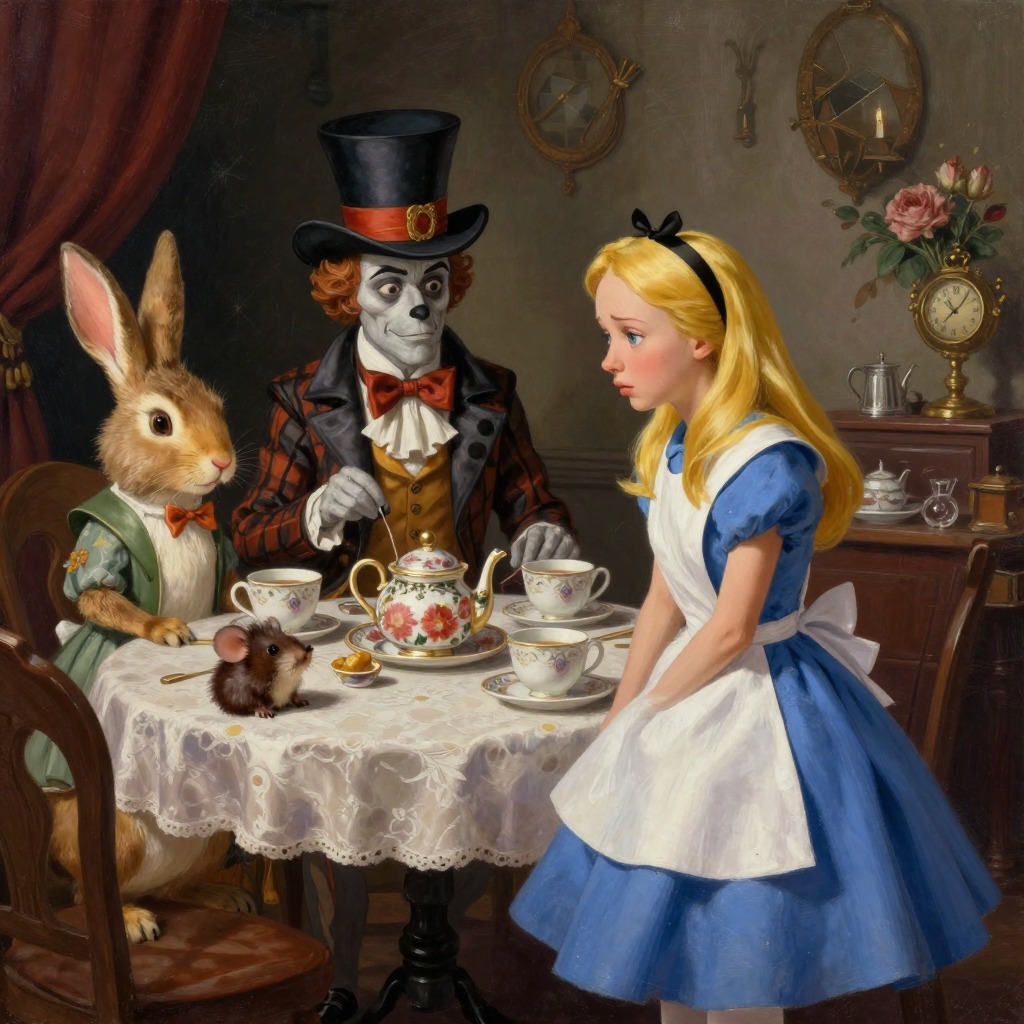
The watch first appears at the Mad Tea-Party, when the Hatter takes it out of his pocket and looks at it uneasily, shaking it every now and then and holding it to his ear. When Alice asks what day of the month it is, she answers "The fourth," and the Hatter sighs, "Two days wrong!" He then angrily accuses the March Hare of having put butter into the works—"the best butter," the March Hare meekly replies—and grumbles that crumbs must have got in as well because the butter was put in with a bread-knife. The March Hare takes the watch, dips it into his cup of tea, and looks at it again, but can offer no better defense than repeating that it was the best butter. Alice, looking over his shoulder, remarks that it is a funny watch because it tells the day of the month and does not tell what o'clock it is. The Hatter retorts by asking whether her watch tells her what year it is, and when Alice says no, because the year stays the same for such a long time together, the Hatter replies, "Which is just the case with mine." The watch thus operates on a logic that inverts the ordinary function of a timepiece: it measures the calendar but not the hours, and it is perfectly consistent within its own absurd frame of reference.
Cause: The Quarrel with Time
The Hatter explains the watch's condition during the tea-party. He tells Alice that he and Time quarreled last March—just before the March Hare went mad—at the great concert given by the Queen of Hearts. The Hatter had to sing "Twinkle, twinkle, little bat!" and had hardly finished the first verse when the Queen jumped up and bawled out, "He's murdering the time! Off with his head!" Since that moment, the Hatter says mournfully, Time "won't do a thing I ask! It's always six o'clock now." The watch is therefore not merely broken but cursed: it is frozen at the hour of the Queen's wrath, and the Hatter's relationship with Time has been severed by a royal decree of execution that he only narrowly escaped. The watch's stoppage is a narrative consequence of the Hatter's transgression against the Queen's aesthetic standards, and it traps him in a perpetual present where he can never move forward to a new hour.
Consequence: The Eternal Tea-Time
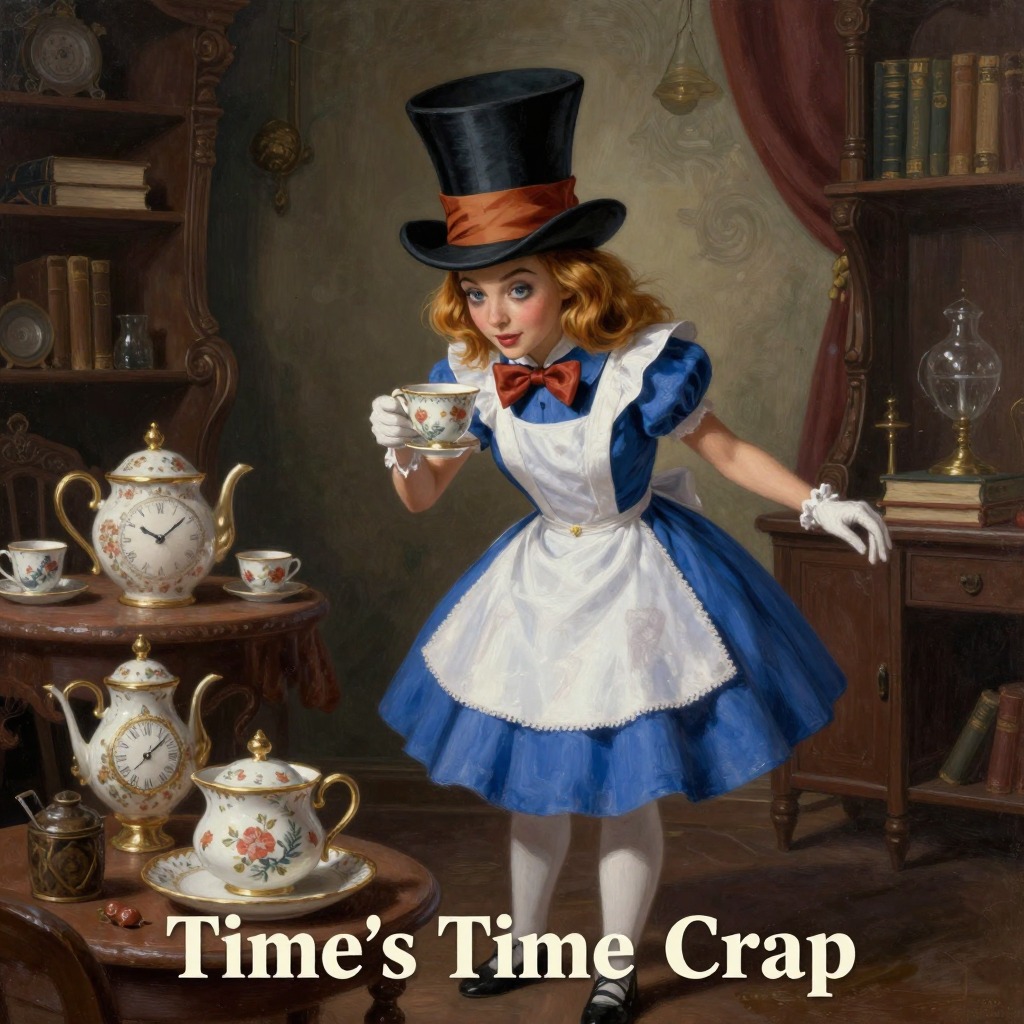
The watch's permanent six o'clock directly creates the Mad Tea-Party's central ritual. Alice asks whether that is the reason so many tea-things are put out, and the Hatter confirms it: "it's always tea-time, and we've no time to wash the things between whiles." The party therefore keeps moving round the table as the things get used up, perpetually washing nothing and drinking tea that never ends. The watch thus governs the entire social arrangement of the tea-party: the Hatter, the March Hare, and the Dormouse are condemned to an endless meal because the watch cannot advance to any other hour. When Alice asks what happens when they come to the beginning again, the March Hare interrupts and changes the subject, suggesting that the cycle has no logical termination—it simply repeats forever, like the watch's frozen minute hand.
Narrative and Thematic Significance
The Hatter's watch is a key object in the novel's exploration of time, madness, and authority. It literalizes the idea that time is a person who can be offended, and that a broken relationship with him produces a broken world. The watch's refusal to tell the hour mirrors the Hatter's own arrested life: he is a man who cannot finish his tea, who is summoned to court still holding his teacup and bread-and-butter, and who lives in a state of perpetual anxiety about the Queen's wrath. The watch also serves as a comic device that exposes the absurdity of Wonderland's logic—the Hatter's explanation is perfectly coherent within its own premises, yet it produces a world where tea never ends and washing never happens. Finally, the watch's frozen time contrasts with Alice's own fluctuating size and her growing impatience with the tea-party's endlessness, highlighting her role as the only character who still measures time by ordinary standards and who eventually walks away in disgust. The watch remains behind, ticking only the date, stuck at six, a monument to the Hatter's one disastrous song.